

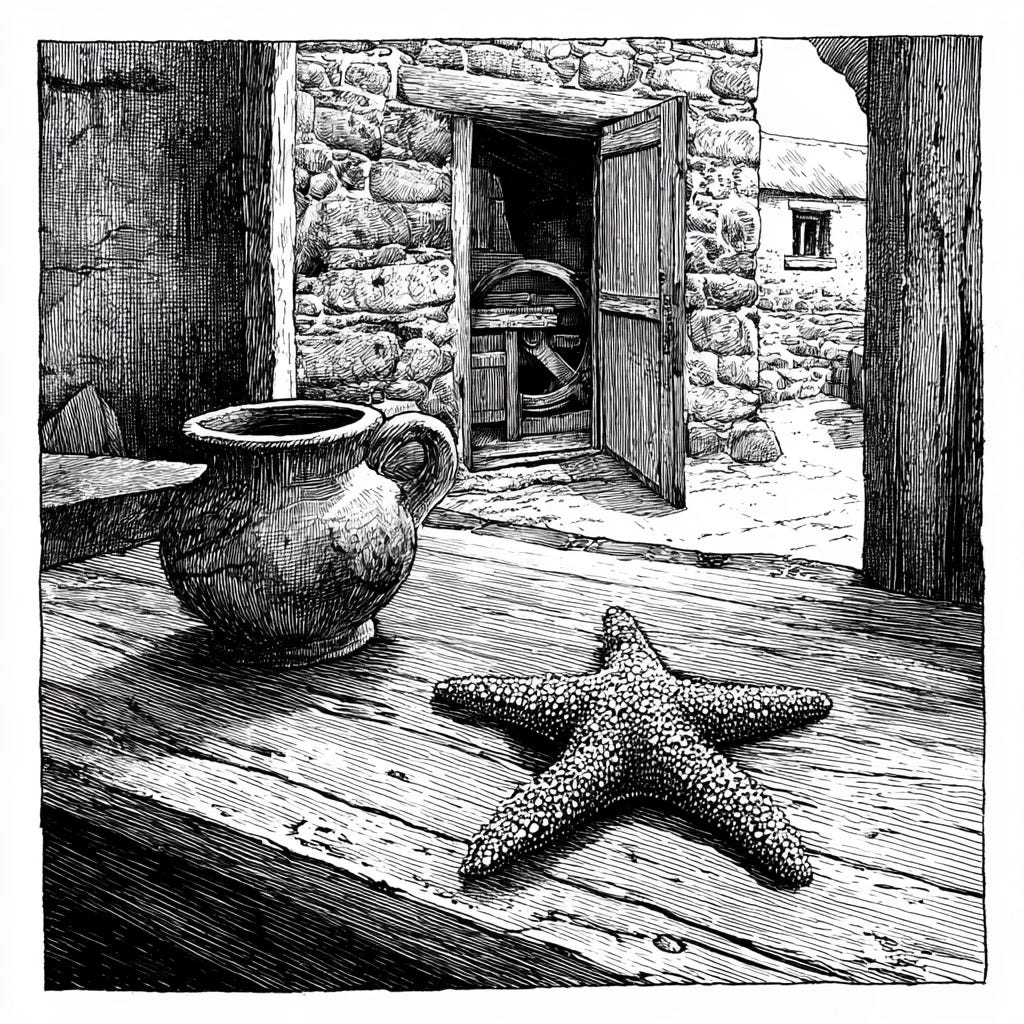
This is a thought experiment, not a business plan; please bear with me.
Denby Pottery has been in administration since February. I have written about it already, and I find I keep returning to it, less because I think anything can now be saved in its existing form, but because the failure itself is as instructive as it is a tragedy. It tells us something about the kind of organisation that cannot survive a particular combination of pressures, and that understanding is worth sitting with.
Denby faced two things at once: energy costs that had become structurally punishing, and a financing model that had been extracting value rather than building it. Those two pressures are not unrelated; they belong to the same logic, and that logic, it turns out, was always fragile.
Ori Brafman and Rod Beckstrom published The Starfish and the Spider twenty years ago, drawing on lessons from the failure of the sophistication of the US Army to deal with the asymmetric warfare of Al Qaeda. How time flies.
The central distinction, as a metaphor, is simple and devastating. Cut off a spider’s head, and it dies. Sever a starfish limb, and the limb regenerates into a new starfish. Spider organisations are centralised: power, knowledge, and function all flow through a single point, and when that point fails, everything fails. Starfish organisations are decentralised: each node carries enough of the whole to survive and reproduce independently.
Denby, as it existed, was a spider. The great continuous kilns at the heart of the operation required constant fuel and constant throughput to justify their economics. That throughput requirement drove volume production, which drove the logic of brand extension and licensing, which invited the kind of financing that prioritises extraction over craft. Each step followed from the last. The spider structure was not an accident; it was the shape that the energy economics and the logic of profit maximisation demanded.
Those economics have changed. Industrial gas prices are not returning to where they were, and we don’t know where they are headed. The large continuous kiln, which once made industrial sense, now looks like a liability dressed as an asset, and the financing model that attached itself to the asset base has accelerated the collapse rather than cushioned it.
So here is the thought experiment. What would a starfish Denby look like?
Imagine a loose constellation of small independent workshops, each run by a skilled potter or a small team of potters, scattered across the area around Denby in Derbyshire. Each workshop has its own modest kiln, electric or small wood-fired, scaled to the work in hand rather than to the demands of volume production. Each workshop is self-governing, financially independent, and makes its own decisions about what to make and how to sell it.
What connects them is not a corporate structure but a set of shared roots. The Derbyshire stoneware clay, which has been dug from this ground since 1809, is their common material. The knowledge of how to work it, built up across generations of Denby craftspeople, is their common inheritance. The place itself, and the history embedded in it, is their shared identity.
This is not a franchise, nor a collective. It is closer to what Brafman calls a circle: an autonomous, self-governing group that participates voluntarily in something larger than itself without surrendering its independence to do so. The connection is real, but it carries no obligation to conform.
In this imagined constellation, a potter might specialise in tableware thrown to the old Denby weight and proportion. Another might work with the local clay in a more contemporary idiom. A third might focus entirely on the kind of bespoke, small-batch work that the industrial model could never accommodate. They would know each other, share knowledge freely, and perhaps share kiln time when it made sense to do so. None of them would own the others. None of them would be in a position to extract value from the others.
The brand, in the conventional sense, might be dispersed or dissolved. But something more durable would remain: a genuine provenance. Made here, from this clay, by these hands, in this tradition. That is harder to fake and harder to license away than a trademark.
There is a deeper point here about the relationship between energy, scale, and craft.
The large kiln requires large throughput. Large throughput requires standardisation. Standardisation is the enemy of the workmanship of risk, which David Pye identified as the irreducible core of genuine craft: the live, responsive attention that cannot be delegated to a template. When the economics of production demand that risk be eliminated, craft retreats to the margins of the operation, tolerated as a quality signal but no longer structurally central to what is made.
Small kilns change this. The energy cost of firing a small electric kiln is manageable for an individual practitioner. It scales to the work, rather than the work scaling to it. The economics no longer demand standardisation, and the workmanship of risk returns to the centre.
This is not sentimentality about small-scale production. It is an observation about what the current energy environment actually makes possible, and what it makes prohibitive. The extractive financing model and the large continuous kiln belong to the same moment in industrial history. That moment is passing.
I have been following the work of Louis Elton, whose Nation of Artisans project has been doing something important and underappreciated. He has been travelling across Britain, documenting the shoemakers of Northamptonshire, the luthiers of Dorset, and the gansey knitters of Yorkshire. Visiting surviving pockets of skilled making and recording what they know and how they work. He has recently launched the British Cræft Prize, looking for what he calls maverick and misfit makers who can draw on the deep knowledge embedded in heritage craft and bring it into genuine conversation with new technologies and contemporary conditions.
There is something significant in that framing. Not preservation. Not nostalgia. A living engagement between accumulated knowledge and present possibility.
What strikes me about his project, in the context of this thought experiment, is that the starfish model he is implicitly documenting already exists across Britain in fragmented form. The knowledge is still there, held in the hands and judgments of practitioners who mostly work in obscurity, not because the work is poor but because the infrastructure of visibility has collapsed along with the industrial structures that once made craft legible at scale. Nation of Artisans is, among other things, an act of making that knowledge visible again. Each film and essay functions as a node: a point from which connections can be made, practitioners can find each other, and something more distributed and resilient than the old spider structures can begin to take shape.
I think this matters particularly now, when the failures of centralised models are becoming hard to ignore. Denby is one example among many. The lesson in each case is not that making is dying. It is that a particular organisational form, one that required continuous throughput, external financing, and the suppression of genuine craft risk to remain viable, is no longer sustainable. What survives, and what has always survived these collapses, is the knowledge itself. The mētis. The embodied practical wisdom that cannot be administered away because it was never held in the organisation to begin with. It belonged to the people.
None of this will save Denby as it currently exists. The administration will run its course. The brand will likely be sold to someone who will attach it to products made somewhere else, from different clay, by different hands. That is a loss, and it is worth naming it as one.
But the potters remain. The clay remains. The knowledge, held in the hands and judgment of the people who have spent their working lives at the wheel and the kiln, cannot be administered away. It belongs to them, not to the company.
The spider has failed. The question now is whether the conditions exist for something more distributed, more resilient, and more honest about where value actually lives in the making of good things. A starfish Denby would not look like the old one. It would be smaller, looser, and far less legible to the financing models that brought the spider down.
Louis Elton’s project suggests that the map of those conditions is already being drawn, one maker at a time. That, perhaps, is enough to be going on with.
We’re talking starfish at The Athanor. If this resonates, have a look…
They were on my mind. I think there are really interesting options to harness the innate relationship strengths they bring. Be good to chat about it. I’ll ping an email….
I love this Richard and see it as the Artisan taking back his/her power, independence and agency that was taken from him/her by having to 'work for' the organisation..
I can also see sense in Andy's suggestion about a farmer's Co-op who retain their independence via their local buying groups.