

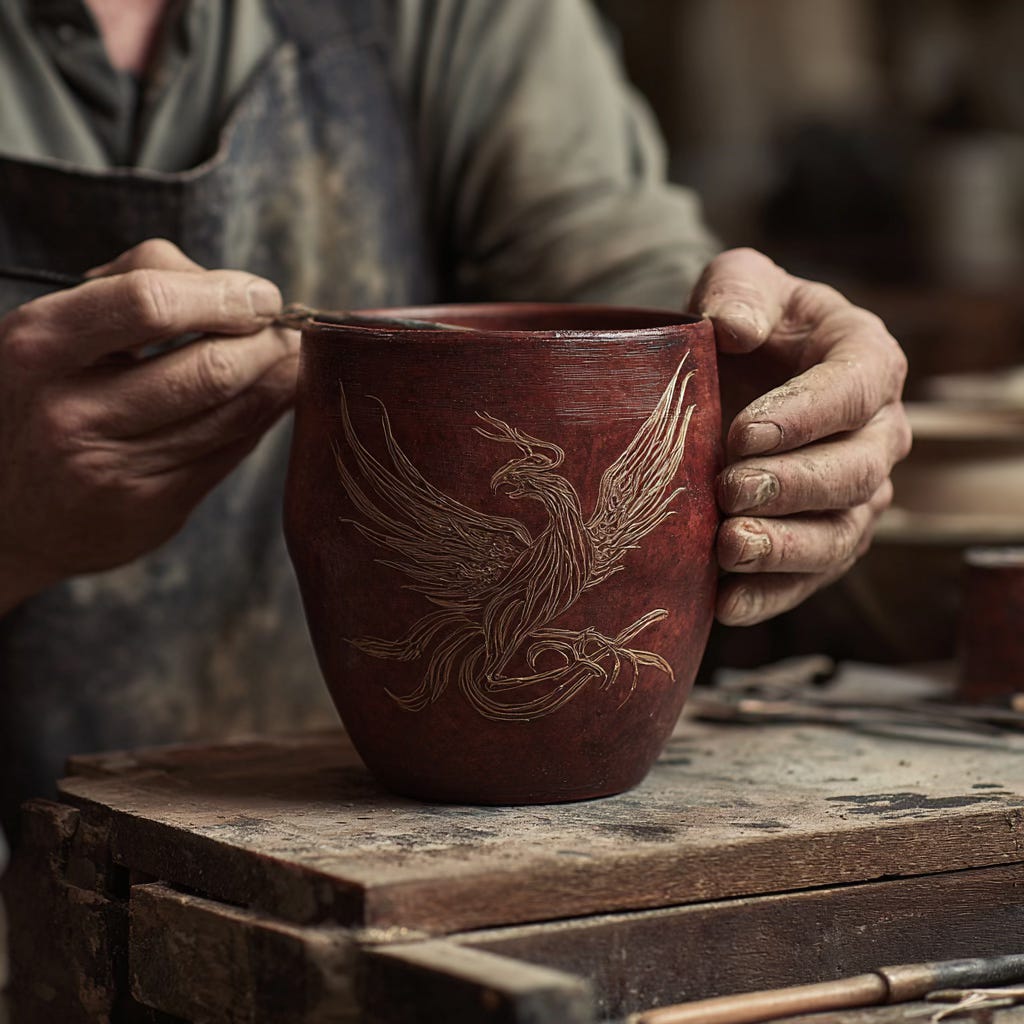
There is a point between when a company starts to fail and when failure becomes inevitable, where there is a sweet spot for a conversation. It becomes not just about survival, but by transition and growth,and involves leadership and courage in all parts because it requires all involved to take a close look at themselves and where they are. What they would like to be and where they are are a long way apart. A new way of looking at things is needed.
But it is possible and in a conversation this week, a company was brought to my attention that exemplifies it beautifully. (HT Jonathan)
In 1948, Edith and Brian Heath founded a ceramics company in a converted shipyard in Sausalito, California. Edith threw the pots, designed the glazes, and made the clay body herself. Brian built the wheels, found the buildings, and ran the books. By 1949 they were producing a hundred thousand pieces a year. By the late 1950s they had built a low, courtyarded factory on Gate Five Road, designed with the architects Marquis and Stoller, and Heathware was being sold through Bloomingdale’s and the original Pottery Barn. By 1971, Edith was the first non-architect to win the American Institute of Architects’ Industrial Arts Medal, awarded for the hundred and fifteen thousand glazed tiles cladding the Norton Simon Museum in Pasadena.
It is a familiar enough arc for a mid-century American craft firm. What is less familiar is what happened next.
The decline
By the 1990s, Heath Ceramics was in trouble. Imports had eroded the market. Tastes had moved on. The Heaths themselves were in their eighties, and in 1993 they handed daily operations over to long-serving employees and stepped back. The atelier survived, but it began to drift. Catherine Bailey, who would later become its creative director, described what she eventually found as a company in “reactive mode and simply trying to survive.”
This is a pattern worth dwelling on. A craft firm built around a particular sensibility can run for decades on the founder’s judgement, on the integration of design and making that exists in a single mind or a single partnership. When that integrating intelligence steps back, what remains is the operational layer: the kilns still fire, the jiggers still turn, the orders still go out. But the firm has lost the thing that made the operations cohere. The making continues; the designing has stopped. The creative vessel is still warm, but the fire that animated it has dimmed.
By 2003, the company was running on the typewriter Brian had once used to manage the books. It had twenty-four employees, around a million dollars in annual revenue, and could not reliably cover its payroll. Edith was in her early nineties and in failing health. There was no successor. The Brian and Edith Heath Trust had been talking to interested parties, but nothing had come of it. The trustee, a family friend named Jay Stewart, had a particular concern: he wanted the legacy to continue, but only if it continued as a working business rather than as a brand to be packaged and sold.
The unlikely buyers
Catherine Bailey and Robin Petravic were not, by background, an obvious answer. She was running an industrial design consultancy with clients that included Nike, Burton, and Microsoft. He was a product design engineer. They had recently moved to Sausalito, and they walked into the Heath showroom one day out of neighbourhood curiosity. Bailey’s first thought, by her own account, was “they need what I’m good at, so maybe I can help.”
They wrote a letter to Edith. Three months later, with Edith’s blessing, the company was theirs. Bailey has remarked that the whole transaction was simpler than buying a house.
What is striking, looking back, is the framing they brought. They did not approach Heath as turnaround consultants holding a generic recovery playbook. They approached it as designers who had recognised a coherent organism in need of careful repair. Bailey was explicit about this from the start. The purpose, she said, was “not to just form a brand or re-form a brand that we could sell, but to keep the integrity of something that should be kept, that there should be more of in the world.”
They did not approach Heath as turnaround consultants holding a generic recovery playbook. They approached it as designers who had recognised a coherent organism in need of careful repair.
The logic of the recovery
Several decisions made the recovery work, and they are worth itemising because they form a coherent pattern rather than a sequence of opportunistic moves. Taken together, they describe a particular kind of stewardship which has more in common with restoring a working instrument than with rescuing a business.
The first decision was to occupy before changing. “We learned about Edith and Brian Heath by occupying their office,” Petravic later said. The first phase of new ownership was a deliberate restraint. The loyal staff, many of whom had worked through the decline, were kept on. The first new product was a single item: a larger coffee mug, sized for the Bay Area’s espresso culture. It became a top seller, and it announced, quietly, that things would change, but only after the new owners had earned the right to change them. This is the discipline of inhabiting a place before intervening in it. It refuses the consultant’s reflex to rebrand or modernise what one does not yet understand.
The second was to restore the design and making loop under one roof. What had drawn Bailey and Petravic in the first place was, as the company’s later writing puts it, the opportunity to bring back designing and making under one roof, so that the start of a design process and its result remained in living contact. They treated this as load-bearing. The factory was not a legacy asset to be optimised. It was the condition of the work being possible at all.
The third was to compress distribution and reclaim the customer relationship. Heath had been distributed through the wholesale channels typical for a mid-century housewares brand. Bailey and Petravic gradually pulled out of those channels and moved to direct retail. They opened a showroom in Los Angeles in 2008, one in the San Francisco Ferry Building in 2010, and in 2012 a flagship in San Francisco co-located with a new tile factory in a former commercial laundry in the Mission District. By the beginning of 2015, the wholesale business was wound down entirely. The pattern is consistent: when the company expanded, it expanded in directions that brought making and selling closer together, not further apart.
The fourth was to collaborate without diluting. New collaborations appeared, but each was chosen for what Bailey calls “design kinship and manufacturing values.” Alice Waters of Chez Panisse, Natalie Chanin of Alabama Chanin, House Industries, Geoff McFetridge, Commune Design. These were not licensing deals. They were extensions of the atelier into adjacent sensibilities, conducted on Heath’s terms and using Heath’s methods.
The fifth, and perhaps the most important, was to refuse the wrong kind of growth. Bailey and Petravic turned down outside investors repeatedly. They resisted pressure, sometimes considerable, to move part of production offshore or out of state. Petravic’s framing is the giveaway. “We want to be here for two hundred years,” he has said, “which means I’m not gonna be around to run it. How do you get to two hundred years? Well, first you’ve got to build that foundation and the values that are going to guide it.”
By 2019, Heath had grown from a million dollars in annual revenue to thirty million, from twenty-four employees to around a hundred and sixty. It had been certified as a B Corporation. It was working with some of the most discerning restaurants and architects in the country. And it was still, recognisably, the same firm Edith had built. The Coupe line, designed in 1947, remained in continuous production.
• • •
The second recovery
The story does not end with the rescue. When the pandemic closed the showrooms in 2020, Heath’s revenue dropped overnight by eighty-five per cent, and the year ended twenty per cent below target. The response was characteristic. Bailey and Petravic raised the minimum wage for their lowest-paid employees to twenty dollars an hour, funding the rise by cutting a 401(k) matching programme that had largely benefited those already at the top of the pay scale. Petravic’s reasoning was that the match “is not created for a culture where people are on the lower end of the payscale and can’t even afford to buy into it.” It was a values decision rather than a marketing one, and it cost the firm real money.
The deeper response, though, had begun earlier. In December 2018, Bailey and Petravic sold a minority stake in the company to its employees through an Employee Stock Ownership Plan. One hundred and sixty-six employees became owners at no cost to themselves, each receiving a commemorative tile to mark the moment. The structure was deliberately gradual. Most ESOPs are exit vehicles, designed to convert a founder’s equity into retirement liquidity in a single transaction. Heath’s was designed as a slow handover, calibrated to avoid disruption to the culture. The financial counsel who structured the deal observed, drily, that “Heath wanted to go slow.”
Designing the succession
In early 2026, Bailey and Petravic stepped back from day-to-day leadership of the firm. Heath is now led by Megan Wernetti and Allison Banks, a Creative and Operations duo who have been at Heath for many years. The structure is deliberate: it preserves the founding model of a creative and operational pairing which has run from Edith and Brian, through Cathy and Robin, and now to a third generation. Bailey and Petravic remain involved, but their attention has shifted. As they put it in a recent letter, they are now “focused on designing Heath to last, not just for the next few years, but for many decades to come.”
The final move, announced this year, is that Heath is on the path to becoming a Purpose Trust-owned company. This is a structure that replaces conventional ownership with a trust whose role is to protect the company’s purpose rather than to maximise its returns. The intent is to make Heath, in any conventional sense, unsellable. Neither inheritance, nor private equity, nor founder fatigue can undo the work, because the legal architecture itself locks the values into the company’s constitution.
The intent is to make Heath, in any conventional sense, unsellable. The legal architecture itself locks the values into the company’s constitution.
What the story actually shows
Heath’s recovery is not a turnaround story in the management consulting sense. It is something closer to the patient restoration of a working vessel. The founders had built something whose integrity depended on a particular fusion of aesthetic, material, place, and people. When the original sensibility faded, the operational layer continued without coherence, a body without its integrating intelligence. Bailey and Petravic did not replace the missing sensibility with their own. They spent years learning what was already there before they presumed to add to it. They then made a sequence of decisions, all pointing in the same direction, which kept the vessel intact across a generational handover.
What is interesting, against the standard heroic-rescuer narrative, is how much of the recovery consisted of not doing things. Not selling to investors. Not moving production offshore. Not extracting equity. Not changing too much, too fast. Not treating the loyal staff as legacy cost. Not letting their own eventual departure become a rupture. The recovery is a long, deliberate act of stewardship, and the most telling thing about it is that Bailey and Petravic have spent the last several years designing themselves out of it.
There is something worth pausing on here. The most fragile element of a craft firm is not its product, nor its market, nor its margin. It is the integrating intelligence that holds aesthetic, material, place, and people in working relation. That intelligence is, almost by definition, embodied in one or two people at a time. The strategic question for any firm of this kind is not how to grow it, but how to keep that intelligence intact across the handovers it must inevitably make. Heath’s answer has been to design every layer of the business, from the factory floor to the legal structure, in service of that single question.
It is, in the end, a small American ceramics company. But it is also a working demonstration that the slow-burning vessel can be tended across generations, and that a craft firm’s most important design problem is not its product but its succession.
The difference between where Denby finds itself now and where Heath finds itself is one of attitude. It’s about the artisan rather than the accountant. It’s always a choice.
Great story because it is so antithetical to the extraction model. I particularly like using a trust to protect the company. Great writing. Thank you.
A different way of seeing… (or perhaps in my language ‘leading from the poetic edge’). Thank you Richard.