

I’ve often played in my writing with the idea of AI as an emerging craft. Now, it feels like time to get of the fence, and say I believe it is. And that it matters.
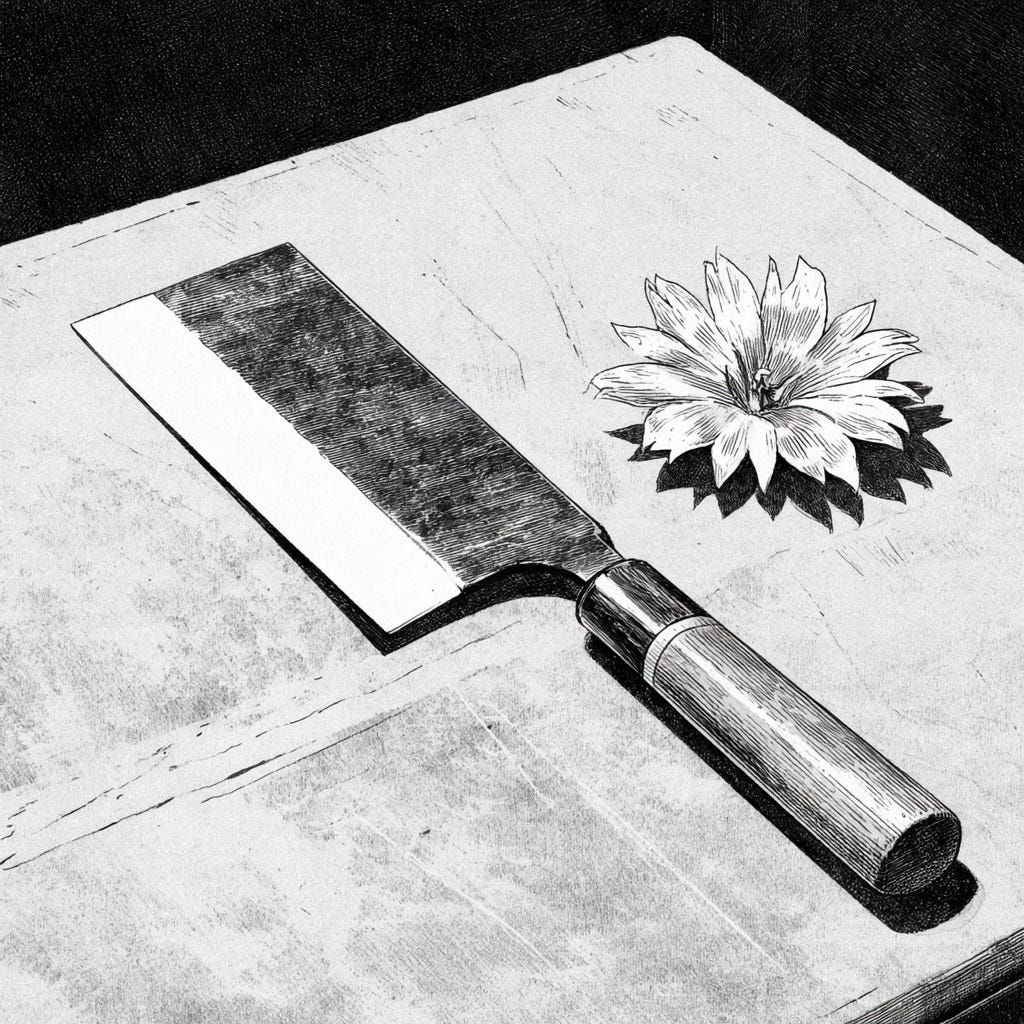
The metaphor I found myself reaching for was that of a Cleaver, and how different one becomes become in the hands of an amateur, and someone who has specialised in it, like the Japanese masters who can use one to cut metres of wafer thin skin from a tomato to create a beautiful flower decoration, just for the joy of it.
I also think about the relationship with the cleaver itself, and the difference between one bought as a tool with little thought as to manufacture, and one that is commissioned by the master who uses from the master who creates it; and the difference from one bought from a supermarket and those from Sakai Takayuki or Takeda, who are amongst the names most often associated with high-end Japanese cleavers.
The analogy is far from perfect, but I think we can think of AI as a cognitive cleaver. There is a difference between using it to cut a question into pieces, and process it, to the skills to work with a question, shape it, and work it until the question we really need emerges, and work that with our own, complete set of very human capabilities.
It seems to me that much of the use of AI, particularly where it is used for efficiency and productivity and embedded in other work processes, is of the former kind. It shapes the user, rather than being shaped by them. The latter kind is what interests me, where it is used by those prepared to work with it, understand it, and shape it to address challenges worth solving.
The last few months have taught us much, and though we are very far from masters yet, I want to adopt the stance that the best way to understand something is to teach others what we know. This is, after all a new craft using old skills.
So for the next period of time, that is where I am going to focus; on the craft of using AI to cover what we are learning on how to address the challenges of those who own the work they do, and who want to create the equivalent of tomato skin flowers because they can, not because someone told them to.
Because there is a world of difference between a meat packing plant and a chef’s kitchen.
Nice provocation, Richard.
Your distinction between recipe and craft is a powerful lens for thinking about AI.
Craft is what emerges when knowledge crosses the bridge into lived experience. AI increasingly commoditises recipes, procedures and even sophisticated knowledge, but craft resides in the transformation of the practitioner through direct engagement with reality. Information can be transmitted, understanding approximated, but wisdom remains embodied because it changes not merely what we know, but who we become.
It resonates with what I wrote https://medium.com/age-of-awareness/the-bridge-of-experience-from-knowing-to-being-f026cb726c7f?source=friends_link&sk=b44cfb44bb8e7539fb4d325dafa4c5ae