

I love this time of year, as the light changes, new life begins to appear so many places, and we feel different; a sense of anticipation that we can’t really articulate, but which we can sense.
Providing that we are open to it.
One of my rituals at this time of year is to get my 1997 Lotus Elise, which I’ve had from new and is now nearly thirty years old, out of our garage and start preparing it for the spring and summer. When I went to do it this year, the trickle charger I keep it on had failed, and the battery was flat. Not just pancake flat. Graphene flat.
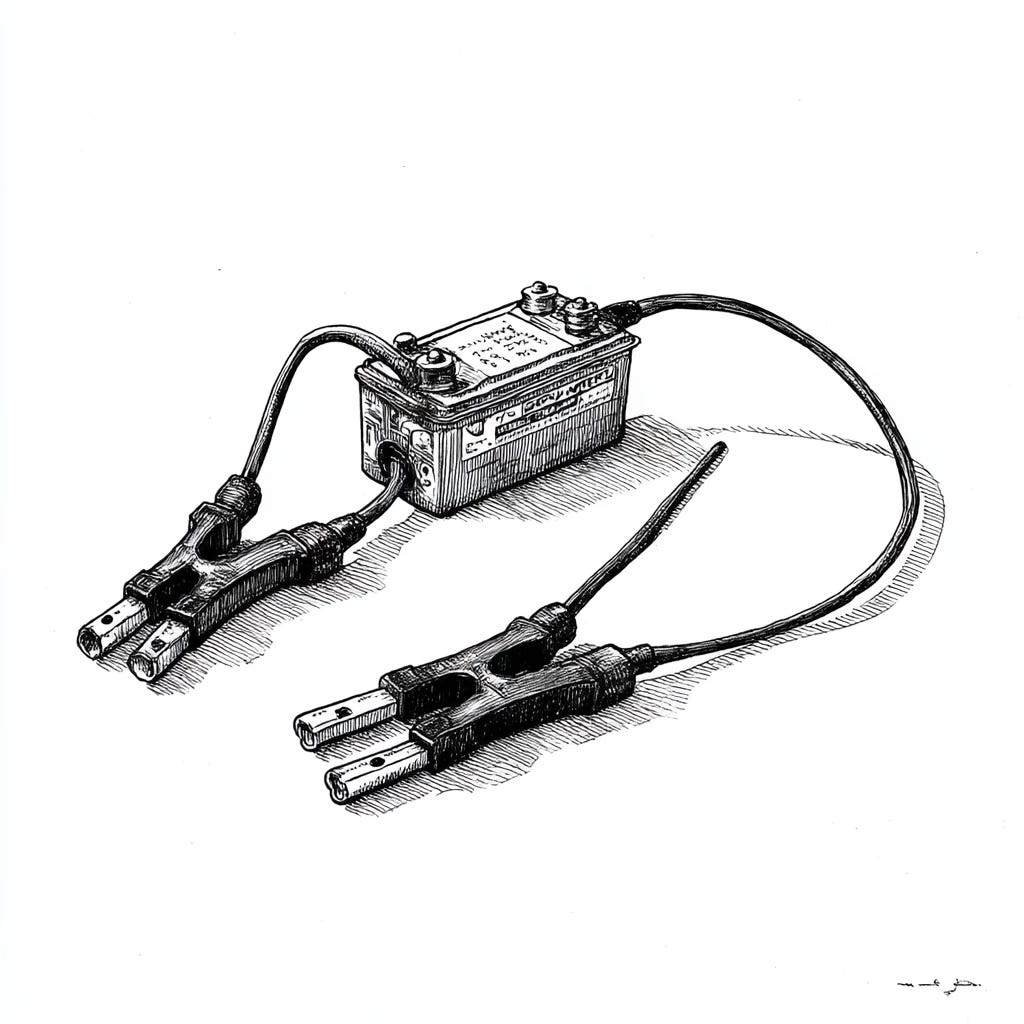
There are two ways to get it back up and running. There’s the brutal way, to jump-start it from another car, which for a battery is the equivalent of being woken up by having cold water poured on you. It gets your attention, but doesn’t make you feel great. The more civilised way is to wake it up gently; connect it to a power source, let it absorb a small charge, and put it back on a new trickle charger. A cup of tea in bed. Let it get used to being awake.
The thing is, though, that for a trickle charger to work, it needs to find at least one or two per cent charge in the battery. Without that, it can’t even recognise what it’s connected to. Below that threshold, the only option is the cold water treatment. Above it, and the patient, steady work of restoration can begin.
I think we’re the same.
People, ideas, and organisations go flat. Not broken, or dead, but depleted to the point where nothing seems to connect. The lights are off, and no amount of gentle encouragement registers. What they need first is not a programme, a strategy, or a ten-point plan. They need that small transfer of energy, just enough to bring them above the threshold where they can begin to charge themselves.
This is what I think the artisan does. Not “rescue”, or change management. Not the dramatic intervention of the jump start, which shocks the system into temporary life but leaves it fragile. The artisan is the one or two per cent; the person who, through their own practice, presence, and their own willingness to sit with the flat battery and find the connection, provides just enough charge for the trickle charger to take over.
If you want to see what the cold water treatment looks like at scale, consider the Citrini Research report that went viral this week.
Published by James Van Geelen and Alap Shah, it is scenario writing at its sharpest. Framed as a fictional postmortem from June 2028, it models what happens when the scarce input that organised the entire modern economy, human cognitive labour, becomes abundant. AI agents matching or exceeding professional capability across most knowledge domains trigger a cascade: mass white-collar displacement crushes consumer spending, mortgage stress and private credit defaults destabilise the financial system, and collapsing tax receipts paralyse policy responses built for an economy that no longer exists. Their most striking concept is “Ghost GDP,” economic activity that appears in national accounts but no longer circulates through households. Labour’s share of GDP drops from 56% to 46%. The circular flow breaks.
It is a compelling, internally coherent provocation. It is also, by design, a bucket of ice water.
Its blind spot is what makes it useful to us.
The report treats intelligence as a single commodity, differing between humans and machines only in cost and speed. Everything it models follows from this assumption. But intelligence is not one thing. There is the kind that can be codified, scaled and automated, and there is the kind that lives in the body, in relationships, in the slow accumulation of practical wisdom the Greeks called mētis. The joiner who understands the feel of the wood. The farmer who knows the soil beyond what any sensor array can capture. The teacher who sees the pupil, not the data point. Artisans carry decades of calibrated judgement, none of which appears in the report’s models because none of it speaks the language the report uses. GDP, employment rates, and consumption multipliers. The Citrini report is a comprehensive map of one economy, drawn with such conviction that you could forget there is another economy it cannot see at all.
That other economy is where the opportunity lives. And it is where the trickle charge matters.
The report models what breaks. It has no theory of what grows. It diagnoses provocatively, but diagnosis alone is the cold water treatment. It shocks you awake, tells you everything that’s wrong, and leaves you standing there, wet and shivering, wondering what to do next. We’ve all been in meetings like that. The consultant who presents forty slides of devastating analysis and then asks, “So, what are you going to do about it?” The answer, of course, is that you sit there, stunned, unable to do much of anything, because the diagnosis has consumed all the energy in the room, leaving you open to the blandishments of the consultant who, of course, doesn’t know either, but can offer your CEO a security blanket.
The alternative is the trickle charge. Not denying the diagnosis, but starting somewhere else entirely. Starting with what’s already alive, however faint. Finding the one or two per cent that’s still there and working with it. It is not optimism; it is a different method and a different worldview.
I have spent the past year exploring what this looks like in practice, through the alchemical frameworks we’ve been developing at The Athanor.
Alchemy offers a more honest map of transition than economic modelling, because it accounts for transformation rather than just destruction. It has language for what happens in the vessel when the old form dissolves, and it understands that dissolution is not the end of the process but a necessary stage within it. Over the coming weeks, I will be taking the questions the Citrini report raises and working with them in that space. Not as a sentimental retreat from the hard numbers, but as a serious inquiry into where new value comes from when the old sources are being automated.
If you’re reading this, the idea of the artisan already resonates with you. I am suggesting that it has never been more important. The artisan is, in effect, that small element of charge that can move people, ideas, and in some cases organisations from flat to the point where they can begin to rebuild on their own. Not by providing the answers, but by providing the conditions in which answers can emerge.
None of this will be easy. The temptation to wait around for somebody to put things right and rescue us is a forlorn hope. The Citrini report is almost certainly wrong in its specifics, as all scenarios are, but it is right enough in its direction to shake us out of waiting. The question is, what do we do with that shake? Whether we treat it as a cold water moment that leaves us gasping, or as the signal to begin the quieter, steadier work of finding where the charge still lives.
We will be exploring this, along with other ideas, at our usual Wednesday gathering. 5:00 pm UK time, on Zoom. The trickle charger is plugged in. You are welcome to connect.