

Sufficiency means enough to meet what is required, and no more.
The first half asks little of anyone; every supplier alive will assure you that what they sell is enough. The work is in the second half, in the “and no more”, because that is a ceiling, and a refusal of unnecessary excess. To call a thing sufficient is to have turned down the temptation of more before it was made.
What the word will not do is tell you where the line falls. Finding it is a skill.
David Pye called this the workmanship of risk: the making in which the result is not determined in advance but stays under the control of the maker the whole way through, open to being spoiled at any moment until it is done, dependent at every step on care and judgement. Against it he set the workmanship of certainty, where the jig and the template settle the outcome before the work begins and the operation only runs it out. There is little judgement in process, particularly when automated.
The judgement of enough belongs to risk. A process model holds no opinion on the matter; it makes what it was set to make, and would a make a thousand more if instructed.
The artisan stops at sufficient because the stopping is part of the work. Past that point the additions detract from the thing rather than adding to it. They make it clumsy. Saint-Exupéry put it as well as anyone: a perfect piece is finished not when there is nothing left to add, but when there is nothing left to take away.
For most of the history of making, the judgement of enough came with help from what was used to make it. Material cost money, effort cost sweat, those costs were felt the whole time, and they told you when to stop. You did not have to supply the whole of the discipline yourself, because the world supplied a good part of it for you. Constraints breed creativity and judgement.
I was held in a queue of traffic at the weekend behind one of the Land Rovers, a six-figure confection of fine engineering, with a Chinese Jaecoo in the next lane, the one some have started calling the Temu Range Rover, doing most of what the Land Rover does at a third of the price. If you work a hill farm or cross country that fights back, the Land Rover earns every pound of its price tag. If the hardest thing it meets is the school run, it is an expensive way to sit a little above the traffic. Sufficient is contextual; the same object is right for one life and faintly absurd in another. The judgement sits in understanding that. No specification sheet makes it for you.
The same thread runs through the tools we work with every day. I once kept a Dropbox account, an Evernote account and a Zoom account. Each was bought for a single job, Somewhere to put files, somewhere to hold ideas, a way to speak to people at a distance. First slowly and then all at once, each began trying to do everything. They still do the thing I bought them for, more or less, but buried now under features I never asked for and cannot switch off, and which now arrive bundled with increasing prices for this “improvement”. The result is a kind of digital obesity: excess marginal functionality with elegance the first thing to go.
The reason is in the economics. The marginal cost of adding a feature is the developer’s time, and increasingly not even that. Addition is close to free, so it never stops; there is always one more thing to bolt on, and the marketer is never satified. The products swell toward each other as they grow, each taking on the others’ features until the differences thin to nothing and the whole category slides toward commodity.
Which is where the artisan’s instinct turns out to be the commercial one as well. When everything around it has bloated, the thing that has kept its shape stands out, and restraint becomes the quality you can charge for. Sufficiency commands a premium. Proton, where I have lately moved the work, sells not much more than this: the things it leaves out are the point; the things it does are done well and without fuss.
None of this is anyone deciding. It is the workmanship of certainty at scale, a system that adds because adding is free, with no ownership of the work and no judgement of enough anywhere inside it.
Which brings us to the newest tool on the bench, where the machine does it to its own thinking.
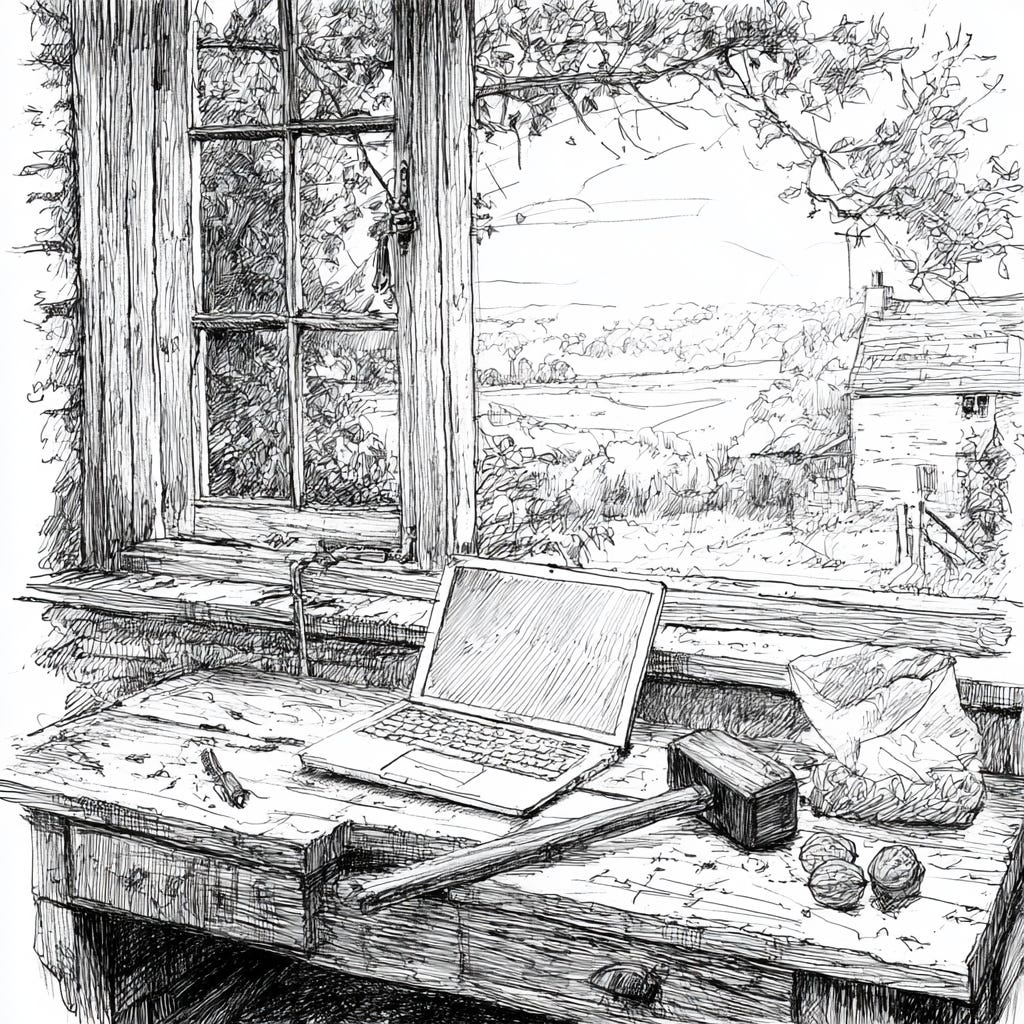
Ask a reasoning model what two and three make, and it may set off as though the question were hard. Researchers have begun to measure the habit; they call it overthinking. On simple sums the reasoning models have been clocked using on the order of twenty times the tokens of an ordinary model to reach the same answer, in one case producing thirteen separate solutions to a question a child answers once. The pattern is worst on the simplest problems, where the least thought is called for, and the model will often carry on generating steps well after it has already reached the answer. The extra effort does little for accuracy. It is the machine reaching for a sledgehammer to crack a walnut, then reaching for it again.
The economics that bloated software also bloat the reasoning models. A larger model costs more for every token and takes longer to answer, so running one for a task a smaller model would handle as well is waste by the plainest measure there is, before the energy behind the compute is counted at all. And again, none of it is decided. The system spends because spending is what it does.
So the judgement Pye found in the hand has to be carried to the keyboard, because nothing the tool has no interests in its cost, and the people who build it have very big bills to pay. Before long, one way or another, those bills will have to be paid, and the cost will find its way to the customer.
When that happens, those who understand the craft of enough will be in demand.
The craft of working with these systems is mostly the craft of enough. You fit the model to the size of the task instead of reaching by reflex for the largest one to hand. Prompting is a conscious skill. You ask for what is needed and leave it there. And when the first answer is already sufficient, you take it, instead of running the thing again for the comfort of motion. The tool has no sense of when it is done; that sense is what we bring to it.
Colin Chapman built Lotus around the removal of weight; a car was quick because everything the car did not need had been taken off it. He told his engineers to simplify, then add lightness. The simplifying comes first, and the lightness is what remains once the simplifying has been done. It holds for a sentence as much as for a piece of software, or for the working of a machine that would think forever if you let it.
Simplify then lighten.
Sources
- Chen et al. (2024), “Do NOT Think That Much for 2+3=? On the Overthinking of o1-Like LLMs.” arXiv:2412.21187. https://arxiv.org/abs/2412.21187
- Sui et al. (2025), “Stop Overthinking: A Survey on Efficient Reasoning for Large Language Models.” arXiv:2503.16419. https://arxiv.org/abs/2503.16419