

AI, in its many guises, is astonishing technology. Used well and with wisdom, it can be an enormous power for good, but if used primarily as a profit-making project, it throws all sorts of spanners in the works.
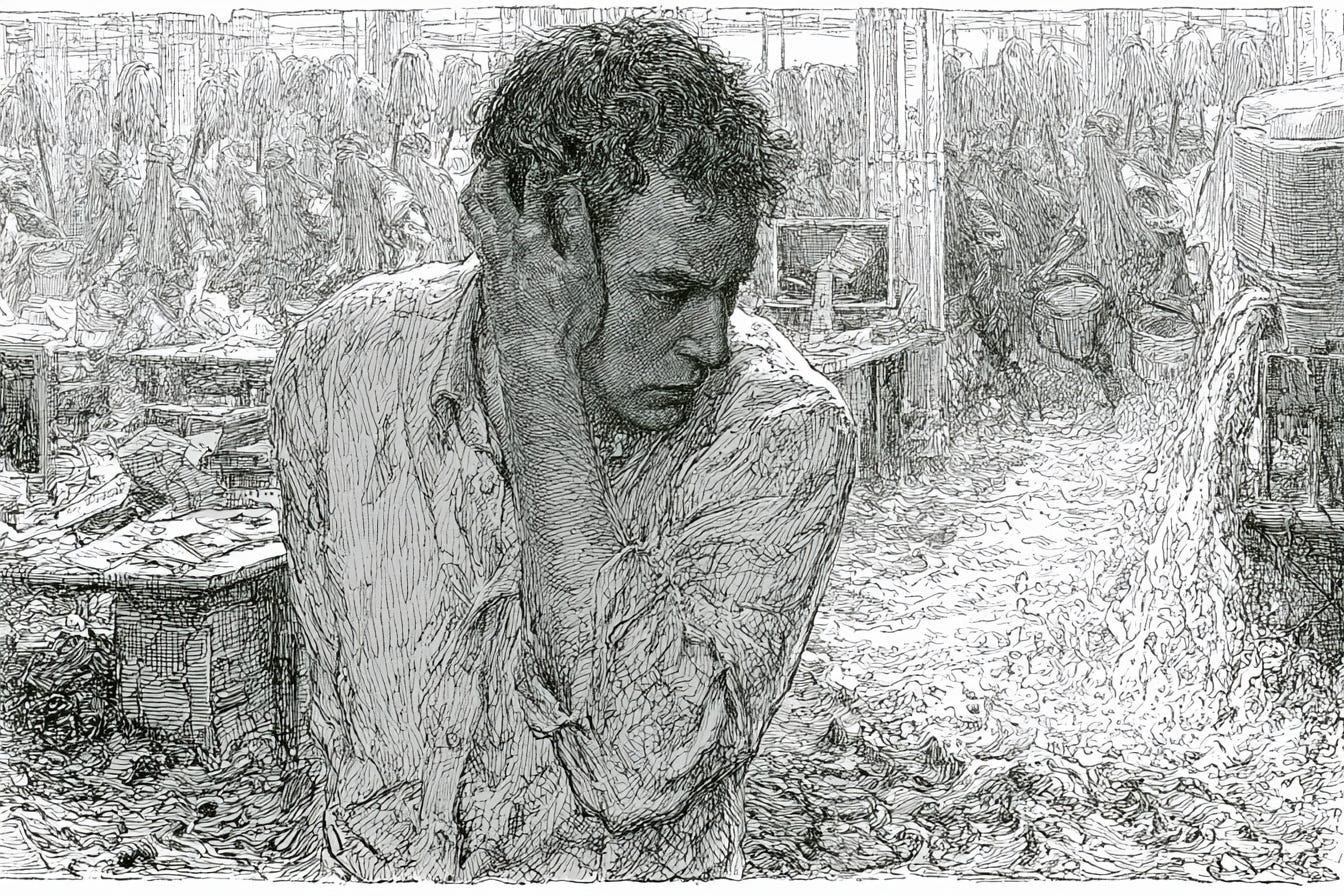
It reminds me of the chaos in the Sorcerer’s Apprentice. The apprentice, left alone in the workshop, casts a spell onto a broom to carry the water so he need not fetch it himself. The broom obeys, and goes on obeying. Pail after pail, it floods the floor, and the apprentice has forgotten the word that stops it. He takes an axe to the thing; each splinter rises as a broom of its own, and now a dozen of them haul water. The room is under water by the time the old sorcerer returns and utters the spell that ends it.
Technology has an off button; the stopping spell exists. It just belongs to different people than those using it, so the trouble is not that the thing cannot be stopped, but that the one who set it going lacks the word to stop it.
Goethe had a good grasp of agentic systems, it appears.
That’s the problem with wishes. With great power comes great responsibility. Not Spider-Man (as often attributed); the sentiment is much older. It appears in a decree of the French National Convention, dated 8 May 1793: “*Ils doivent envisager qu’une grande responsabilité est la suite inséparable d’un grand pouvoir*”, roughly, that they must consider that great responsibility follows inseparably from great power.
It applies to all of us. AI is a ubiquitous general-purpose technology because its commercial rationale makes it so. Whilst much of the attention is on its potential impact on the job market and the workplace, not so much is on the astonishing power it has for individuals.
Give an artisan a power tool and two things happen together. The heavy, repeatable part of the work, the cutting and planing that used to take the morning, can be done in minutes; and craft that makes the difference becomes concentrated in that part of the process where power is not enough. AI is a power tool where we have certainty, where the result is fixed once the setup is right. Craft is the workmanship of risk, where the outcome is not guaranteed by process but by feel, connection and judgement exercised in the doing. A power tool changes the ratio between them. It takes over more of the certain work and leaves the risky part more exposed, so the demand on judgement rises rather than falls. The broom carried the water well enough. What was missing was the judgement to stop.
Responsibility, in a craft, is not a slogan. It is the workmanship of risk itself: the maker answerable for what they make or create, with no process to take the blame. The old decree fixed responsibility to power; a general-purpose tool spreads both, and hands the burden to anyone who uses it.
Generative LLM are power tools for the knowledge trades. What they take over is the certain work: drafting a serviceable first version, summarising a field of research, and assembling the background we used to gather by hand. What they leave is the other part, the part that was always the craft.
The change most people notice first is the collapse of friction. A question used to be cheap to think and expensive to follow. It involved expensive modes of learning and years of certification. The distance between wondering about a subject and knowing enough of it to make something was the barrier, and for most of us most of the time that barrier excluded us. Tyler Cowen, who has thought about this as deeply as anyone, describes buying twenty or thirty books to pursue a single thread and now asking an LLM instead, treating it as a secondary source that has read more than he ever could. The friction that fell away was that of acquisition.
Acquisition is not capability. The material a curious person can gather in an afternoon is raw and unfinished, and has never been the hard part. The hard part is the combining: the judgement that selects, discards, arranges and decides what the material is for. LLM make first relatively effortless, yet unreliable on the second. It will bring us to the edge of a subject in an hour, yet what you do at that edge is ours.
Which is why I think the use of these tools is craft, not just technique. The distinction matters. A technique can be written down and handed over; it is the workmanship of certainty in another form. The ever increasing libraries of prompts and tips are attempts to make use into a technique, and they disappoint for the reason such attempts always disappoint: the skill they mean to codify is situated, not general. It lives in practice and resists the rulebook: mētis, the cunning of the teacher and the doctor; the craft of knowing that cannot be converted to data.
The craft resides in the things a process, or an instruction cannot hold. Knowing which questions the tool will answer well and which it will answer fluently and wrongly, a boundary that is jagged, unmarked, and learned mainly by being caught out on it. There is the discretion to recognise a confident answer that is mistaken, and to hold one’s ground when the machine, pressed, compounds its error with more, often fictitious, supporting detail rather than giving it up.
And there is the inconvenient judgement of when to accept a draft and when the very ease of accepting it is will cause more work late. Richard Sennett described craft as a long conversation between the maker and the material, in which skill grows as much by finding problems as by solving them. Used at its best it is a conversation conducted in questions, where the practitioner returns each time with a sharper one.
Because it is a craft, it can be taught, and because it can be taught, its spread is a matter of culture rather than talent. This is the element that is occupying me. Access to an LLM does not confer the capability to use it, any more than a key to a Ferrari gives us the ability to drive it to its potential.
What stands between the two is a set of conditions: some prior knowledge, enough practice to sense what is happening, the time and attention that are the genuinely scarce inputs, and the disposition to stand at the edge of our ignorance without retreating.
Those conditions are a choice we make in full awareness of what we seek to learn. To say that anyone can now learn anything is true of an LLM but not of us, because our circumstances decide whether the tool converts what we are working on into anything useful at all.
Circumstances are what a culture creates. The conditions that turn access into craft are what good teaching and good training have always built. Facts were the cheap part even before AI arrived on the scene; the expensive part was always the cultivation of judgement, of discretion, and the appetite to ask.
For the mid-career professional the point is sharper. The accumulated knowledge that once made you valuable is the part the tool has made common; what stays scarce is the judgement you built alongside it, and the craft you bring in use that is judgement brought to a technology that lacks it. Craft is both choice and attitude. It is what knowledge matures into, which is the whole premise of taking craft seriously in the middle of a working life.
Ivan Illich drew a line between two kinds of tool. The convivial kind enlarges the range of a person’s competence and can be used without becoming subject to it; a relationship that allows us to keep our agency. The other kind creates dependence, shapes us to its own demands, and gathers control into the institutions that control it.
A generative model is not fixed on one side of that line. Used as a craft it is convivial, leaving the practitioner ever more capable of the next thing and retaining that capability in its absence. Used without craft it is the other kind, and the evidence is already emerging in the studies of people who feel faster while measurably slowing, and in work passed along in a superficially fluent state but which carries no thought and leaves the recipient to do the the work the “writer” did not, or face the consequences.
In Deschooling Society Illich charged Educational Institutions with confusing schooling with education, and with monopolising something that is not theirs to own. A patient tutor available to anyone at any hour, that meets a learner where they are and follows a question wherever it goes, reads less like a provocation from his 1971 book and more like a specification for what we can now build. The catch is the one mentioned earlier: The tutor increases a person’s agency only where the person is building a craft with it. Where it is used to avoid the labour that fosters judgement, it does the reverse, and breeds a dependence more complete than the schooling Illich complained of, because it asks even less of the user.
People who hold this new craft are harder to govern by the old rules. Much institutional authority has rested on an asymmetry of knowledge: the professional knew what the client did not, and the organisation knew what the individual could not find out, and charged a rent for access. LLM used as craft tools wears that down. It is dangerous ground.
Established orders have met knowledge-spreading tools before and have mostly absorbed them. The printing press did not end authority; it produced new authorities, the licence, the copyright, the publishing house, and in time the state that made the printed word law. The network that promised to remove the middleman delivered middlemen larger than any before it. Carlota Perez has described the pattern: a technological revolution opens a turbulent phase in which the new unsettles the old, and then a settling phase in which a new order forms and the power briefly loosened gathers again. The unsettling is real; the question is always what hardens afterwards.
LLM carry a feature the printing press lacked. It is expensive to make, with frontier models held by a few, and its returns flow in part to whoever owns the models. The same instrument that could dissolve the old asymmetry could set a steeper one in its place, a fresh asymmetry between those who own the capability and those who rent it. This is the apprentice’s problem drawn larger.
You may set the tool going; but the word that stops it, and the profit it earns, sits with others. James Scott’s warning arrives from the same side: a tool that can serve a person’s situated knowledge can as easily serve an institution’s appetite to make everything legible and controllable, and the model that tutors one person can watch and standardise a thousand to create profitable mediocrity.
So the craft, on its own, overturns nothing. The individual who holds it is still small, whilst organisations are large. What shifts the balance is less the lone practitioner, however able, than the new ease with which such practitioners combine: craftsmen and craftswomen who can now find one another, pool what they know, and act together without an institution’s permission. The threat to the established order, and there is one, is associational before it is individual.
Movements win in three phases: mapping the ground, mobilising it, then a cascade lit from outside. Satell counts a new technology among the sparks. The large language model may be this decade’s, lowering the threshold at which a waiting constituency finally moves together.
The tool is new but the craft is old. A crafts answer to a machine that takes over it’s work has always been the same, to go further into the work that cannot be automated and to grow, if anything, more exacting about it.
What differs this time is the speed, and the cost of getting the culture around it wrong. Whether the craft of using AI becomes common or stays the possession of a few will not be settled by the technology. It is the kind of thing a society decides, mostly without noticing it is deciding, in what it teaches and what it rewards.
Sources
The Sorcerer’s Apprentice — Johann Wolfgang von Goethe, Der Zauberlehrling (1797), a ballad in fourteen stanzas; the broom, the axe, the splinters and the returning master are all Goethe’s. en.wikipedia.org/wiki/The_Sorcerer’s_Apprentice
“With great power comes great responsibility” — the line predates Spider-Man; the earliest documented form is in the Committee of Public Safety’s Plan de travail, de surveillance et de correspondance, printed in the Collection Générale des Décrets Rendus par la Convention Nationale, 8 May 1793, p. 72. Provenance and the false Voltaire and Spider-Man attributions are traced by Quote Investigator. quoteinvestigator.com/2015/07/23/great-power · en.wikipedia.org/wiki/With_great_power_comes_great_responsibility
David Pye, The Nature and Art of Workmanship (1968), for the workmanship of risk and of certainty. Full text at the Internet Archive. archive.org/details/natureartofwor00pyed
Tyler Cowen — the reading practice (a book as a jumping-off point, buying twenty or thirty supporting books, AI as his “main secondary source”) is from his conversation with David Perell, “Learn How to Write with AI” (2025); his standing home is Marginal Revolution. linesofdefence.com/note/how-tyler-cowen-uses-ai-2025 · marginalrevolution.com
Richard Sennett, The Craftsman (Yale University Press, 2008), for craft as a conversation between maker and material. yalebooks.yale.edu/book/9780300151190/the-craftsman
Ivan Illich — Tools for Conviviality (1973), for the convivial against the manipulative tool; Deschooling Society(1971), for the institutional monopoly on learning. en.wikipedia.org/wiki/Tools_for_Conviviality · infed.org/ivan-illich-deschooling-conviviality-and-lifelong-learning · full text of Tools for Conviviality (Cornell): arl.human.cornell.edu/linked docs/Illich_Tools_for_Conviviality.pdf
Carlota Perez, Technological Revolutions and Financial Capital (2002), for installation and deployment and the order that re-forms after the turbulence. en.wikipedia.org/wiki/Technological_Revolutions_and_Financial_Capital
James C. Scott, Seeing Like a State (Yale University Press, 1998), for legibility, and for mētis against episteme and technē (Chapter 9), which also underpins the earlier mention of the Greeks. yalebooks.yale.edu/book/9780300078152/seeing-like-a-state
Robin Dunbar — “Dunbar’s number,” the ceiling on stable relationships. en.wikipedia.org/wiki/Dunbar’s_number