


Denby Pottery has been the theme of my recent posts, because of the nature of the business, the fact that it’s local, and it feels personal on a number of counts.
Unless something remarkable happens; however, this will probably be the last one, as the administration process has now moved from threat to reality. On April the 23rd, what is conveniently labelled the “making and design departments” were closed, with 49 redundancies, whilst the retailing and selling arms remain for now.
It’s an odd terminology: “the making and design department”, for a business over 200 years old whose very existence has been on designing and making. It seems a little like saying the heart has stopped without mentioning the effect that might have on the rest of the body.
Closure is being blamed on external events, soaring energy costs, low consumer confidence, and labour and material costs. The business, of course, couldn’t do very much about any of these without fundamentally changing the nature of what was made. It’s not a chocolate business, where cost pressures can motivate those who manage rather than make to reduce cocoa content and up the marketing spend.
Except that that’s not quite true. It was just done more quietly. The exact figures are difficult to determine, but they can be derived. Over the last decade, Denby Pottery’s R&D spending has been about 0.5% to 1.5% of turnover. Most of that was offset by R&D tax credits. Over the same period, though, the marketing spend was estimated at roughly 5-8% of annual turnover.
The precision of the figures matters less, I think, than the attitude it conveys. It suggests a priority given to selling what was being made, as against doing the work to make what would sell. Given the nature of the external shareholders, it is not surprising, and I can understand the management doing it. Heritage is a quaint notion when the focus is on quarterly results for shareholders far away, and performance reviews beckon. Running a craft pottery with a mass retail mentality was always going to lead us here.
There is, though, a broader lesson for those of us who identify in whatever way as artisans. Unless you’re running your own business, your artisanal skills tend to come for free. They are not recorded in job descriptions, or performance reviews, because they cannot be measured. Just as at Denby, they are harvested, not invested in. It was not always the case; it’s a relatively recent trend, I think. Now, though, when it comes to skills and investment, whether in human systems or individual skills, at a practical level, we are in the situation of the fable of the scorpion and the frog. Scorpion will sting us, not because it’s bad, but just because that’s what it does.
Marketers will probably hate me for saying what I’m going to say next, but I believe it to be true. The people with ideas and the true creativity remain as valuable as ever, but the people who turn those ideas into deliverables are expendable. Marketing ideas, even the genius ones, are a form of cappuccino froth. They have an increasingly short lifetime, and when we have something as disposable as that, the ability of AI to reform data into the next idea is not just viable, it’s reliable. And cheap (for now, at least)
Marketing never really differentiated Denby, despite the amount of money spent on it. What really made Denby differentiated was the seam of clay it sits on. Iron-rich with a particular quality that the vitrification process turns into unique stoneware. It is admittedly the same qualities that have caused the problems. It is highly energy intensive and requires skills not just in making, but creating and crafting glazes that work with it. In the end, what made Denby different was material integrity. Whatever happens to the brand name, that material integrity will not go along with it.
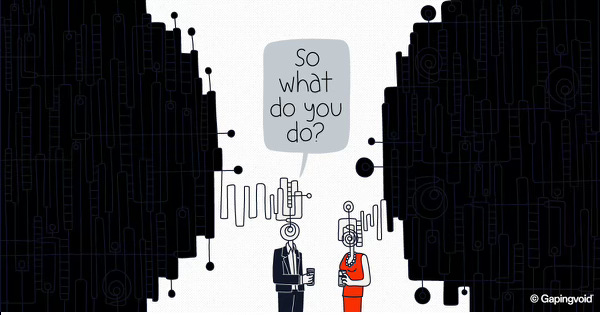
There is a timely post on The Gaping Void as I write this. Its core message is simple. For most of us, work has been abstracted into so many processes, systems and accountabilities that we cannot describe what we actually do. Our work is a void into which we disappear every day; until, of course, we don’t, and then we cannot really explain to people what we used to do. The same is true of many businesses. They are voids too, reliant on marketing to weave a temporary story without substance, run by CEOs trained in business schools as if they were baristas, taught to assemble a product to a recipe.
Properly read, Denby’s case is not a story about energy costs or consumer confidence. It is the story of a business that allowed the layer that could be replaced to grow at the expense of the layer that could not. The seam will still be there when the brand is sold on. It is the people who could read it who are leaving.
We can feel the change around us. If we have a business that can describe what it makes, with customers who understand and value it, and we can describe our part in it, we have a kind of human material integrity. We are not in the void. For everything else, increasingly, there is AI; not as the problem in itself, but as the consequence of a problem we already had with our work, our ownership of it, and our investment in it.
If you have a craft, whether of the traditional sort or the emerging kind, in working with AI, and you can describe it to a five-year-old; show them what you do, what you made, and who it is for; then you have something AI cannot quietly absorb.
It is interesting, by contrast, to watch some of the second-generation entrepreneurs in tech, the people who made a great deal of money out of stock options during the boom phases of Software as a Service or Games, and who now propose to repeat the exercise with their own money. They are very talented people. They are also, almost always, very lucky people. Watching them is too often like watching a lottery winner set up a business teaching others how to win the lottery. They seem to believe that they can “rinse and repeat” and not be affected by the technology that brought them the luck. Material integrity matters as much whether you make with human or mathematical digits.
If you live in the void, AI will find you, in the sense that it will fill the space you are occupying.
If you have a craft and you can describe it, customers will find you. It feels like the better strategy, and quite possibly the only one we have.
Note: I will be away next week, digital free, so will be back in two weeks…..
“In most agencies, account executives outnumber copywriters two to one. if you were a dairy farmer, would you employ twice as many milkers as you had cows?”
- David Ogilvy