

There was a time when quality, provenance and connection were the prime determinants of success. Not through virtue, but through necessity. If you needed boots, you went to the local bootmaker with a good reputation. The one your neighbours used, who had been there for twenty years and whose work you could see on the feet of people you trusted. Social Proof, before we had a term for it.
Word travelled slowly then; a reputation took years to build and could be lost in a season. The product was the proposition, and marketing was the conversation. Then we learned to make things at scale, and everything changed.
Mass production created a curious problem. We could now make ten thousand units of something, but had no natural connection to ten thousand customers. The old mechanisms, reputation, visible craft and direct relationship, could not span that gap. So we invented advertising.
We built an entire industry whose job was to manufacture attention and desire at industrial volumes. To create the demand that matched the supply in order to bridge the distance between the factory and the stranger. It worked spectacularly, and it changed the equation entirely.
Success became about managing the gap between production capacity and consumer awareness, and the product itself became almost secondary to the machinery of desire creation. Brands became abstractions, and marketing became a tax on everything as companies began spending more on telling people about things than on making the things excellent. We learned to sell stories rather than substance, and have lived inside this system for so long now that it feels like the natural order of things. Scale or die. Either we reach people we will never meet, or we do not matter.
Something wonderfully unsettling is happening now: the ground is shifting underneath us in a way we sense rather than understand. Not in the way we expected, but in a way that might matter more.
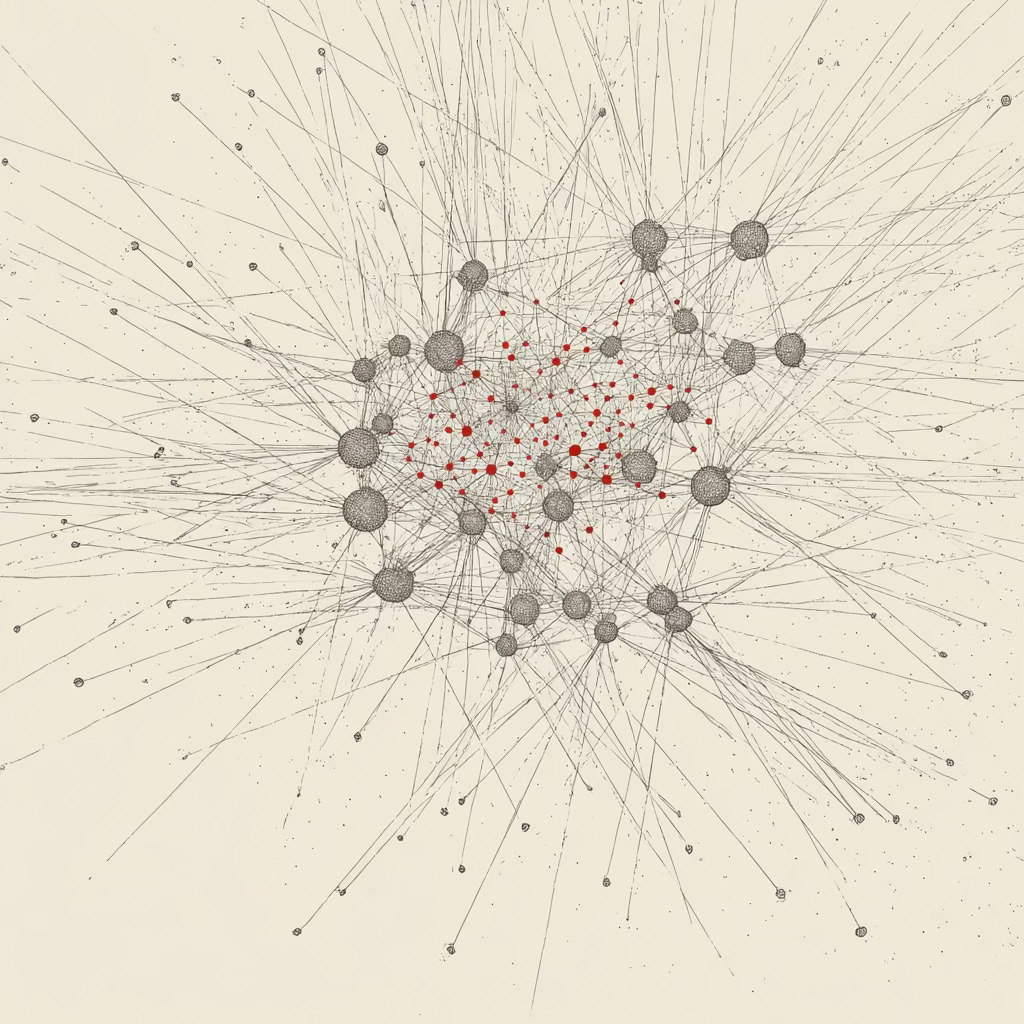
Artificial intelligence is not, it turns out, primarily about replacing humans, at least not in any simple sense. It is becoming very good at jobs where our human qualities are not a priority, where we are required to be some sort of Meat Based Algorithm. What it seems to be doing, though, for those paying attention, is amplifying capability. A small group of committed, well-organised, skilled people can now do sophisticated, bespoke work at a pace and quality that previously required an industrial apparatus. There are no committee dynamics, political overhead, or bureaucratic coordination tax. Just capable individuals who trust each other, using tools that extend their reach without diluting their judgement. We are seeing them here on Substack, as the abstractions of big businesses are replaced by mycelial networks of specialists.
Which means the bottleneck has moved; we have solved production, and we are drowning in output. The scarce resource now is something else entirely; wisdom, perhaps; judgement, taste, validation. The tacit stuff that emerges from practice and relationships that cannot be industrialised because it cannot be fully articulated. Michael Polanyi saw this clearly. We know more than we can tell. Most of what matters in craft lives in the watching and the trying, not inside the algorithm.
There is something about that kind of knowledge; it does not scale the way products do. It spreads differently, through conversation and people working in close proximity, with someone trying something, succeeding, and mentioning it to someone else who has a similar problem.
Word of mouth, not the fake kind that marketers try to engineer with campaigns and influencers, the real kind that travels through existing trust.
Which makes me wonder whether we are not, in some strange way, going full circle.
Not back to the village and the bootmaker, obviously, but to something structurally similar. A world where the primary discovery mechanism for serious work is not broadcast, but recommendation, where reputation is continuously updated rather than manufactured in bursts and being genuinely remarkable matters more than being loud.
Mark Carney used a phrase in his now-famous WEF speech at Davos that has stayed with me. Middle Powers. He was talking about nations, not superpowers, but not spectators. Countries that cannot coerce but can convene, who trade on competence, credibility, relationships and punch above their weight not through size, but through trust. Those who have no desire to be a superpower but who become indispensable through their qualities of practice, character, consistency, and integrity.
Maybe there’s a parallel. A handful of capable people, known for their craft and their practice. Called when something tricky needs doing. Too small to throw their weight around. Too competent to ignore.
Superpowers, whether countries or companies, compete on dominance. They try to control the game. Spectators accept irrelevance; they are not in the game at all.
Middle powers play differently. They become indispensable to specific situations, not because they are the biggest, but because they are the ones who can actually solve the problem in front of you.
What if we apply this to the world of work? The empire, the big consultancy, platform or corporation, competes on reach and standardisation. We can serve anyone, anywhere, using a proven, generic methodology. Just change the client name on the slide deck. The exile, the solo freelancer, or portfolio worker accepts limitations. They do what they can do, with what they have.
The middle power, though, the small atelier, tight practice or workshop, competes on something else entirely. They do a specific type of difficult thing exceptionally well, and you know this because others you trust have told you so. Their distribution mechanism is not advertising, it is being remarkable in the original sense; worth making remarks about.
It only works, though, if there is a way for the right clients to find the right practices.
In the old world, that was geography. The village, or the neighbourhood. In the industrial world, it was broadcast. Television, billboards, then the digital machinery of reach.
What seems to be emerging now is something different again. Networked reputation. Awareness of good practice because someone you trust worked with them and came back changed. The signal is not reach, it is the specificity of praise. Not everyone can or should use them; that’s the point, but they solved this exact type of knotty problem for us in ways we did not know were possible.
It creates natural scale limits, which is actually the point. We do not want infinite clients, we want the right clients, whose problems are interesting. Whose values align, who will let us do our best work and then tell others who might need similar thinking. The sort of practice that cannot be sold to deficient big business short on ideas, because relationships and people cannot be sold.
There is something both liberating and demanding about this. Liberating because we are no longer competing on volume or visibility, or trying to be all things to all people, but rather trying to be the right thing for the right people at the right time.
Demanding because the work has to actually be more than good, it must be remarkable and memorable, because the work itself is the only marketing that matters. Our reputation is continuously updated, and every engagement either reinforces or degrades our position. There is no coasting on brand, or a buffer of advertising spend to smooth over mediocrity. Accountability is very real.
If this is right, if word of mouth is returning as a vital discovery mechanism for serious work, then several things follow.
We need to be findable by the right people, not everyone. Those who have the specific problems we are built to address, which means being visible in the places where those people already gather and trust.
We need to be clear about what we are for. Not a laundry template list of services; a sharp, memorable point that travels through conversations without losing meaning.
We need to tend our network as seriously as our craft. Not networking in the oily “speed dating” sense, but knowing who is doing genuinely interesting work; staying in touch with people who have seen you at our best, and being genuinely useful when we can, not just when it’s for money. The mycelial layer that carries signals.
And we probably need to resist the urge to scale beyond our capacity for coherence. The moment we cannot maintain the quality, the word-of-mouth mechanism turns against us. We need to be small enough to stay sharp, good enough to be worth talking about and connected enough to be found by those who need us.
Not empire. Not exile. Something in between. A middle power built on trusted alliances.
I know many of you reading this, and I’m aware that in what I’m saying above, I’m in danger of preaching to the converted. I think repeating it matters. I know a lot of people who are already middle powers, but who are trapped in environments where they cannot exercise what they’re capable of. We become the average of the people we associate with. If we find ourselves not being able to exercise what we’d like to, maybe we need different company.
Because, at heart, business has always been about people dealing with people. We just forgot for a while, because we were dazzled by the machinery and the technology.
The question, then, is simpler than it seemed.
Who needs to know we exist?
And who do they already trust?
I think we start there.
Zoom will be open this evening, 4th Feb at 5:00 pm UK. Feel free to join us,
You can also consider doing the work at The Athanor…