

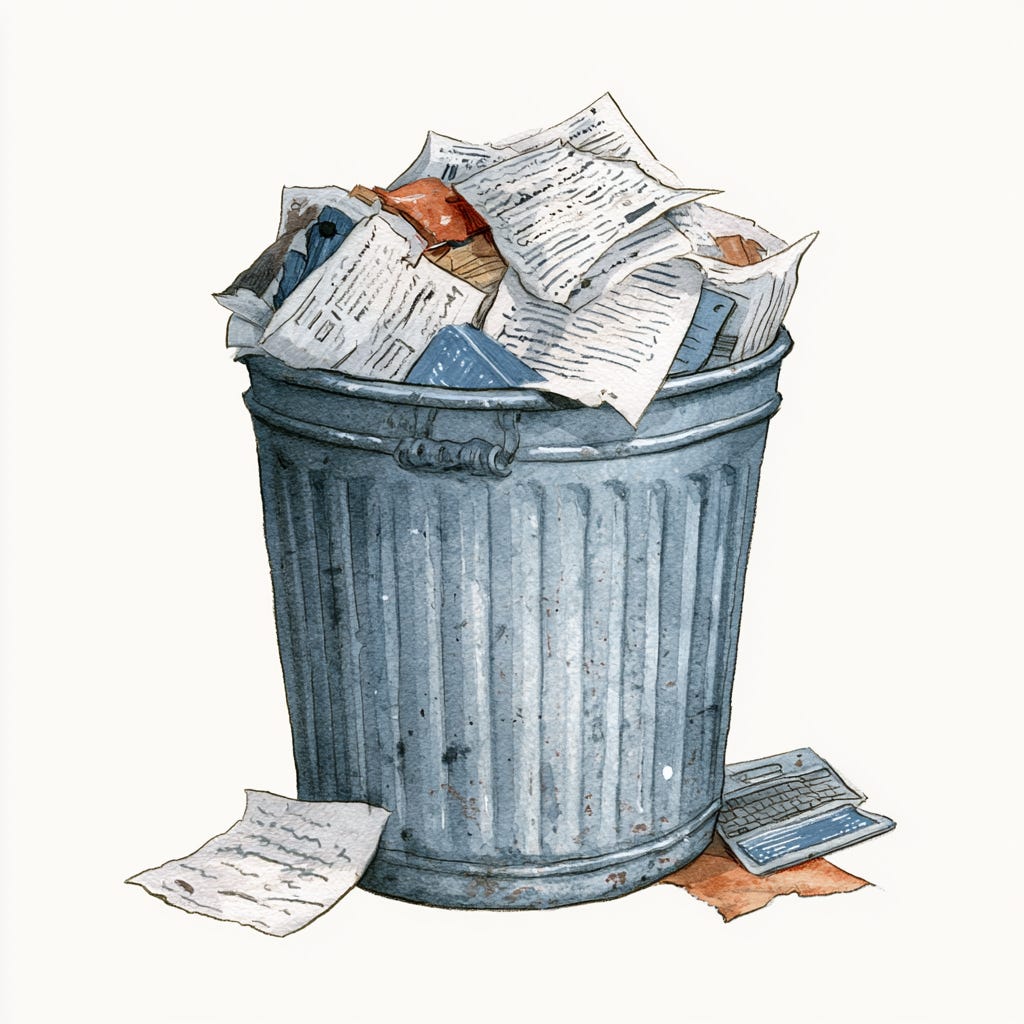
One the challenges of working on our own account is that we have to find somewhere to start. There is no one to give us a goal, timescales, budgets or KPI’s.
“The first draft of anything is shit”
Ernest Hemingway
We have to do the work of thinking, imagining, researching, drafting, reviewing, throwing it in the bin, and starting again until something gels.
It’s the price we pay for doing something original, often imperfect, with an end in mind beyond money.
And AI is an interesting partner. It will take our shitty first draft, and tell us it is the best piece in the history of mankind. Or, if asked, will look at it from as many different angles as we want. If it’s writing, it can criticise us like Hemingway; if it’s code, like Steve Jobs. Whatever we are working on, we can have it looked and critiqued in myriad different ways, and nobody but us will know.
Until, at some point, our draft stops being shitty.
Not because AI has improved it, but because we have.
It will give us more to think about, and if we ask, will research, validate, and even interview us on what we are trying to do.
What it will not do is the work of starting.
It is one of the reasons I think AI is a craft tool. It takes time to learn how to use it, to get a sense of how to work with it. It is, I think similar to the difference between an amateur using a sophisticated modern camera on fully automatic, and a professional who understands light, texture, depth of focus, timing and framing.
The first will produce a perfectly acceptable but unexceptional result, the second may just stop you in your tracks.
When photography emerged in 1839, painters like Paul Delaroche declared “painting is dead,” and critics such as Baudelaire warned the new medium would “supplant or corrupt” art altogether. Yet the panic proved largely unfounded.
Freed from the burden of mere documentation, painters didn’t disappear; they pushed into territory the camera couldn’t touch, giving rise to Impressionism and, eventually, Modernism. The lesson wasn’t that a new tool replaced the artist’s hand; it was that the tool changed what the hand was for, separating the craftsman who merely captured a likeness from the one who used the same device to say something no camera could say on its own.
AI sits in exactly that lineage: like the camera in an amateur’s hands versus a master’s, it will hand anyone a technically competent result on automatic, but it takes a craftsman’s judgment; knowing what to ask, what to discard, and when the draft has stopped being shitty, to make it stop us in our tracks.