

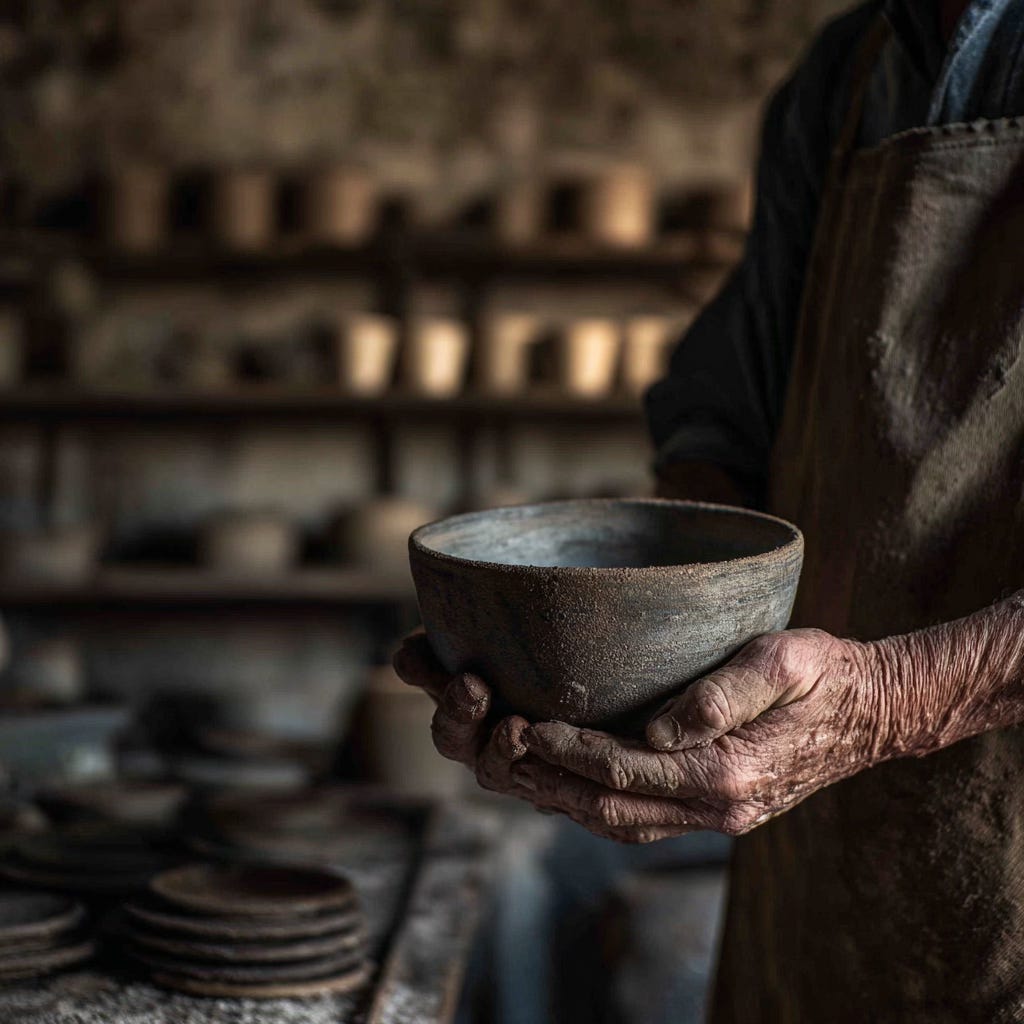
Dulce et decorum est pro oeconomia mori. It is sweet and fitting to die for the economy.
It doesn’t work, does it? The famous line, pro patria mori, that has sent men to their deaths for centuries, only functions when the thing you’re dying for has a name, a place, and a face. You can love a country and grieve a community, but an economy is a set of metrics that belongs nowhere and connects nothing but numbers.
Denby Pottery remains on my mind as we await news of its fate. It made things that lasted. Generations of the same families worked there, and people who own Denby pieces tend to keep them. We have pieces from before we were married, half a century ago. There is an almost visceral relationship between the clay, the place, the makers, and the people who bring what they made into their homes. That relationship with Denby has a name, and I’ll come to that.
What it doesn’t have, apparently, is a sufficient number on a balance sheet. And so it finds itself on life support, in the care of Administrators.
The fate of Denby is not unusual. It is the logic of a particular kind of ownership applied to a particular kind of thing, with predictable results. Venture capital and private equity do to heritage businesses what phylloxera did to the French vineyards in the late nineteenth century; moves through them systematically, leaving the surface intact long enough to extract value, and the underlying organism dead. The French, after the phylloxera crisis, developed the AOC, the Appellation d’Origine Contrôlée, precisely to protect what markets alone could not. A legal recognition that some things are inseparable from where and how they are made.
That “terroir” is not sentiment. It is substance.
Denby would have a claim. The clay is specific to that valley, as is the skill accumulated across generations of workers which is not transferable to a cheaper location. The relationship between maker and user, built over two centuries, is not a brand asset that can be stripped and redeployed. To reduce it to a number and then to act only on the number is not only fatuous, it is a particular kind of wilful short-term blindness because the thing being ignored is inconvenient to the dogma of a model.
The Greeks had a word for what is being destroyed in these transactions.
Metaxy; the between.
Eric Voegelin used it to describe the participatory space in which human consciousness exists: neither purely immanent nor transcendent, but tensioned between the two. Communities need economies to function, but an economy is not an community. Between them, between what we make and who uses it, between the place something comes from and the person who receives it, is the metaxy. The space where connection is created or severed.
In Plato’s Symposium, Diotima tells Socrates that Eros is not a god but a daimon, an intermediary being whose function is to occupy and traverse exactly this space. Daimons carry meaning between realms that would otherwise be sealed off from each other. Without them, the divine and the human, or for us, the community and the economy, fall apart into incommunicable worlds. The daimon is the activity of the between made personal.
When Rome received this idea, it became genius, but with a significant shift. The Roman genius was not an external visitor. It was the generative, animating principle of a person or a place. Every person had their genius, and every place its genius loci, its presiding spirit, the force through which it acted, created, and accumulated meaning across time.
The crucial point: the genius was not you. You collaborated with it.
Romans made offerings to their own genius. They had a choice; they could honour it, cultivate it, or neglect it. What they could not do was manufacture it or move it somewhere with lower overheads.
Denby has a genius loci. The particular clay, the generations of hands, the accumulated tacit knowledge that cannot be written in a manual or loaded into a system; these were its offerings. To close the vessel is to lose what was inside it. That is not a sentimental observation. It is a precise one.
This matters now more than it might have in a quieter moment, because we are making the same category error at scale.
The story currently being told about AI is an economic story. Valuations are built on displacement; on the proposition that human judgment, craft, and presence can be systematically replaced by process. And because the story drives the valuations, and the valuations drive the decisions, it is becoming self-fulfilling. Not because it is true, but because enough people are acting as if it is.
What the Greeks understood, and what our accounting systems do not, is that not everything that matters can be measured. Between everything we create and those who use it, there is a metaxy. We are part of its genius loci. What we do may, in many cases, be automated. But how we do it; the particular presence, the judgment under uncertainty, the mētis that comes from years of practice in a specific domain, is not separable from us in the way that a process can be separated from a person by a machine or an algorithm.
Denby may be a tragedy, but it is also a warning.
This leaves us a genuine choice. We can become centaurs, humans working with AI, directing it, using it to extend capacity while retaining the animating judgment. Or we can become reverse centaurs, humans in service of the machine’s requirements, our role reduced to managing its exceptions. The difference between these is not technical; it is a question of what we believe about ourselves, and whether we are prepared to act on that belief.
The Romans would have put it simply: are you making offerings to your genius, or sacrificing yourself on the altar of technology?
That question, what it means to cultivate your own animating principle in conditions actively hostile to it, is what we are exploring at The Athanor. Not as nostalgia, or resistance for its own sake, but because the vessel that we each are matters.
The workshop, the atelier, the intentional space where mētis is cultivated and the genius loci is tended are not luxuries in a transition. They are the point.
If you want to explore what that means for your own practice, come and have a look.
This is an urgent need:
“This leaves us a genuine choice. We can become centaurs, humans working with AI, directing it, using it to extend capacity while retaining the animating judgment. Or we can become reverse centaurs, humans in service of the machine’s requirements, our role reduced to managing its exceptions.”
However, without taking away any of the impulse to be responsible for our choices, we need to also face the submerged part of this iceberg, which is not open to free choice but to resistance. Most of the conditions that will determine whether most of us end up as centaurs or minotaurs is up to our tech overlords and how they see fit to deploy the new means of production in order to save their overstretched investment positions.
There is some free choice for those wealthy enough to secure a personal version as it inevitably becomes more expensive in the days to come. But there is no choice for the majority working in the organisations that will repay the investment of the tech overlords by switching to this mode of production.