

I continue to think about Denby Pottery. As I wrote last week, the company is in administration, and I find myself hoping that a way will be found to keep the craft and the clay together in the place they have occupied since 1809.
Administration, it seems to me, is a facet of hard power: the triumph of numbers over nurture, and of the interests of those who don’t make things over those who do. If it leads, as I suspect it will, to the sale of the assets and the transfer of the brand, then the Denby name will be exploited the way we mechanically recover meat from a bone. Something will be extracted, and nothing will be created.
The craft, though, will not disappear. It will relocate, because craft is far more than skill. It is the way in which skill is used. It cannot be recorded in a balance sheet or transferred with a trademark. It belongs to the people who practise it, to the materials they work with, and to the conversation between them that has been going on for over two centuries.
Richard Sennett’s argument in The Craftsman is that good work is fundamentally dialogic. The craftsman doesn’t impose a vision on inert material. He enters into a conversation with it, attending to grain, resistance, the way a joint fits or refuses to fit. Peter Korn deepens this in Why We Make Things and Why It Matters. Making is partly self-discovery, but it is also a form of listening. The material has its own agenda. You negotiate with it. The moment you try to force it, to make the wood do what its grain will not support, to fire the clay faster than it wants, you get fracture. The object resists because it has integrity. It will not submit.
David Pye called this the workmanship of risk. In craft, every cut, every question, every decision is live. Failure is always a moment of inattention away. There is no template that guarantees the outcome, and what matters is continuous, responsive judgement: a quality of attention that cannot be delegated to a process. It is why genuine craft is so hard to industrialise. It depends on the practitioner remaining in genuine contact with the thing being made.
I keep returning to the idea of craft as a form of soft power. I think they are describing the same underlying truth about how durable outcomes are made.
Joseph Nye described hard power as power that compels. Soft power attracts. The distinction sounds simple, but the deeper implication is the one that gets less attention. Soft power only works if you genuinely attend to what others value, what they aspire to, what they find legitimate. You cannot manufacture attraction through an act of will. A CNC machine compels; a joiner senses the grain.
If your culture, your institutions, your policies and your leaders lack genuine appeal, no quantity of effort converts them into soft power resources. The material here, other people’s values and perceptions, has integrity too. It resists.
James Scott, in Seeing Like a State, shows why high-modernist power fails so consistently. It tries to impose standardised legibility on systems that require attentive, local knowledge. The state tries to compel society into submission. It cannot. Society, like wood, has integrity.
The parallel with soft power failures is uncomfortable but precise. Cultural diplomacy that ignores local context, aid that transplants institutional templates and creates lasting damage rather than development and policy exported as finished product rather than offered as conversation. The idea that a brand is portable. These are all attempts to force the outcome that the material will not support. They fail not because the intention was wrong, but because the epistemology was wrong.
Adam Kahane’s concept of generative power points in the same direction. Power that opens and creates is structurally different from power that closes and controls. The craftsman who listens to wood and the diplomat who listens to culture are engaged in the same epistemic practice. Albert Hirschman offers a useful way of reading what happens when that practice is abandoned; when you try to force compliance from a system that requires genuine engagement, you eliminate the conditions for voice. What you get back is either exit, or a performance of loyalty that holds only until it is tested.
What all of this points toward is a particular quality of attention: attention that takes the integrity of the other seriously as a condition of the work, not as an obstacle to it. Call it constitutive attention. Both craft and soft power are practices of this kind. They work by staying in genuine contact with what they are working with, following its logic as much as imposing their own.
We cannot craft something into submission. This is not simply a warning about method. It is a description of how reality is structured.
Which leaves a question worth sitting with. When technology is used as hard power, when the lathe becomes a weapon, and the algorithm becomes a mandate, where does the craft go?
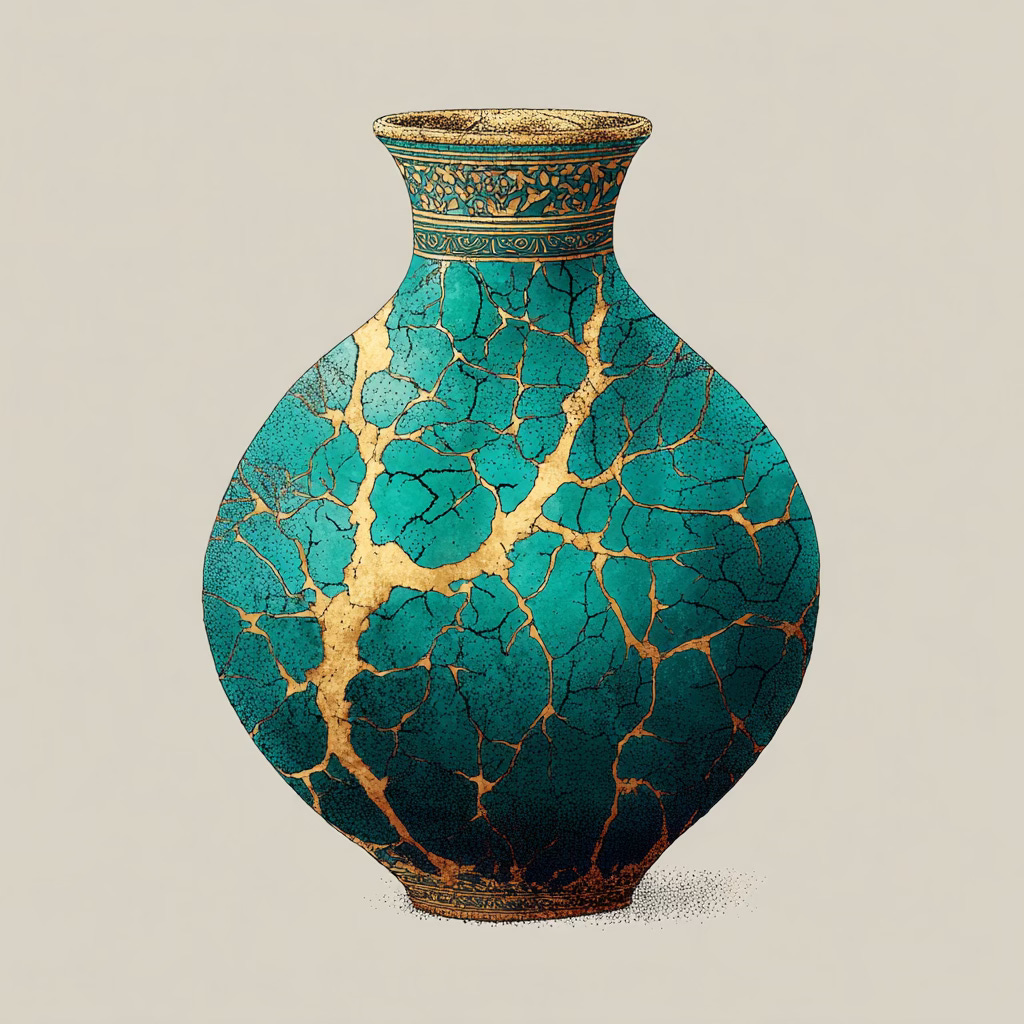
It does not disappear. It relocates. Kintsugi is the practice of repairing broken ceramics with gold, so that the fracture becomes part of the object’s history rather than a flaw to be hidden. The break is not erased. It is honoured.
We seem to have a surfeit at the moment of people who revel in their ability to break things they do not have the patience or curiosity to understand. Craft is the opposite impulse: to attend, to repair, to make something that can live with its own history.
Craft has patience, persistence and soul. That is not softness. It is the only kind of strength that lasts.
There may be an important distinction to make here: I agree with you that craft is soft power and works the way you describe, If I read your use of the word "craft" as "a craft-like approach". That is dialogic and has the other components you name.
Looking at your Denby pottery example, however, I am not sure that, as you say, "the craft will relocate". The craft of pottery may not relocate. There are crafts which over time have been lost in the same way that some languages (which I would count as a form of craft) have been lost.
So what will relocate? Certainly, people who prefer to take a craft-like approach will find ways to practice that approach elsewhere. The disposition survives. The craft of Denby pottery may not. In the long term, the overall craft of pottery may not survive - or it may degrade, like other parts of ancient skills have.
And that is two levels of the term "craft": dialogic approach vs. the specific dialogue.