

The Overlooker’s Moment
The house I live in has seen this all before. The River Derwent flows through the bottom of the valley, and was the spine of the Industrial Revolution. A few miles upstream is Arkwright’s Mill at Cromford, in which we can see a perfect microcosm of the shift from the “golden age” of the independent artisan to the rigid discipline of the factory, and finally to a new class of technical specialist. I think there is something in that story we need to pay attention to right now.
Before the 1770s, weaving and spinning were largely domestic “cottage industries.” Artisans possessed holistic skills, managing the entire production process from raw material to finished product. Mastery of the handloom and the spinning wheel required years of apprenticeship, and these workers had high levels of autonomy, controlled their own hours, and owned their tools.
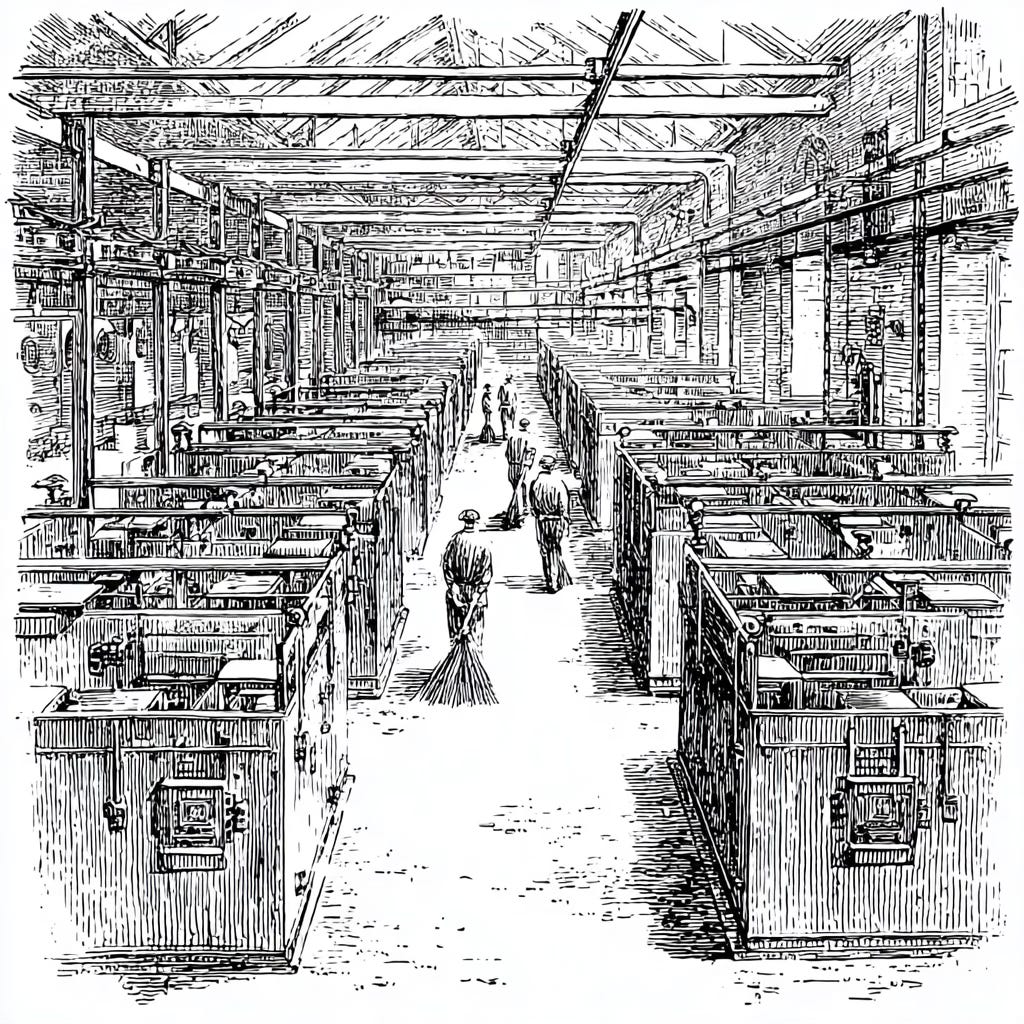
When Arkwright introduced the Water Frame (patented 1769) it effectively “de-skilled” the spinning process. By using water power to drive the rollers, the artisan's physical strength and rhythmic intuition were no longer required to produce high-quality warp thread. When Arkwright opened Cromford Mill in 1771, he didn’t look for skilled weavers; he looked for cheap, compliant labour. Because the machinery performed the complex task of drawing and twisting the fibre, the human role was reduced to “minding” the machines. By the late 18th century, a significant portion of the workforce at Cromford consisted of children as young as seven, and “skill” was replaced by the need for cheap dexterity and stamina. The tasks were repetitive: piecing together broken threads, cleaning dust and fluff from moving parts. The worker was no longer a creator but a small, replaceable gear in a larger mechanical system.
It sounds horribly, currently, familiar.
But Arkwright’s conviction that his Water Frame was so automatic it only needed children to mind it lasted about a decade. The machines were temperamental beasts; rollers misaligned, water power fluctuated, threads snarled, entire lines stopped dead. Downtime meant thousands of pounds sitting idle, and Arkwright quickly realised he needed something his original vision hadn’t accounted for: Overlookers who understood the mechanical heart of the system.
These weren’t the old artisans in different clothes. They were a new hybrid, part mechanic and part manager, enforcing factory discipline on children who’d never worked by the clock while managing belt tension and lubrication. The need for skilled supervision emerged through trial and error, with management by physical coercion until Arkwright discovered that terror-based management actually increased machine breakage.
Meanwhile, the independent artisans who’d been displaced didn’t accept their obsolescence gracefully. The Luddites smashing frames weren’t opposed to technology; they were responding to the perceived theft of their craft and their independence. The older weavers who simply couldn’t compete with the sheer volume the mills produced were structurally displaced, regardless of their skill. Their craft hadn’t become worthless; the conditions in which it could be practised had been dismantled around them.
The Complexifying Stage
As the 19th century progressed, the machinery at Derbyshire mills grew increasingly massive and complex. The “automatic” nature of the factory began to require a new kind of high-level worker to ensure the system didn’t collapse under its own weight. A new class of elite workers emerged: Overlookers and Mechanics who didn’t just operate machines but understood the logic of them. These workers required a blend of the old artisan’s “feel” for the material and a new, scientific understanding of mechanics.
It seems to me that this is precisely where we are with AI.
The initial excitement has been about deskilling, about the prospect of cheap cognitive labour. We are told that AI can write our reports, manage our projects, analyse our data, handle our customers. The promise is the same one Arkwright made: the machine is so capable it only needs children to mind it. But as anyone who has used AI for anything consequential knows, we are entering the complexifying stage. The power of what has been invented creates conditions that require skills and perspectives we have not considered in our excitement at the prospect of cheap labour.
The overlooker’s job was not to operate the machine. It was to understand when the machine was wrong, to notice the subtle signs of misalignment before an entire line stopped dead, to hold in their head a model of how the whole system worked so they could intervene at the right point and in the right way. They needed the old artisan’s feel for the material combined with a new understanding of the mechanical system. Neither alone was sufficient.
This is the hybrid we need now. Not someone who can prompt an AI (the equivalent of minding the machine), but someone who understands the logic beneath, who can feel when the output is wrong even when it looks plausible, who knows enough about the domain to supervise rather than merely delegate. Someone who, when the system produces confident nonsense, has the first-principles knowledge to catch it.
First Principles
AI is not starting from scratch. It is automating what has already been partially automated. It is not the start of a revolution; it is a further intensification of what began when computing found its way into our working lives. Each wave has deskilled one layer while creating demand for a new kind of oversight at a higher level. The pattern is consistent. What changes is what we need to oversee and the kind of understanding required to do it well.
First principles means remembering what is at the core of your craft. The ability, if needed, to start from scratch. To create a profit and loss and balance sheet by hand from a pile of receipts in a Tesco bag, to code by hand, or to manage a project without resorting to software. Ancient, legacy skills, but as with legacy technology, the foundations on which what we do is built. It is where craft, mētis and networks of knowledge are created.
Our clients don’t care what tools we use. They rely on us to know what tools to use and, if necessary, to improvise. They want reliable outcomes, not a detailed explanation of the reasons why our system is down, or why it has made a basic category error because we had delegated but not supervised. They want accountability. That has not changed since Arkwright’s day; it will not change in ours.
In an always-on culture, it is easy to accept that the process is the work, that KPIs capture the value of what we do, and that value is determined by the bottom-left-hand corner of the profit and loss. To accept that is to become the fluff in the machine, the same fluff those children once cleaned from Arkwright’s rollers: something to be brushed away to keep the machinery running smoothly.
The Question of Access
There is something else the Cromford story teaches us, if we are honest about it. The overlooker’s path was not available to everyone. The children minding the machines did not, for the most part, become the mechanics who understood them. Access to that transition depended on conditions that were unevenly distributed then, and they are unevenly distributed now. The ability to invest time in understanding first principles, to step back from the immediate demands of productivity and develop the kind of deep knowledge that makes genuine oversight possible, is not equally available to everyone in a world that demands constant output. If we are serious about the artisan’s path, we need to be honest about who gets to walk it and why.
Where This Leaves Us
When we talk about AI displacing knowledge workers today, this is the shape transition actually takes. Not smooth evolution, but breaking points that force new configurations of human capability into existence. The Cromford weavers were not inadequate. They were caught in a structural shift that dismantled the conditions for their craft faster than new conditions could form. The overlookers who emerged were not superior people; they were people who found themselves, through circumstance and disposition, in a position to develop a new hybrid competence.
We are at that point now. The question is not whether we can use AI. The question is whether we understand the thing we are using well enough to know when it is wrong, to supervise rather than merely delegate, and to maintain the first-principles knowledge that makes such supervision possible. Whether we can be overlookers rather than machine-minders.
The Derwent still flows through the bottom of the valley. The mill at Cromford is a museum now. The pattern it set in motion has not finished with us yet.
We will be meeting this evening, 5:00 pm UK as normal on Zoom….