

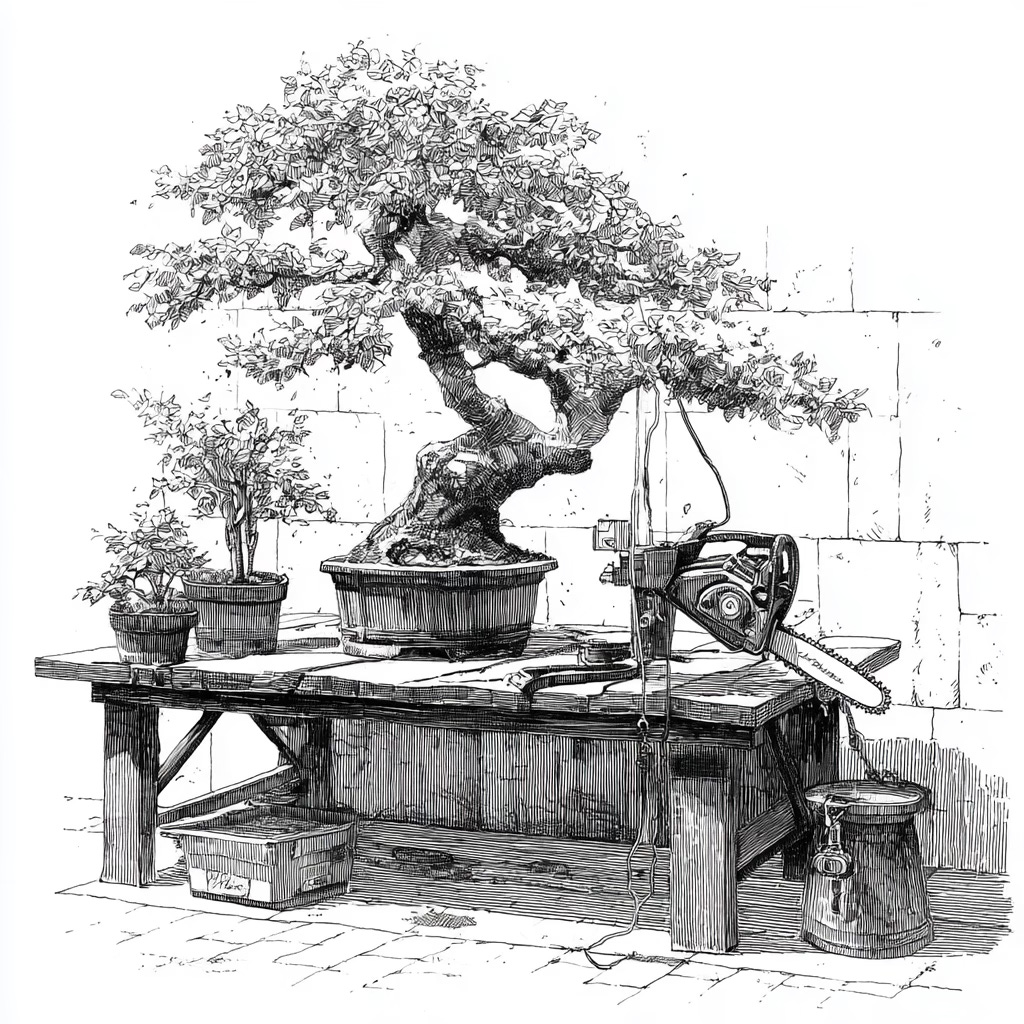
Whilst it is only ever an abstraction of what we think, see and sense, language has astonishing power to inspire, repel, evoke love or hate, diminish or expand.
We can either use it as a Bonsai Master, a bonsai-shi, paying exquisite attention to every aspect, or we can use it like a chainsaw, all noise, fury and speed.
Algorithms are chainsaws, and those who use them often dress themselves in the protective clothing of policies, protocols and processes that distance them from the collateral damage they cause.
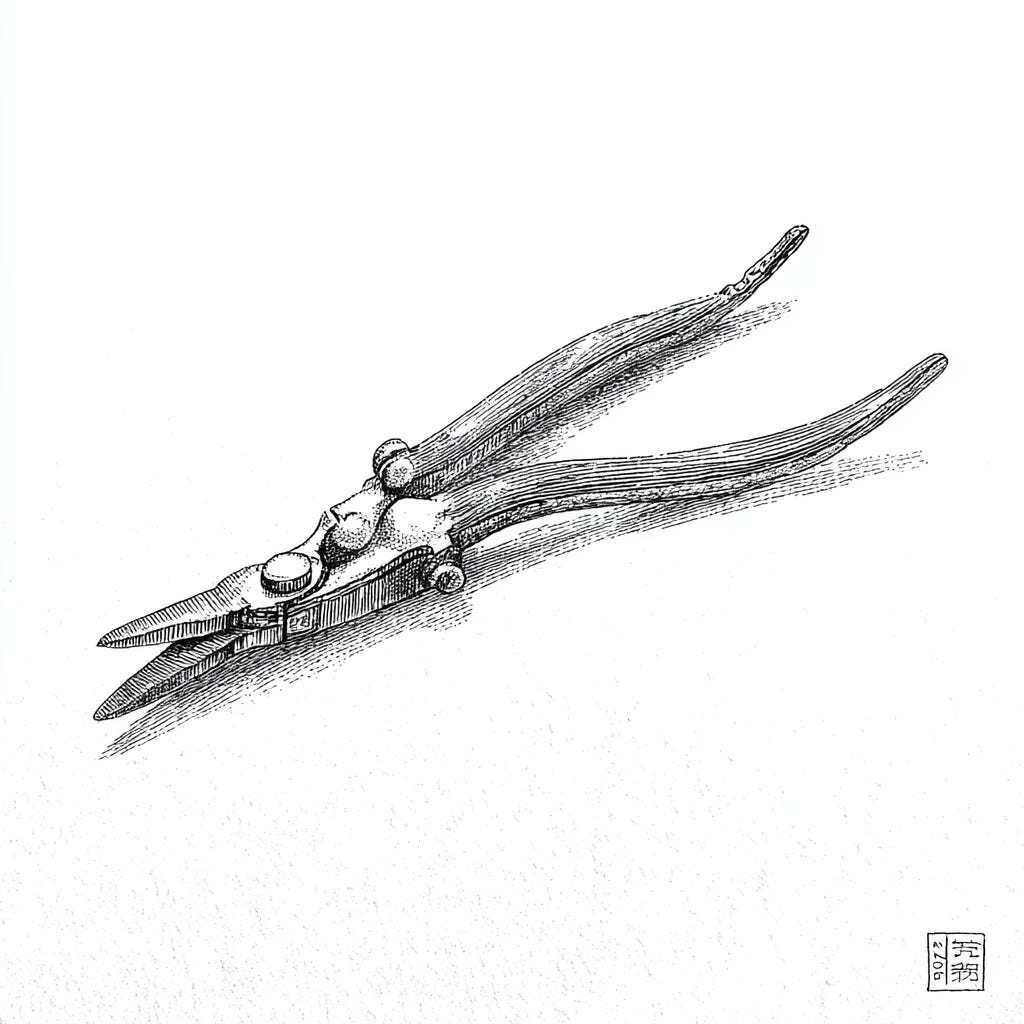
High-growth businesses, by and large, like chainsaws. Get the job done and treat the damage as an externality to be socialised. Family businesses are often different, which is why so many of them, like bonsai, are much older than they look. Their language is different, more akin to the hasami, the delicate shears used by Bonsai Shi that are used to follow the natural growth of the tree rather than the overwhelming force of the chainsaw that imposes its will upon it.
There is something similar in our approach to AI.
Some see only the quick wins, the lumber rather than the grain, and use AI like a chainsaw to reshape business models and processes. Everything is agentic and optimised, as the broader consequences are quietly pushed onto communities.
Then there are artisans, the Chi no niwashi, Gardeners of Wisdom. They use AI differently, as a tool of inquiry rather than a shortcut. They are patient with it and look for the subtle cues in what its power reveals, rather than forcing it to mimic what already exists. They observe how ideas grow, branch and sometimes fail as they shape and prune with intent.
The result is not needless automation but capability; not efficiency but discernment. They work with AI as a reflective companion, something that sharpens the eye rather than dulls it, revealing the quality of grain and texture as it questions assumptions and brings information we did not know we did not know into play. Decisions are slower, but more rooted.
This is AI as craft. Hasami prompts rather than chainsaws.
If the bonsai metaphor helps us think about individual practice, forests help us understand the systems that emerge when many practices sit together over time.
Monocultures and Slow-Growth Forests
Chainsaws are at their most cost-effective in purpose-grown monoculture forests. These are planted for access, fast growth and predictable short rotation cycles. Cut and come again. Excellent for the bottom line, but not for the ecosystem. Fast growth but shallow roots, vulnerable to pests, disease and climate shocks. The price of happy shareholders is little diversity, depleted soil, and dependence on external inputs. Fragile, but impressive on spreadsheets. Much the same mindset underpins the extractive, quick-win approach being applied to AI across so much of business.
Slow-growth forests, such as those promoted by Pro Silva, are different. Structural diversity, a multi-level canopy and continuous renewal support wider ecosystems and resilience under stress. Returns appear more slowly and emerge through stewardship rather than fast extraction. They require skill, patience, observation, a craft mindset, and they carry a multi-generational perspective with legacy in mind.
AI is an outstanding technology, but adopting an instant forest approach will not only cause unnecessary disruption and damage, it will also mean we miss what we might learn by allowing human curiosity to meet technical capability.
It is hard not to feel we are applying artificial fertiliser to something that would be better grown naturally, yet, as in every bubble, greed exploits story before substance. We will benefit from the technology, but likely only after the carnage of a crash.
In the meantime, we each have to decide about our relationship with AI.
Chainsaw or Hasami?
If your instinct is more bonsai than bulldozer, you might like to join us over at The Athanor as we explore how craft can matter in a scale obsessed workplace.
The boom part of AI, Large Language Models, may indeed be useful to those with a 'Bonsai-sin' mentality but the economic model is that of the monoculture forests and chainsaw. Appreciation of the grain will not satisfy the demands of the model, and so when the market for AI lumber collapses, we may well lose much of the AI bonsai as well.