

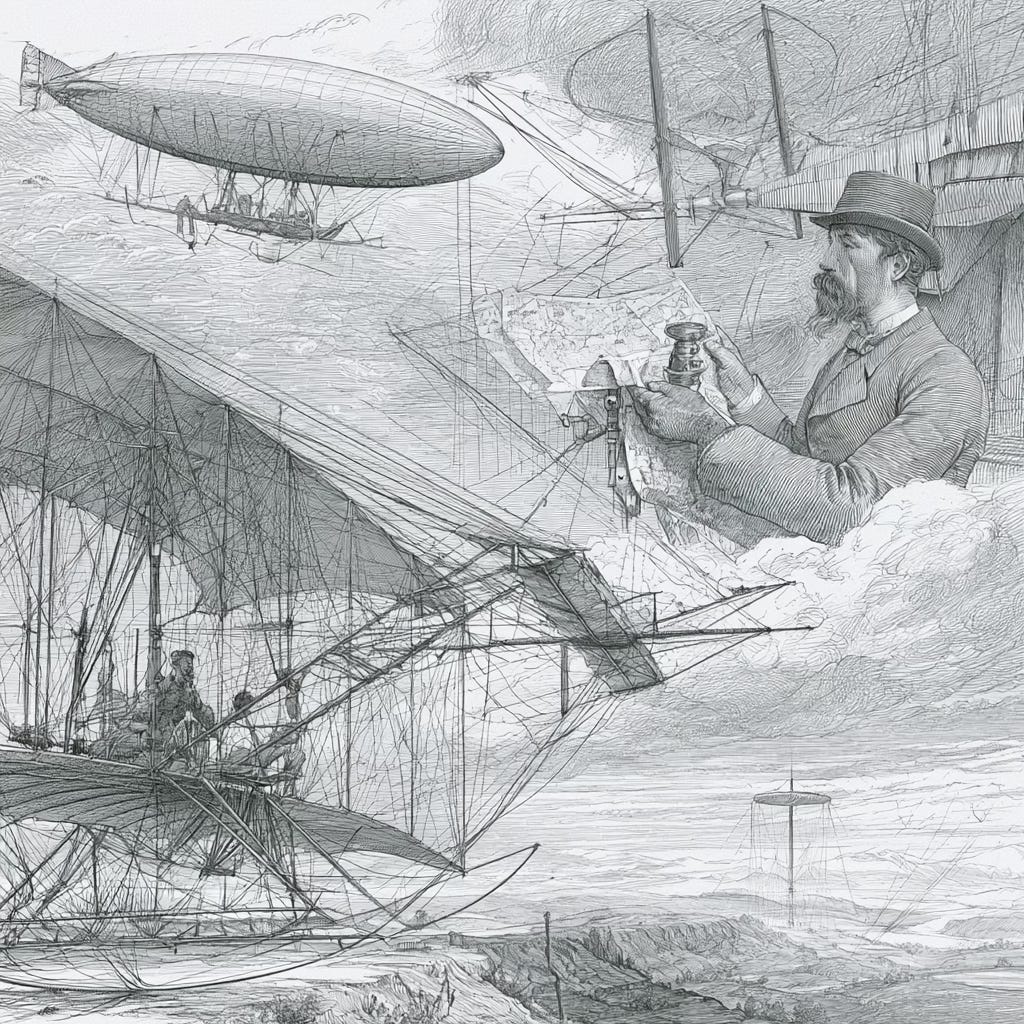
Most of us do not design the tools that we use. We find ourselves doing our best with tools created for us by people who don’t know us, and in doing so, find the flaws that they were mostly unaware that they had created. One exception that stands out to me is John Boyd. He was so dissatisfied with the aircraft the US Air Force designed to do everything and maximise production budgets, but turned out to do nothing particularly well, that he went and did a degree in aeronautical engineering and designed his own. Through his Energy-Maneuverability Theory, Boyd used mathematics to map out exact advantages in thrust and drag, allowing pilots to outmanoeuvre opponents rather than just outrun them. His groundbreaking approach fundamentally changed air-to-air tactics and directly inspired the agile design of legendary modern fighters like the F-15 and F-16. Put simply, accelerate faster, slow down faster, and change direction more quickly than the situation you find yourself in.
I’ve been test-flying AI for the last 18 months. I could no more build it than I could build the aircraft I once flew, although that doesn’t stop us putting in the effort to fly it to the best of our ability. What I’m starting to realise is that the AI we’ve been given is like those aircraft that were designed to do everything, but ultimately did no single thing with excellence (other than make money for the manufacturers).
A vanishing point is a specific spot on the horizon line in a perspective drawing where parallel lines appear to converge and fade away. It is a foundational concept used by artists and architects to create the illusion of three-dimensional depth on a flat, two-dimensional surface. I think AI has a vanishing point, in that, it gives us an illusion of capability. It will give us an illusion of a horizon based on data. It cannot convey a real horizon that incorporates what it cannot see or understand, the qualities that make us human.
As humans, we have our own Energy-Manoeuvrability Theory. The word emotion comes from the Latin emotere, meaning "energy in motion." When it comes to AI, emotion is the energy it cannot supply. It can make us incredibly manoeuvrable with data, but not give it purpose or meaning. That’s our job.
So, we have to learn to work with it, in the space beyond the illusory vanishing point.
Emotion is what Craft and Métis bring to what we do. It cannot be counterfeited (other than to the willingly gullible) nor can it be outsourced. Other people may love the work you do, but they cannot love it for you.
In So Good They Can’t Ignore You: Why Skills Trump Passion in the Quest for Work You Love (2012). Cal Newport’s argument is a direct inversion of the “follow your passion” advice popularised by Steve Jobs’s 2005 Stanford commencement address. Newport calls this “the passion hypothesis”: the idea that the key to occupational happiness is to figure out what you’re passionate about and then find a job that matches it. He argues that this advice is not just wrong but actively harmful; leading to anxiety, chronic job-hopping, and the daydreaming dissatisfaction of always imagining a better job elsewhere.
In its place he proposes what he calls the craftsman mindset: an approach to working life in which you focus on the value of what you’re offering to the world, rather than on what the job offers you. Passion, on this view, comes after you put in the hard work to become excellent at something valuable, not before, and that what you do for a living matters less than how you do it.
AI is a formidable invention that will not go away, but wherever it is applied, it will have a vanishing point, because it does not have, nor I suspect ever will, have complete information. Completeness needs us.
Whatever you do with AI, you will not love it until you learn how to fly it. There are no instruction manuals, not best practice, because we are the only one of us there will ever be, and we all fly differently.
Go fly.
A flyer of the first order…
If you like music, and artisanal attitude, you will like this. Sent to me by Mark E, a good friend I have yet to meet. I love it when people connect me to stuff they know I will love that I did not know about. Craft like this is enough to bring tears to my eyes.
The question of passion is an interesting one. I'm passionate, but I am more interested in the effect or impact of passion. What does passion change beyond the motivation of the individual?
It reminds me of twenty years ago when I became interested in gratitude. It is a feeling that is like passion. At that time, people were creating gratitude boards in their offices and kitchens.
To me, there was something unsettling about that.
I realized that the whole focus of gratitude was about how I feel. Not who I was grateful toward.
So, I created The Five Actions of Gratitude.
1. Say Thanks
2. Give Back
3. Make Welcome
4. Honor Others
5. Create Goodness
The real idea behind this was to change how business relationships function. Simply put. Do one of those actions every day, and do each of them at least once a week. Keep track. See what happens at the end of the month. Do it another month. Do customer service surveys to see if they see a change.
My gratitude alteration operated like Boyd, forcing change in how fighter jets are designed. Before, the goal was self-serving to the Pentagon and its aircraft suppliers. Afterward, Boyd's design work changed modern aviation.
I'm still working on the gratitude program. Thank you, Richard, for another excellent piece.