

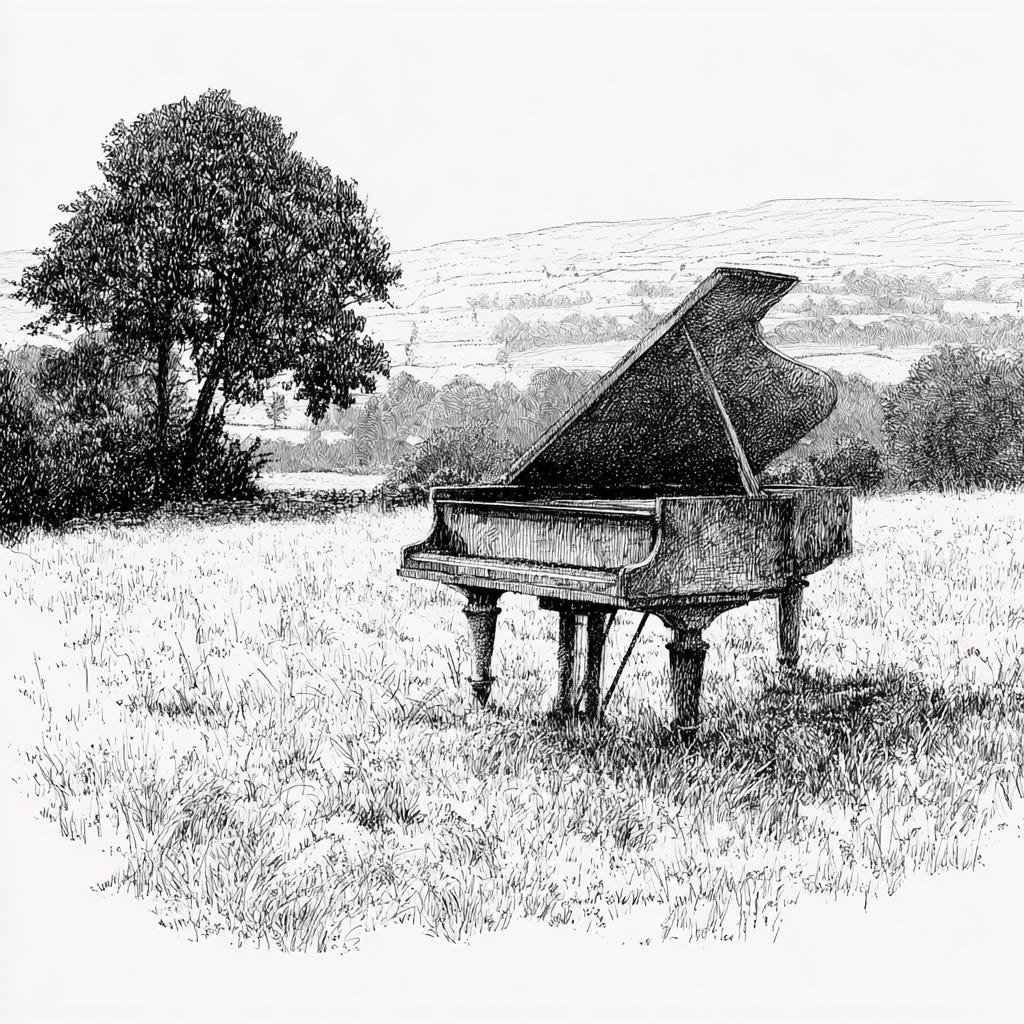
Sometimes, we just get lucky.
For me, this last Sunday, lucky meant living in a small Derbyshire village, which through a combination of serendipity, dedication, and hard work found itself hosting Jools Holland’s Rhythm and Blues Orchestra. It was part of a weekend festival set in a set of playing fields by the river. Is small, both by choice and physical constraint, so I got to see one of my favorite acts of all time in a crowd of less than 2,000 people. The organisation of it was brilliant, and the numbers meant you could do things you can’t normally do at a festival, like walk up to the stage. The setting felt more like a private audience than a public festival.
The real revelation there was seeing a display of artisanal mastery I will not forget. It was a stunning demonstration of someone holding a group together and putting them on show. Jools Holland derived his authority not from being at the front, but from making sure other people were, and from gluing them together. There was a lovely part where he acknowledged this piano, how important it was and the difficulty of getting it around the various venues. This was his piano, not a piano, and it was his partner. Throughout a two-hour stint, while everybody played together, the various members of the orchestra, each brilliant in their own right, gently rotated to be the centre of the action. Stunning saxophone, Double Bass and Guitar solos, and a 10-minute drum solo by Ed Richardson, the new drummer of the band, that took me back to Ginger Baker and Cream. (I am now that old :-))
Perhaps the overriding impression I came away with was the one of just seeing people play for the joy of it, connected to each other and the audience in a way that had an intimacy to it. It was agency at its best, a combination of self efficacy, context, connection, and purpose that was tangible. In a small Derbyshire field, in beautiful weather, on a Sunday. As I say, sometimes we just get lucky.
Luck, though, is not random. The golfer Gary Player is often credited with coining the line “the harder I practice, the luckier I get.” We could probably have had any one of a number of other well-known acts on that field on that Sunday and not had the same experience. The music would still have been brilliant, but the way it was generated may well not have created the connection that this did. It’s a personal thing, so I’m not making an argument that it’s always right, other than the reality that it was right for a group of people on that day.
I can’t help but wonder what it would take for a business to operate like that. The leaders in the business make the effort to display the people who do the work rather than take credit for it. To acknowledge the importance of the equipment they use and their relationship with it, and perhaps above all, to convey the joy that they get from the work they do.
It’s not impossible, but it’s probably a choice. I know and have worked with businesses like this. Their success often attracts investor interest, and once investors are involved, the business can keep growing, but the joy is lost. The business becomes about the money, not the music.
And it’s the music we remember, not how we earned the money we paid to hear it.
They are one of my favourite acts as well. Not just for the virtuosity and craft but because it is a shared endeavour and they are obviously enjoying it enormously. They are joyful. What is businesses aimed to be joyful? That would be truly transformative - although I doubt it would be understood by investors.
Brilliantly stated Richard. Thank you for sharing.