

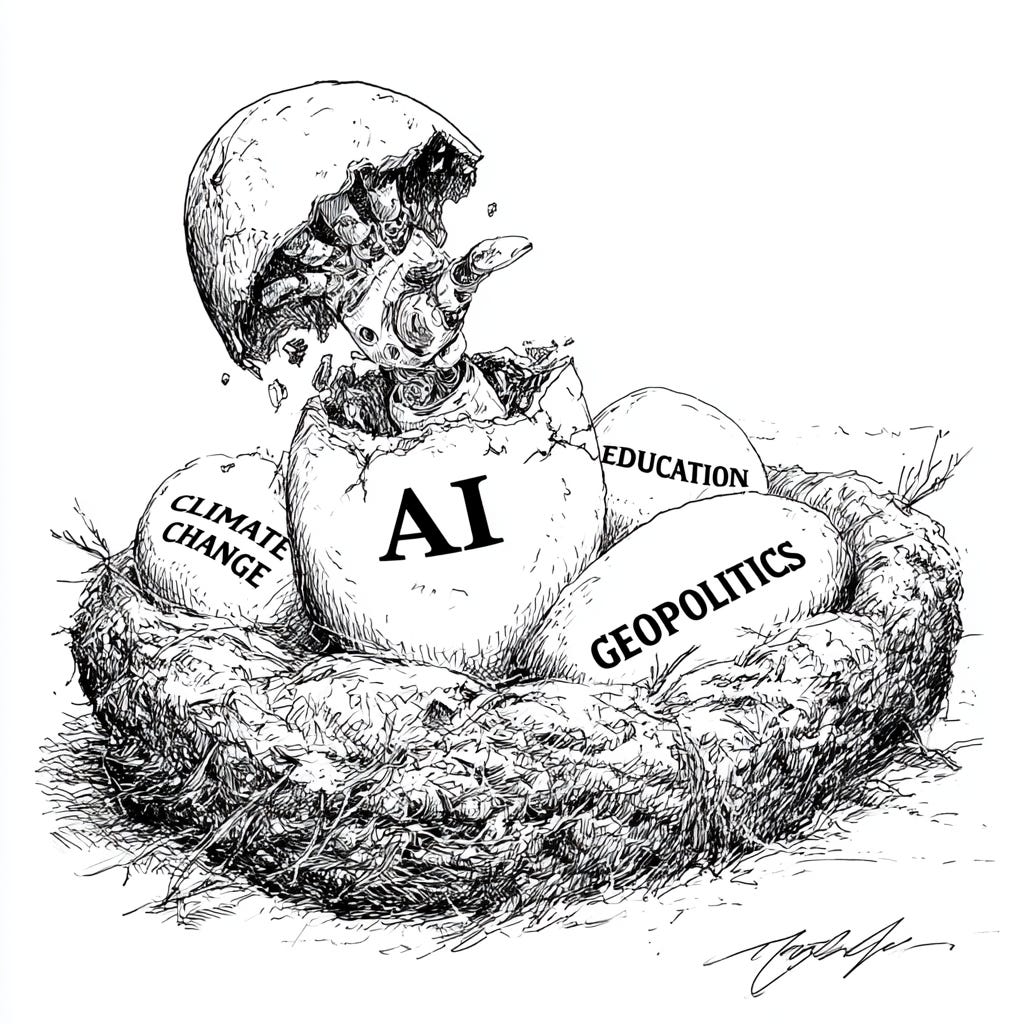
I think that AI is a like climate change. We’ve seen the signs of it coming for decades but have chosen to do nothing about it. Something ignorable while things are happening gradually change when it tips over into suddenly.
Scientific management was perhaps the first indication of embryonic AI when we took what relied on human judgement and turned it into more efficient but less flexible process, creating a division between head and hand, and management and labour. Then the exponential curve started as we moved through total quality management, Toyota Production System, Business Process Engineering, then into Agile,Scrum and now AI.
Roger Martin wrote decades ago about his knowledge funnel, converting mysteries into heuristics and heuristics into algorithms. It’s one of those really simple but elegant models that we can hold up to what’s going on see it reflected back at us.
In many ways corporations were the first primitive institutionalisation of AI as they used the algorithms of scientific management and its progeny to scale what was once craft. In doing so they dramatically reduced its cost but also its affinity with our humanity. Scale increased the ubiquity and availability of what was once small scale specialised production, but in doing so robbed it much of its identity. Any colour you like so long as it’s black. It was a reasonable trade-off as we became materially better off even as we sacrificed our identities and increasingly our communities as we climbed the ladder of scale and localities gave way to globalisation.
And now where we were once willing to let process separate hand from head we are now separating head from judgement. Just as Clausewitz described war as the pursuit of politics by other means, so AI is the continuation of process by other means.
Which was fine when we sat in the middle of the life cycle curve.
We can’t really establish processes until we know what we’re doing. We need the data, the analysis and a reasonable degree of certainty in terms of the marketing environment in order to apply process. We have to be able to analyse what we do from step to step in a predictable way. We cannot do that at the beginning of the life cycle quite simply because we’re still working it out, nor can we do it at the end of the life cycle as the rate of change runs ahead of our ability to analyse and organise it, and process fragments.
I think that whether we like it or not, we are at the beginning of the next life cycle and that trying to use AI to improve the old life cycle is largely futile. As that icon of the previous age, Henry Ford, observed, if he’d given people what they thought they wanted he would have invented a faster horse.
Put another way we are now at a point where the processes that were so efficient until very recently can no longer keep up, 
And that carries with it an associated problem. The data sets on which our AIs are trained comprise that previous knowledge. They will give us a sweet spot while we drink the last dregs of that knowledge to improve what we already do, but to continue to develop we need new knowledge, and new ways of organising that knowledge.
At the same time as AI enables us to automate what we already know how to do, it creates a minefield for those choosing to delegate to it, dismantling the totality of their job and working out in reality who is working for who. Then there is the really interesting aspect, as AI offers individuals and small groups with ideas massive leverage in materialising those ideas. It is these people who will develop the new thinking from which, as they become established, new processes will emerge.
It is why I think that working with AI, for a time, will be a craft. Yes, it will eventually succumb to process, but not until what the artisans who master it have brought about the changes that will make our current familiar processes obsolete.
Despite that, the indications are that most of us are paying lip service to AI. Despite being a dominant topic of conversation, there are far more casual observers than there are those making the effort to orient themselves to what it might mean to them.
Beneath all the rhetoric, the reality is that we have a technology that will change how we work.
What it will not do is replace us.
It is asking questions of each of us as to what we really do, as well as offering us the chance to stand up as who we are, not just process operators. Whether or not we like the idea, we own this.
What we cannot do is ignore it.