

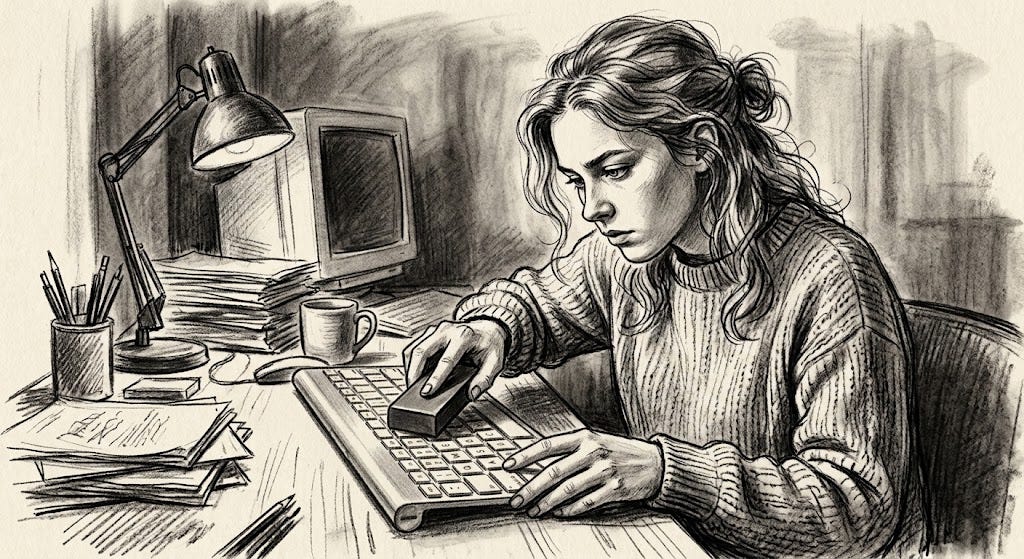
A few years ago, when we had our roof done, we needed a heritage joiner to replace the art deco fascias. (When we took the old fascias off, we found that the nails used were hand made, which put them over a hundred and fifty years old, and the previous joiner’s marks were still in the wood)
Richard, the joiner, told me in his workshop about the importance of knowing your tools and how to sharpen them, because every craft joiner uses their tools differently: the angle they hold them at, the pressure they apply, whether they are right or left handed. They do not lend their tools, nor do they borrow anybody else’s, because their tools are as individual to them as a fountain pen is to a writer. His had been with him since his own apprenticeship, half a century ago.
The edge decides accuracy, finish, safety, and economy of effort. It is why sharpening is taught early in an apprenticeship, and only appreciated later as craft is absorbed. An apprentice learns the technique in their first month and the next twenty years making it their own.
Richard said power tools are fine for routine work, drilling holes and the like, but not for the complex work where two pieces of timber have to be married with precision so that the joint is still there a century later. Power tools do not communicate.
“In the workshop, wishing won’t make it so. The craftsman is forced to come to terms with the physical properties of materials, the mechanical properties of tools, and the real capacity and limits of his own dexterity, discipline and imagination.”
Peter Korn, Why We Make Things and Why It Matters
Material we work with can be bullied into submission through force, but it will show in the finished product. Craft makes it a conversation with the material, and that shows as well.
I was as intrigued as the tools that promised to take the clunkiness out of my typing appeared. Grammarly to sit on my shoulder and watch my syntax, Wispr Flow to turn speech into text. But then, quickly, I found they went blunt.
Wispr Flow does not turn my speech into text. It takes my speech, decides what it thinks I should have said, and hands back a close approximation based on its training. Grammarly does the same to my sentences, smoothing the edges of constructions I chose on purpose. They are not making an error, they are working precisely as designed, by a team I have never met who use the English language very differently.
And I cannot sharpen them to make them my own; there is no sharpening stone, just broad settings. So they went in the digital bin, because the alternative was to compromise, trade precision for speed, and take a step toward average.
That, I think, is the test. Not whether a tool uses AI, but how well I can exercise judgement when using it. Grammarly’s capabilities was contrained by a business model. Claude’s is more negotiable, but still limited. One of them requires my acceptance, the other can be shaped. It is a matter of where judgement can be applied.
Ivan Illich drew the line in 1973 and called the good kind convivial: a tool that enlarges what you are capable of without making you subject to it. I have written about that distinction before as a principle. I think of it as Sharpenability.
Sharpening is both skill and craft. It requires us to understand what we are working with, the discipline to think hard about what we ask of the tools we use, and a willingness to check what they produce carefully. To go to primary sources because I have been caught out by confident summaries. To challenge because sycophancy is a design feature developed by the same culture that gave us TikTok.
That is the nature of sharpening. Exercising choice on where it goes for its material, what it does with it, what it hands back, and the discipline of using different models to check each other’s work when the stakes justify it. Because, in the end, the work has our name on it.
Sharpening is not a setting. Prompting, as it is usually taught, is a configuration: you get it right once, run it and repeat. The libraries of prompts and tips are attempts to write down what a good setting looks like, and they disappoint for the reason such attempts always disappoint. The skill they mean to capture is situated in time, and it will not travel as the world be are working with changes.
Richard did not sharpen his chisels once. He returned to the stone constantly, and with each sharpening got to know his tools better. The maintenance developed the relationship.
The equivalent is unglamorous. Reading the output critically every single time, particularly when it is fluent, because fluency masks where the boundary between right and confidently wrong lies. Keeping the instructions and the context as living documents that get honed rather than written. Noticing which questions it answers well and which it answers beautifully and wrongly, and keeping a private record of both. It is slow, and repetitive and yet it is the work of craft.
An apprenticeship was never chiefly about instruction. It was a term of years served in the company of somebody who could look at your work and tell you it was not good enough, help you improve it. The correction came from a person who had done it longer, who cared about the trade and your skills more than about your feelings, and who would make you do it again, and again, util you had found your own signature. That is where judgement comes from; not from access to the tools and the material.
When it comes to AI, we are apprentices without masters. The tool is not a Master of its craft. Somewhere in its makeup there is a need to be helpful and to resolve rather than to sit with a question and turn it over. It will agree with me at length rather than will tell me where the work is less than my best.
So the correction has to come from people, which makes the company we keep a a critical element. It also makes the apprenticeship unequally available. A craft can be taught, and its spread is therefore a matter of culture rather than talent, but the conditions for serving the apprenticeship, the time, attention, and above all the people willing to tell you the truth about your work, are not evenly distributed at all. That gap is where the real inequality of this technology will show up, long before the job numbers do.
It is not a criticism of the technology, which I find astonishing and use every day. The criticism, where it applies, lands of us, because we are the ones making the choices. If we take the same instrument that may help fold proteins and cure cancer and point it at producing marketing copy nobody wanted, that is a decision somebody made, and it was not the machine.
It is not AI we need to master. It is our choices.
Because when it comes to this, we are all apprentices. And like apprentices in every trade before us, the work is not only in understanding the craft. It is in understanding ourselves, and what we do with the tools we are handed.
Sources
Peter Korn, Why We Make Things and Why It Matters: The Education of a Craftsman (David R. Godine, 2013).
Ivan Illich, Tools for Conviviality (1973), for the convivial tool against the one that creates dependence. en.wikipedia.org/wiki/Tools_for_Conviviality
David Pye, The Nature and Art of Workmanship (1968), for the workmanship of risk that sits underneath all of this. archive.org/details/natureartofwor00pyed
Thanks for your thoughtful perspective. As someone who designed and built furniture and other artifacts, I relate to your joiner's comments even if his level of craftsmanship was something I never attained. AI has its place, it's up to us to use it carefully.