

When I did my year-end review, I wrote that I thought 2026 would continue the trend of 2025 and amplify it. That hardly makes me smart, but I think we’ve all been taken a little aback, not just by the pace of change, but by its seemingly malicious irrationality.
Except, of course, if we look back, we can see history repeating itself in a perverse sort of way. The Louisiana Purchase in the early 1800’s was, at heart, an act of strategic audacity wrapped in pragmatic restraint. Jefferson didn’t conquer territory; he bought optionality. For $15 million, the United States more than doubled its size, secured the Mississippi trade route, removed a European great power from its western flank, and bought itself time and space to become something bigger than a coastal republic. It was an expansionist move, but a quiet one. No triumphalism, no ideological crusade. Just a cold-eyed recognition that power in the 19th century would belong to whoever controlled land, logistics, and internal coherence. It was empire-building by invoice rather than invasion.
Fast-forward to American foreign policy now, and you can see almost the inverse pattern emerging. Where the Louisiana Purchase was about expanding the strategic perimeter and reducing long-term risk, today’s posture feels like perimeter contraction and risk externalisation. The US is not buying space; it is shedding obligations. It is not embedding itself deeper into a rules-based order; it is selectively disengaging from it. The instinct is no longer “how do we shape the terrain for the next century?” but “how do we stop paying for this quarter’s problems?”
What we are seeing is not strategy, it is culture, and as for America, so for its approach to business. In turn, that means corporates, as we witness them coagulating, in a values-free zone in Davos, aping authoritarian power.
But my purpose here is not another on line polemic, but rather a reflection on what it means for us, as artisans, when trusting large business with our livelihoods and careers becomes an unacceptable risk.
From 1800 to today, Britain has changed its workplaces far more than its underlying patterns of advantage. Industrialisation, the rise of big organisations, the postwar expansion of white-collar work and the growth of higher education all created huge absolute mobility, as millions moved into better, safer, higher-status jobs simply because the economy itself was being remade. The deeper inheritance mechanism, though, has proved remarkably persistent. Across two centuries, the chances of reaching the top have remained stubbornly tied to family background, even as job titles and institutions have shifted. In the nineteenth century, this was shaped by apprenticeships, patronage and literacy; in the mid-twentieth century by organisational ladders and selective education; and today by credentials, networks and, increasingly, access to wealth and housing. The result is a society that feels more open and modern, but still reproduces class patterns with quiet reliability. The big contemporary shift is that mobility is no longer just about occupations; it is about assets and security, with property and inherited wealth becoming the new gatekeepers. So social mobility has changed in form and scale, but not nearly as much in its underlying logic. Britain has modernised the furniture many times; the old floor plan still shows through.
Our lives have been a three-part affair. In the first part, we have no choice over who we are born to, where we are born, or our early circumstances. In the second act, we entered the workforce shaped by our first act and made our way through our careers until, in act three, we had a short retirement before exiting stage left.
The jobs may have changed, but the structure has not, until now.
From Three Acts to Five Acts
Our second act, depending on circumstances, was likely to be a forty-year or so affair. We would stay in the same worklane, whether in a profession or a trade. We would progress as far as our abilities and luck took us, and then cruise to retirement. Yes, we became more mobile, changing companies more often, but the basic pattern remained the same.
Three acts. Prepare for the workplace, work, retire and exit.
In little more than a decade, our second act has changed out of all recognition as globalisation, technology and financial engineering have turned what used to be a single act into an uncomfortable adventure.
Since 1975, the half-life of a job has shrunk from decades to single-digit years, but the half-life of what we actually do in our job has collapsed to a couple of years or less. Volatility has moved from the edges of working life into its daily texture.
Or in more practical terms, as a rule of thumb. In 1975, you changed jobs every 10 to 15 years, and your job changed shape every 15 to 20 years. By 2000, you changed jobs every 7 to 10 years, and your job changed shape every 5 to 7 years. Now, you change jobs every 3 to 7 years, sometimes more often, but your job changes shape every 1 to 3 years, and the tools you use change every 6 to 18 months.
The uncomfortable reality is that we have to be preparing for our next job as soon as we start this one, because by the time we change, the job we are leaving, or being ejected from, no longer exists. Our second act in the world of corporate is an accelerating cycle of brief mastery and continual apprenticeship. Whereas our second act would end in our sixties, it has been getting shorter and shorter. Even for “professionals”, real ones, those who are members of chartered bodies, are hitting in their early forties. For everybody else, it’s in their thirties.
Act Three
Act Three begins when the job you were hired to do can be reduced to something that can be done faster, cheaper and with fewer questions asked. Sometimes by someone younger and more recently trained on the latest tools, and increasingly, not by someone at all, but by something. You can see it arriving in the metrics organisations already use. It begins when time to productivity matters more than depth, when outputs are standardised into templates and workflows, and when the skill half-life of a role collapses to a few years.
It is when discretion is stripped out by dashboards and playbooks, and when revenue per head rises even as judgment density falls. When creative roles are unbundled into asset pipelines, toolchains and production sprints, when AI starts generating art, code or dialogue scaffolds, and when seasoned professionals find that their craft is being reclassified as throughput.
The job may still have your name on it, but the system has been redesigned for a faster, cheaper, more compliant version of you. Act Three, then, is not just about being replaced. It is the moment your work stops being tacit and starts being legible, when what once required judgement, nuance and connection is treated as just another workflow to be optimised.
There is a word for the kind of intelligence that survives this hollowing out. The Greeks called it Metis.
Metis is not formal knowledge or professional technique. It is practical, experiential intelligence that emerges from long engagement with specific situations. It is the ability to read context, to sense timing, to judge when rules no longer apply, to improvise in ambiguity, to translate between incompatible worldviews, and to act without a script when the script has failed. It is what allows someone to spot regime shifts early, to move sideways into adjacent roles, to build trust where systems break down, and to create small, resilient pockets of value when large structures start to wobble.
Organisations systematically exclude this kind of intelligence because it cannot be captured in best practice, standard operating procedures or performance dashboards. It cannot be benchmarked cleanly, automated easily or priced neatly. And yet it is precisely this form of intelligence that becomes decisive when episteme and techne, formal knowledge and professional technique, stop being enough.
Act Three is the phase of a career in which your accumulated expertise begins to depreciate, but your situated judgement rises in importance. It is not that you suddenly become less valuable. It is that the system becomes less able to recognise your value.
In dramatic structure, Act Three is not just the ending. It is the turning point. It is the moment when the assumptions that carried the protagonist through Act Two stop working; when the rules of the game are revealed to have changed, when the cost of continuing in the same way exceeds the cost of changing.
It is the point where complications peak and illusions fall away, when hidden constraints become visible, and the protagonist must either reframe the situation or be destroyed by it.
In Shakespeare’s The Tempest, Prospero begins the play in apparent control, using his books and his art to conjure the storm that strands his enemies on the island. But the real drama unfolds when his magic, his technique and his carefully laid plans prove insufficient to resolve what he has set in motion. The turning point arrives not with more spectacle, but with a moral pivot. Prospero must choose between domination and reconciliation, between continuing to control events and relinquishing power. The climax of the play is not a technical triumph but an ethical one. He breaks his staff, drowns his book and forgives his enemies, discovering that what finally restores order is not mastery of the system, but judgement, timing, restraint and mercy.
The Tempest is not a story about control, but about the limits of control. It is about the moment when wisdom must replace technique, and is exactly what Act Three now asks of us.
I do not think this story resonates inside most corporations. The story there is still one of mastery and control, of optimisation and scale, of dashboards and deliverables. Which means that our own Act Three asks some serious questions of us. Whether, being aware of the position we are in, we choose to stay or move on. Whether we are happy to be defined by the job we have been doing, or by who we are becoming.
Act Four and the Three-Legged Stool
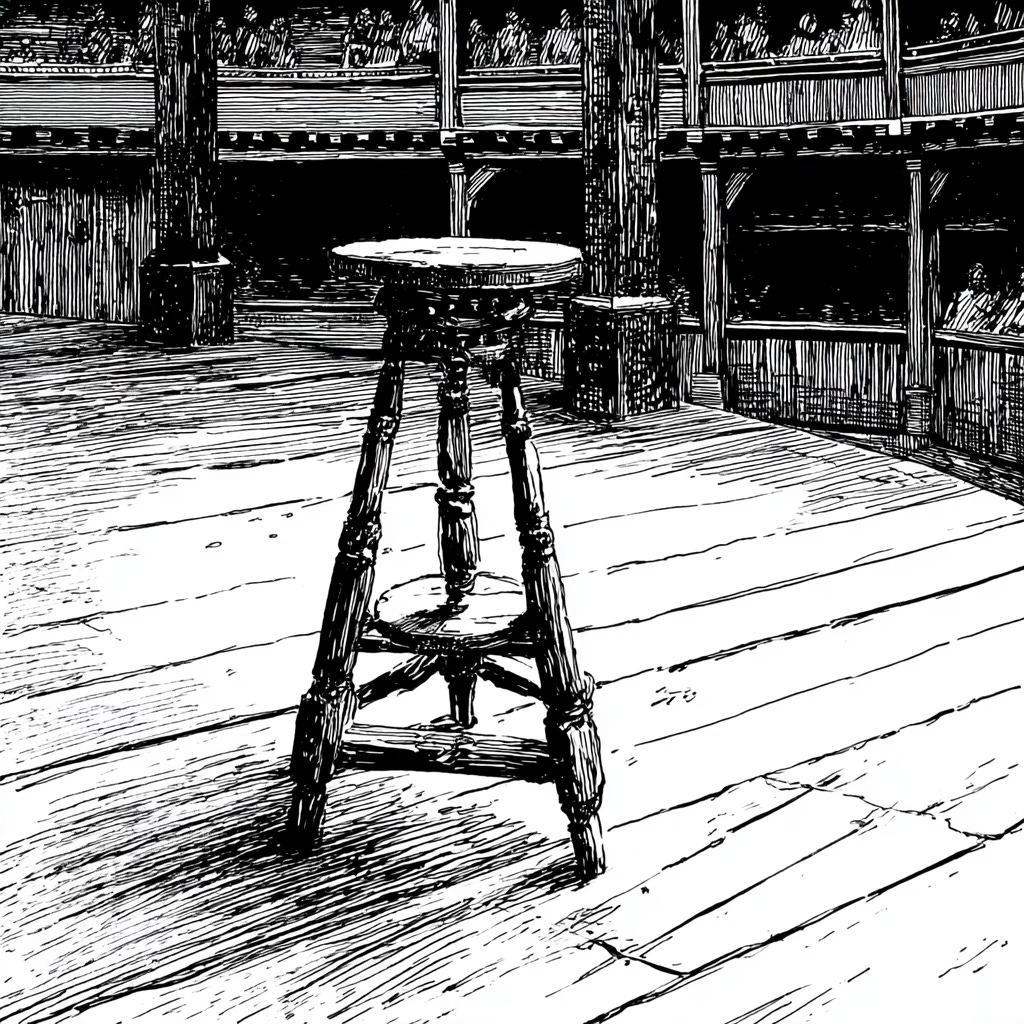
Imagine, if you will, that you are sitting on stage in the middle of Shakespeare’s Globe. You are sitting on a three-legged stool you have made, telling a story to the audience. The stool has to be stable. Any wobbling, any uncertainty, and your story will be incoherent, and you will be distracted.
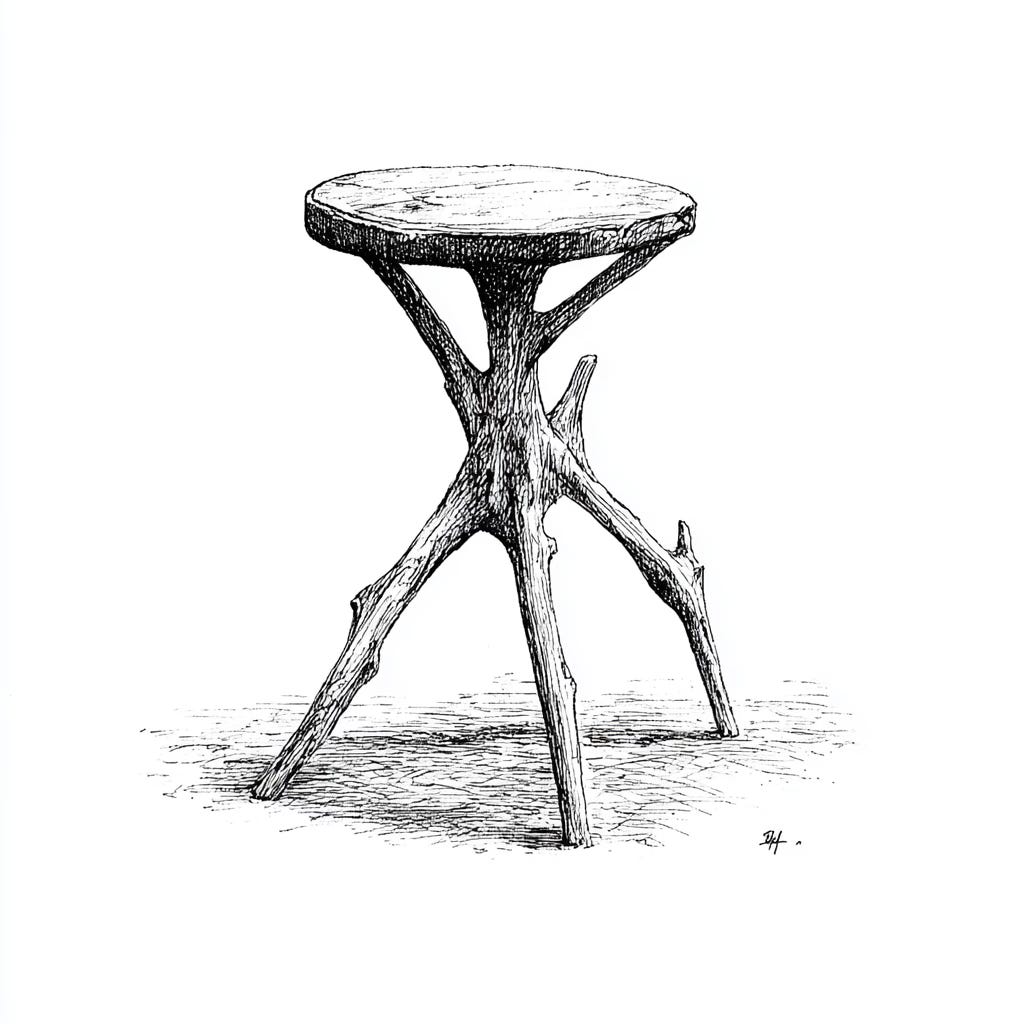
The first leg of the stool is your career to date. What you have done, what you can prove, what you have learned and the mistakes you have made. It is a well-crafted leg, and you are confident in it. Even as you know, on its own, it is not enough. One-legged stools do not work.
The second leg of the stool is your Metis. It is all the things you have learned that cannot be measured. The relationships you have made, the insights you have gathered, the opinions you have developed, and your sense of what you could shape and craft given the opportunity. The second leg of the stool is the essence of who you are becoming, not just who you have been.
The third leg of the stool reflects your options. In many respects this is the scariest part. It may involve leaving the familiar, taking on the risk of failure, and learning new skills. It may involve leaving people behind and meeting new people. It may involve stepping sideways rather than climbing upwards.
The stool needs three legs. There are no rule books, no best practices, no foolproof processes. But we can learn from those who have been on the journey and those who are on it. We can learn from what they have learned and from their mistakes.
Crafting your own three-legged stool is the stuff of alchemy. It is where we decide what to leave behind, what to pick up, and what to develop. It is the point where we step out of other people’s plays and into our own, even if we have to write the script as we go.
Crafting our own stools is what we do in the Athanor. It is not a programme of optimisation or acceleration. It is a counter space to the systems that are hollowing us out. A place where Metis is treated as an asset rather than an inefficiency. A place for slow conversations, deep pattern recognition and mutual sense making. What you make of it is determined by what you bring to it, and how you help others as they help you.
Because right now, few of us are sitting comfortably.