

I don’t think artisans and large organisations make good partners. Everything that makes an artisan an artisan is anathema to the economics of large organisations. Product before process. Care ahead of cash flow, and patience before performance. None of that makes process, cash flow or performance bad, any more than it makes the people in large organisations anything other than human. But the dynamics and structures that make a corporation effective are a constraint too far for an artisan, who is identified by their work and their relationship with the people it is for.
For the artisan, AI is a double-edged sword. It is astonishingly effective for research and for understanding what we are about to work with. If we delegate to it one step too far, though, it can break the web of connections and relationships on which artisanal work is built. That is why I have been writing about AI as a craft tool, rather than something that crafts of its own volition.
The difference will reshape our workplaces. Broadly, I think they have been home to three sorts of inhabitant: those who are politically astute and effective with power; those who are there to learn and develop a skill or profession; and those who are willing to trade agency for security.
The first group will probably thrive, although perhaps in fewer numbers, as they learn to handle AI the way they have previously handled employees. For the second group, life is becoming much more precarious, as fewer apprentices are recruited so that routine work can be handed to technology, leaving judgement with those who wield the power. The outlook for the third group is bleak: they have already traded away their agency, and they no longer have the security they traded it for.
It is difficult to know how this will develop. I suspect the first group will thrive until the cracks start to appear and they discover that technology is not afraid of them, nor does it have any loyalty. When it comes to structures and doing work, it is artificially sociopathic and sycophantic. For the third group, it will be about survival and having options: what we used to call, romantically, a portfolio career, but which seems more likely to become a hybrid, a gig economy of skilled professionals with nowhere to belong.
It is the second group that interests me. These are the people who have shaped every transition like the one we are in: the scribes who benefited from the innovation of writing, the printers who benefited from its industrialisation, and those who embraced the sciences during the Enlightenment. None of them belonged in the mainstream at the outset. They existed at the margins until the work they did became essential, and then. as their relevance and scarcity diminished, they became professionals. I suspect the same will happen this time, although probably faster, in years rather than decades. In that period, as the technology develops, the people who know how to do things without the technology, who have in their bones the skill that the technology supports, and find our how to work with it seem likely to be the ones who thrive, for a while at least.
A change of format causes a stir, whether it was Dylan going from unplugged to plugged, or Bon Jovi going from plugged to unplugged. Each broke the rhythm and pattern people expected, and opened them up to possibilities they had not previously considered.
I wonder whether work is any different. Some of those we would least expect to embrace AI creatively will do so, and change our understanding of what is possible. Others, having been carried along on the wave of enthusiasm for AI, will leave it and go back to the raw craft of what they do, again showing us possibilities we had not considered. At the centre of both is care for what we do: an occupation that matters, that helps us express ourselves, and work that carries our signature.
As Colin Newlyn wrote on Monday, this is not something to consider as our next step. It is something we need to be doing now.
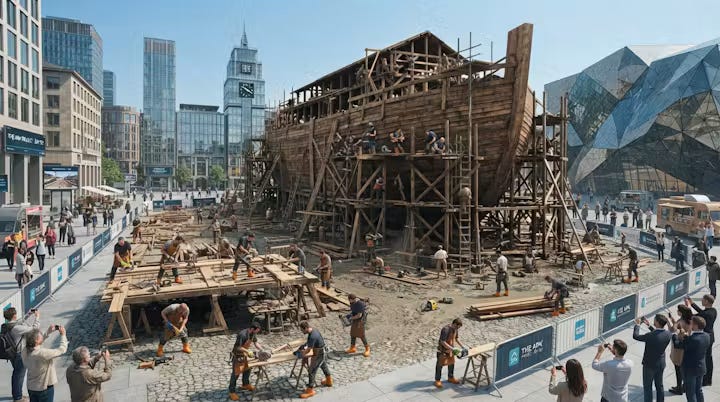
“When did Noah build the ark? Before the rain. Before the rain.“
Nathan Muir in the 2001 film “Spy Game”
It is difficult, because the things that make you different, that make you special, are not the things in demand in large organisations. What is in demand is what makes you the same and compliant, and willing to work for less. We know AI is coming for that.
If we are to shelter from the rain, we need to know now what we are willing to go the extra mile for: what we love doing, what we are willing to take a risk on, and what we will commit the time to. It is not a logical exercise. Logic has its part, but at the heart of it is something we cannot explain.
Working with that is the work.
For the many people I know who understand this, being understood inside a large organisation is a challenge, right up to the point where the people they talk with come to understand it themselves. It is an exercise in commitment and patience.
But I think the second group has the better path. Few of us, I suspect, would swap places with the tech bros or the corporate titans, and even fewer of us want to be indentured.
It’s time to start building your own ark.
I wonder (and fear) that the less scrupulous of your first group, the politics- and power-savvy, will find themselves both able and rewarded for skillful use of AI to become even more uncaring of those their machinations impact. The optimist in me hopes that AI's albeit-mechanistic grasp of human empathy could steer them towards better looking after their underlings (group 3); and that it could even steer them into an appreciation of the professionals and artisans. But my inner pessimist is far from convinced!