

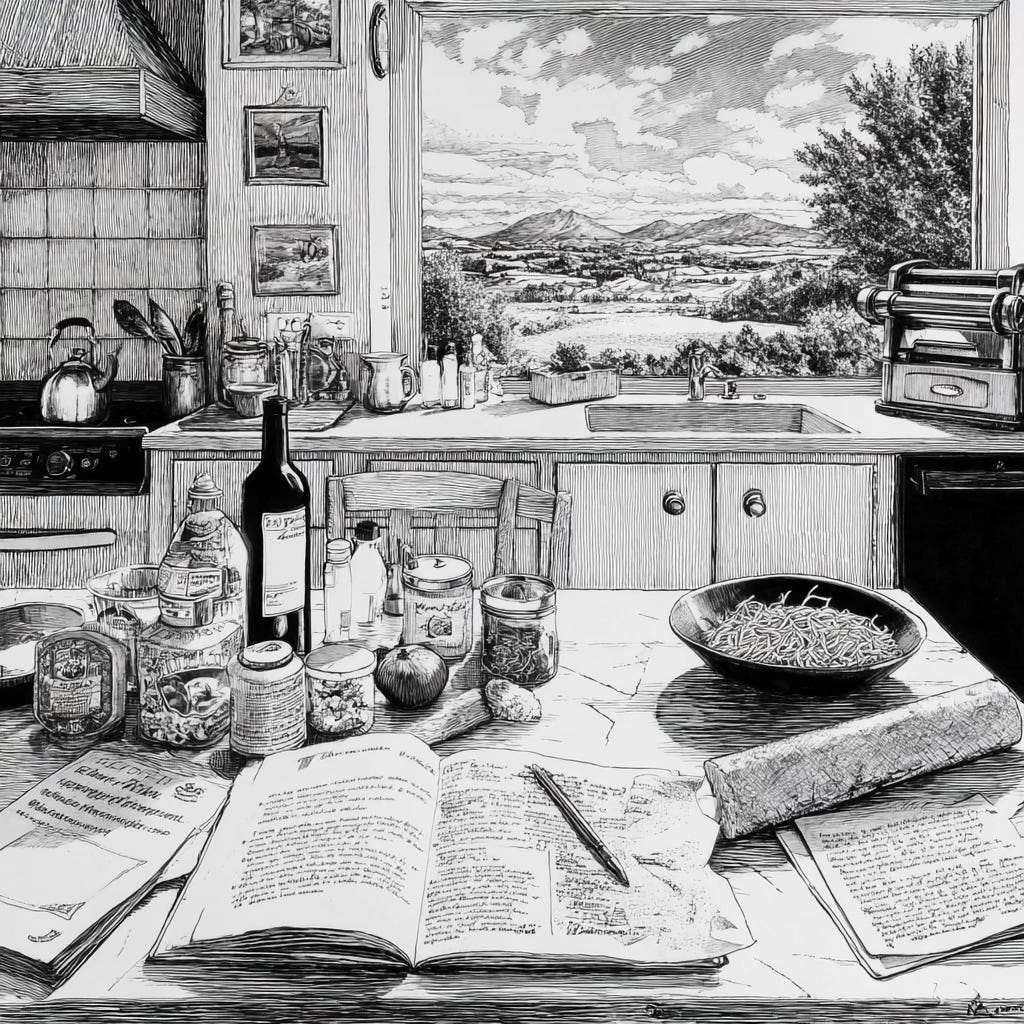
Artisans are deeply invested in their craft, and have an understanding of and with their raw materials that makes recipes superfluous. The realisation occurred to me when reading C. Thi Nguyen’s excellent “The Score”, his latest book on the philosophy of games and scoring systems. It reminded me of a time in my life, decades ago now, when I was given a task to launch the first chilled pasta range in the UK.
Chilled Pasta is ubiquitous now, but then it was an innovation. It involved long hours, and long lunches, with a wonderful, eccentric Italian chef, Andreano Rossi, for whom pasta was something of a religion. I learned that making fresh pasta was an art that involved the feel of the flour, the ambient temperature and humidity, and the nature of the equipment. Sauces were also an art, and tomatoes, herbs and garlic come in all sorts of varieties, even when they look the same. Choosing ingredients felt more like an extended interview for Goldman Sachs than a shopping trip. The results were uniformly wonderful, hence those long lunches.
The challenge was developing recipes that could be scaled to industrial production, because Andreano refused to do them. He refused on the basis that making great pasta and sauces needed more than a set of instructions; it involved empathy. His line was that recipes produced mediocrity, and he wouldn’t do mediocre. If I wanted a recipe, I would have to write it myself. And that is what happened: lots of observation, increasing understanding, but not the empathy of mastery, which takes years of daily practice, and I suspect, a drop of Italian DNA.
The range was a great commercial success, but I always felt a bit of a fraud.
Nguyen helps me understand why. One of the central ideas in The Score is the distinction between scoring systems that liberate and scoring systems that constrain. In games, we adopt rules freely, and the constraints become scaffolding for creativity. A chess player hemmed in on the board discovers moves they would never otherwise have imagined. But when institutions impose scoring systems on work, something different happens. Rich, complex activity gets flattened into measurable outputs. Nguyen calls this value capture: the process by which thin, quantifiable proxies replace the thick values they were meant to represent. Scores replace the experience of playing, metrics replace the experience of managing, and recipes replace the experience of cooking.
A recipe is a scoring system imposed on craft. It captures the achievement, the measurable output, but it cannot capture the striving, the quality of engagement between maker and material. Andreano’s cooking was striving play: the point was the conversation between him and his ingredients, the feel of the flour between his fingers that told him something no thermometer could. The recipe I wrote reduced all of that to steps and quantities. It worked, and produced consistent, defensible results, but it was somebody else’s game, and Andreano knew it.
Anything that can be reduced to a recipe follows the same pattern. MBAs are a case in point. They are recipes for management: frameworks, case studies, decision trees, all designed to produce competent operators at scale. They work, in the same way that my industrial pasta recipe worked. But the best leaders I have encountered did not get there through a curriculum; they got there through years of paying attention to the texture of situations in ways that no case study can teach. The MBA gave them a start point, a vocabulary, and a set of tools. Mastery, for those who made the effort, took years of commitment, of learning to “feel the flour”.
The same is true across most of the professional landscape. Coaching methodologies, agile frameworks, accounting standards, consulting playbooks: all recipes. All designed to produce acceptable outcomes at scale, and all available now, courtesy of technology, for a fraction of what they used to cost. The franchise model is built entirely on recipes, which is both its strength and its ceiling. If your business or your role is built on following recipes, the next few years will be instructive, because the recipes are about to become very accessible, and very cheap indeed.
This is where AI enters the picture, not as threat but as a revealing agent. AI is extraordinarily good at recipes. It can process, recombine and optimise codified knowledge faster and more cheaply than we can. If your work consists of following recipes, AI will do it better, and this is not a prediction; it is already happening. But AI cannot strive. It cannot feel the flour, has no empathy with its materials, and no embodied relationship with the situation it is working in. It operates entirely in achievement mode, which makes it powerful and, for anything that matters, fundamentally limited.
I have now spent enough time working with AI, with Claude in particular and Gemini Deep Research alongside it, to understand something important about this relationship. Using AI well is itself a craft, more than a recipe. There are plenty of recipe-level guides to prompting and workflow, and they will get you started in the same way that my pasta recipe got the factory started. But the real work, the critical thinking work that produces something genuinely powerful, involves developing a feel for what each tool does well, how they interact, where to push and where to listen. It involves learning to read the texture of a response in the same way Andreano read the texture of his dough. It is mētis: the embodied, practical knowledge that develops through sustained attention to a particular practice.
This matters because it changes the landscape of value. When recipe-led solutions are ubiquitous and cheap, the focus moves to craft, to mētis, to the quality of relationships and the depth of understanding. The recipe gets you to the starting line. It is necessary, and it is no longer sufficient. Turning up to crank the organisational handle, following the process, delivering the acceptable output, that is no longer a place of invisible safety. It never really was, but the fiction was sustainable when recipes were expensive and hard to come by. Now they are everywhere, and the question shifts from “can you follow the recipe?” to “what can you do that the recipe cannot?”
The answer, for Andreano, was empathy andlove of cooking. The answer for the overlookers at Cromford Mill, who understood both the craft of weaving as well as the the machinery, was a hybrid sensibility that no instruction manual could produce. The answer for us is something similar: the willingness to develop a relationship with our tools, our materials and our situations that goes beyond competence into genuine understanding.
None of this is comfortable. Mastery takes years. It requires commitment to a practice when the recipe offers a shortcut, and means sitting with the discomfort of not yet being good enough, of feeling like a fraud, which is perhaps how most of us feel when we are genuinely learning rather than merely performing. The range of subjects to be mastered is exploding, and the pressure to reach for the recipe has never been greater. But the recipe, however good, will only ever produce Andreano’s mediocrity at scale. The craft is where the difference lives.
Nguyen’s subtitle asks the right question: how do we stop playing somebody else’s game? For Andreano, the answer was simple. He refused. He wouldn’t write the recipe because writing it meant accepting that pasta could be reduced to a score. The rest of us may not have his clarity, or his stubbornness. But the question is worth sitting with, because the game is changing whether we like it or not, and the recipes will not save us.
I am bringing my observations here, and at Outside the Walls together at The Athanor as we look to turn them to practical use in a changing world. We meet every Wednesday on Zoom at 5:00 pm UK. Feel free to join us.
As someone who likes to cook, and who actually has learned to cook in his early teenage years, I tend to disagree on one particular aspect here: What, for you, is a recipe? It looks to me as if you use it as a synonym of "algorithm". And you've made that craft versus algorithm argument elsewhere and I agree with that. But what does a recipe contain? It asks for an egg, but you need to scale it up by 1.5. What do you do? It asks for this spice but you have only that. It doesn't ask for certain vegetable, but you add it in anyway because if you leave it one more day until tomorrow, it will not be good anymore. And then it tastes great, actually, and you add it to your personal copy of the recipe, which you keep in your personal cookbook.
There is a lot of craft in applying recipes!
That is different from the craft in implementing algorithms. An algorithm is a fixed thing mathematically defined. You can make implementation errors or shortcuts or there may be efficient or less efficient implementations. But the algorithm does not leave any room.
The recipe does. "Season to taste!"
-------
[addition after publication] Upon further thinking, I think I need to add to that. I see a recipe as what you have called a heuristic. What was asked from Andreano was to algorithmify the heuristics expressed in his recipe. By giving the words of it, with all the open ends and the need for case-by-case judgement that has to be applied to "implement" it, to a company who would (need to!) turn it into a repeatable algorithm, he would have given maybe his name, or at least something of himself, and would have allowed it to be turned into something entirely different.
So, IMHO, A recipe is absolutely ok to use, because it is only an orientation, a guidance. Alchemists used recipes all the time ;-)