

The Oxford English Dictionary’s earliest citation for “best practice” is from Popular Science, 1927. Its next citation isn’t until 1984, from an accounting textbook. Fifty-seven years between appearing and finding a home, and longer still before it became the consultant’s approach: take an idea, codify it, build a deck, then fit the client’s problem to the solution on the slide.
An idea can sit unused for half a century and still take over the language when its moment arrives. Best Practice’s moment was scale. Mass production needed a way to say that one method was correct for every factory, branch, and team, regardless of what made each of them different. The phrase did that work efficiently, and is still seductive for the busy under pressure, which is why letting it go is hard.
We keep buying the same solution because uncertainty is uncomfortable, and copying is the cheapest way to make it stop. It offers comfort, and someone else to blame if it does not work as advertised. DiMaggio and Powell called this mimetic isomorphism; when goals are unclear or the ground keeps moving, organisations imitate whoever looks confident rather than work out what actually fits their own situation. Imitation offers legitimacy and the comfort of believing someone else has already solved the problem. It is what fills the space where an organisation’s own thinking should be.
Which is how we ended up cycling through Scientific Management, Total Quality Management, Business Process Re-engineering, the Balanced Scorecard, Six Sigma, Design Thinking, Agile. Each promised the general solution, delivered something, for a while, then stalled and fell out of fashion as the next one arrived promising the same thing in fresh language. It is less cynicism, and more what happens when critical thinking is expensive and imitation is free.
Now we have Agentic AI, and the instinct is to slot it into the same queue: codify its use, write the best-practice guide, brief the client, but it misreads what’s different this time.
Sangeet Paul Choudary’s argument, made at length in Reshuffle, is that AI’s effect is not to improve the existing process but to re-architect the work itself. The earlier fads all operated at the same level: they were competing answers to the same question, which single process should everyone run. AI removes the premise behind the question. When tailoring a response to a specific context costs almost nothing, there’s no longer a case for the one-size answer that best practice existed to supply. Best practice was the workmanship of certainty, made cheap through scale, in Pye’s terms; it produced sameness at a price everyone could afford, but slow to adapt. What AI makes critical now is the opposite: judgement, applied individually at scale that used to require standardisation to survive.
The trouble is that judgement doesn’t arrive with the tool. AI democratises process and information. It remains, for now, indifferent to craft. Ask it for prêt-à-porter and it will oblige, fluently and at volume. Ask it for something tailored, something that recognises who you actually are and what you’re actually trying to do, and the model supplies the material; the fit is still yours to find.
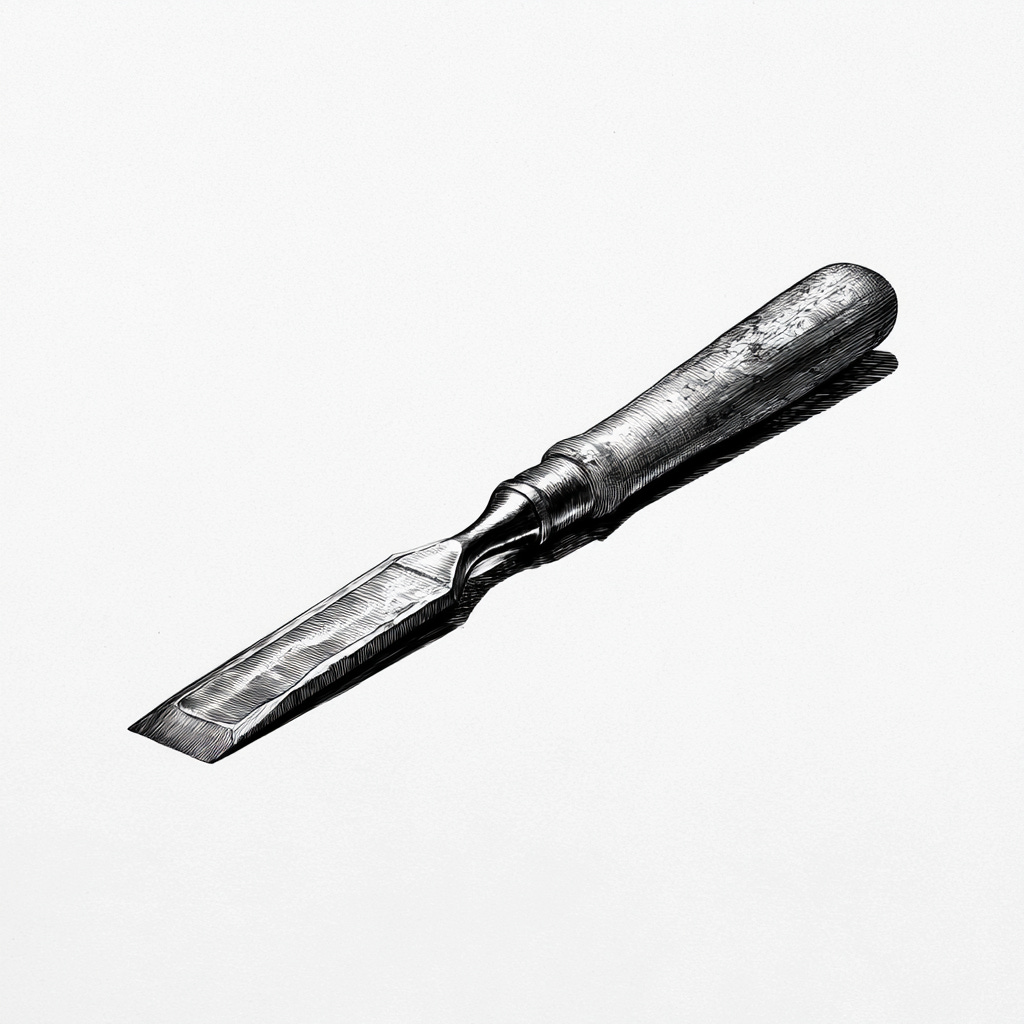
AI feels more like a cognitive chisel. A chisel comes with no book of instructions, and there’s a world of difference between what it produces in the hands of an apprentice and a skilled joiner. I don’t expect AI to be much different. As I wrote last month, Pye’s distinction between the workmanship of risk and the workmanship of certainty addresses exactly this problem: work where the outcome isn’t settled in advance and stays open to being spoiled right up until it’s finished, against work where the process has already decided the result. Best practice was always process. What’s changed is that the process is now optional for anyone willing to do the harder work of critical thinking and judgement instead.
That’s the test AI is setting us, and most of us are still avoiding it, wanting the benefits without giving up the certainty. We want the tool to be Google with better manners. It isn’t, and the sooner we stop treating it as the next best practice waiting to be written up, the sooner we can get on with the harder, more interesting work: deciding, case by case, cut by cut, what to hand over and what to keep for the hand that holds the chisel.
Sources
Oxford English Dictionary, “best practice, n.” https://www.oed.com/dictionary/best-practice_n
DiMaggio, P.J. and Powell, W.W. (1983), “The Iron Cage Revisited: Institutional Isomorphism and Collective Rationality in Organizational Fields.” American Sociological Review, 48(2), 147–160.
Choudary, S.P. (2025), Reshuffle: Who Wins When AI Restacks the Knowledge Economy.
Pye, D. (1968), The Nature and Art of Workmanship. Cambridge University Press.
Merrick, R. (2026), “Artisanal Sufficiency,” New Artisans, 1 July. https://newartisans.substack.com/p/artisanal-sufficiency