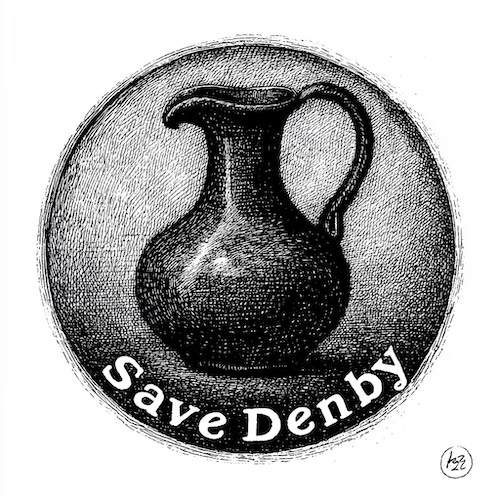
I have been writing about Denby for a few weeks now, and I find I keep circling back to a particular figure. Not the business, the balance sheet, or the administrators; but the kiln manager who, after forty years, can read the colour inside the chamber and know what it means. That is not a skill description, it is formation. Something built slowly, in one place, out of thousands of small judgments made under the pressure of real work. The administrators cannot touch it, and whoever buys the brand name cannot acquire it. When the kiln goes cold, it does not vanish; it goes home with the person who carries it.
That observation has sat with me longer than I expected, because it opens onto a question the Denby story has been quietly pressing me for all along. If the formation travels with the person, then the organisation was never the source of it. The organisation was the vessel. A good vessel, for a long time, providing the materials, the companions, and the accumulated example of earlier generations of makers. But a vessel, not a spring. And when vessels break, as Denby is breaking, what you discover is what it was actually holding.
Most of us, if we are honest, have been treated as though we were the vessels and the organisation was the substance. Job descriptions and role descriptions encourage this inversion. They are crude abstractions, written by people who do not do the work, used by recruiters one further step removed, in order to find someone who will be a close enough fit for long enough to collect a fee. The language of community and family, when it is deployed on LinkedIn, is written by the most cynical marketers. The reality, for most people in most organisations, is closer to being an orphan than being a family member. We are tolerated as long as we are useful to the current theory of the business.
That has always been the case to some degree. What is different now is that the theories of business are changing faster than the descriptions can keep up with. The shadow of AI falls across every job title. Role descriptions written twelve months ago describe work that no longer exists in quite that shape, and the work that is actually being done has no official language yet. The instinct, when this happens, is to reach for a framework that will make the uncertainty manageable. I have watched a lot of people reach, and I have watched a lot of those frameworks fail to describe them. The frameworks were designed for a more stable territory than the one we are now in, whilst those who do not understand pretend it hasn’t. It’s easier that way.
What does describe people, when I watch carefully, is something older and stranger than a framework. It is what they have read, what they have watched, who they have worked alongside, and what they have made and remade. The books they return to when they are lost. The films they quote without thinking, and the teachers whose voices still arrive in the middle of a hard decision. The predecessors at the bench, or the desk, or the studio, whose examples they measure themselves against. I have taken to calling this a person’s canon, though formation is probably the truer word. A canon suggests a list. A formation is what a life has built.
The Denby craftspeople have a formation that would humble most of us. Two centuries of accumulated practice in a single valley, a specific clay, a lineage of makers teaching makers, and a relationship with the people who would eventually bring what they made into their homes. That formation is not in the administrators’ report. It does not appear anywhere on the balance sheet, and is, in accounting terms, invisible. And yet it is the only thing at Denby that has any prospect of surviving what is about to happen, because it is the only thing the administrators cannot sell.
A personal formation is not a list of favourites, and it is not built by collecting; it is built by returning. The books that keep calling you back are the ones doing the work. The films you watch every few years are rearranging something in you each time. The conversations you find yourself repeating to other people, years after you first had them, are part of your structure now. Formation is not curated; it reveals itself through the pattern of what you cannot leave alone. Most of us carry one and do not know what is in it. The exercise, when things become uncertain, is not to build a new one. It is to notice what is already there.
This matters practically, and not only as consolation. In fluid markets, where the descriptions of jobs are unstable and the organisations themselves are being reshaped in real time, what you carry in your formation is the most reliable thing you have to offer. It is what makes you legible to the people who might want to work with you, and it is what distinguishes you from the next plausible candidate whose CV looks similar on the page. A role description can be matched by many people. A formation is yours alone. It is also, usefully, the part of you that AI cannot simulate, because it is not a set of outputs but the accumulated judgment behind them.
I think often of the kiln manager. Whatever happens to Denby, he will walk out of that building with his formation intact. It was never theirs to keep. He will find, or be found by, other work, because what he carries is rare and the rarity will out. The tragedy of Denby is real, and I do not want to diminish it. But the lesson, for the rest of us watching from our own fragile vessels, is worth taking. The organisation is not the source of what you are good at. It is the setting in which your formation has been visible. When the setting goes, the formation does not. It walks out with you.
We are, most of us, organisational orphans now. That sounds bleak, and on a bad day it is. But orphans, as the old stories remind us, are also the ones who travel. They take what is theirs and they find the next place where it can do its work. The question worth sitting with is not how to hold on to an organisation that may not hold on to you. It is what, exactly, you would take with you if the furnace went cold tomorrow. That inventory, more than any job description, is the measure of what you have.