

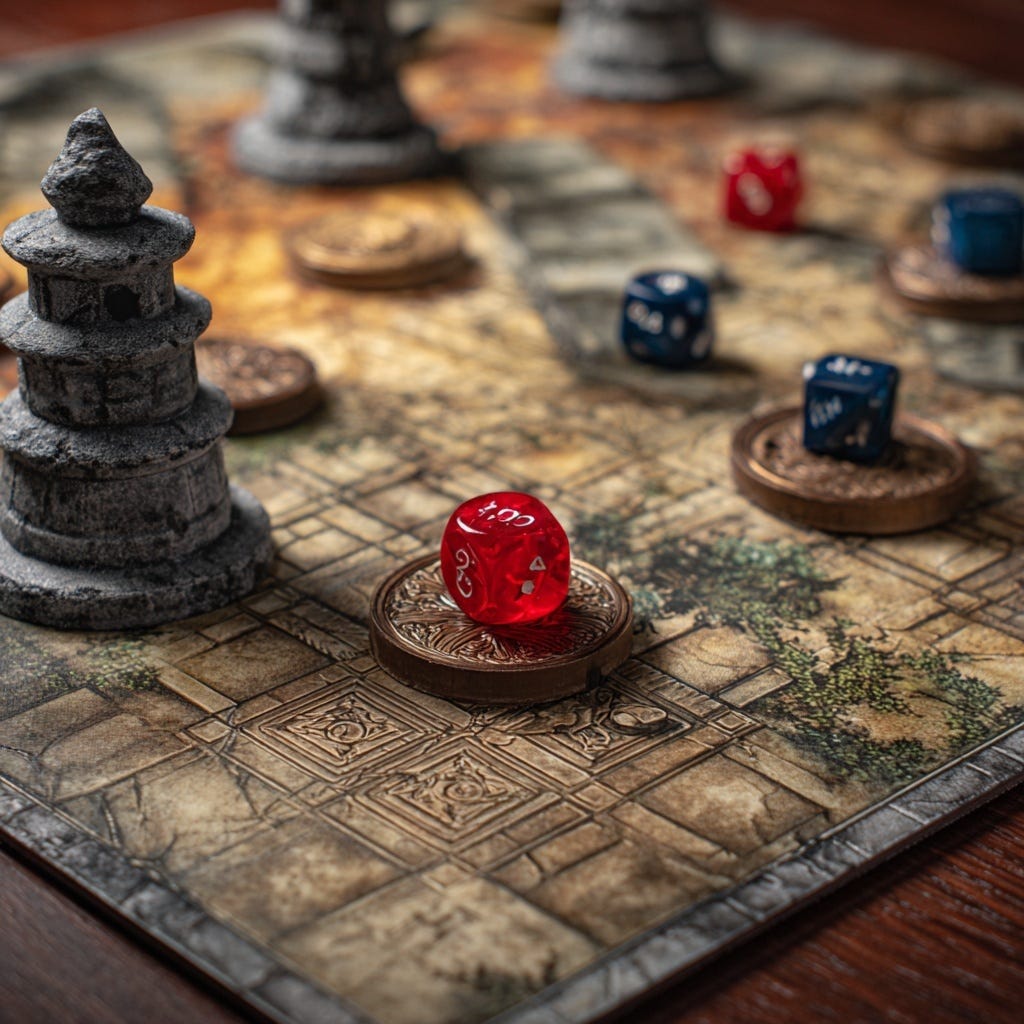
It seems at the moment that our lives are a series of connected games, each separate but inextricably linked to the others. Different goals, strategies and rules. The boundaries feel less permeable than they once were, when work and personal life were connected by shared interests, shared places, shared histories. Today, each game feels different, more intense. In some, if we’re lucky or determined, we are the game master, making the rules, setting the scene, controlling the narrative. In others, we are just players, with limited resources, riding our luck and hoping for a break.
Picture our lives as a series of connected game spaces, touching the others but governed by distinct rules. The work space operates on achievement metrics and quarterly outcomes. The family space runs on unmeasured care and presence. The creative space thrives on exploration without predetermined endpoints, time to be with ourselves, free of the other two. They share edges, moments where one bleeds into another, but we’ve been required to keep them separate. “Work-life balance” has become a sick joke, as though our lives can be compartmentalised and remain coherent.
We can end up placing a different element at the centre while the others orbit at the periphery. At work, we might prioritise capability and measurable output, pushing values and relationships to the edge for a while. At home, we centre connection and care, but skills and aspirations fade into the background. In our creative work, we promote identity and possibility, even as constraints find their way in like intrusions from another game entirely.
This constant rotation is exhausting, not because the elements change, but because we’ve lost the sense that they could all occupy the same space simultaneously. We’ve accepted that focusing on one means neglecting the others, that fragmentation is normal. We leave our skills at the boundary when we enter a different space, as if bringing our whole self to every space would cause some kind of catastrophic breach.
Why?
C. Thi Nguyen, in his book Games: Agency as Art, identifies two kinds of play that bear on this. Achievement games are those where winning is the sole purpose, where coming second is failure, and the result is everything. Striving games are different: winning is a necessary condition of play, something that gives the game its shape, but it’s secondary to the experience of playing well. Think of the difference between a child learning to ride a bicycle and a professional cyclist in a race. One is fully absorbed in the struggle; the other must win or the day is wasted. James Carse captured the same distinction differently: finite games are played to be won; infinite games are played to keep playing. Our lives contain both, and the problem is that we’ve allowed the finite games to colonise the infinite ones.
Most organisations start as infinite games. In those early times, when enthusiasm and commitment to an idea need the play ethic to make sense of the chaos they generate, everyone knows who the players are, the goal is clear and shared, and pleasure is a feature of the game. Then, somewhere along the way, we find ourselves with different game masters who have little interest in the game, only the result. We are now players in a different game to the one we thought we joined, unable to leave without real penalty. Why else would we stay voluntarily with companies that make the headlines every week for behaving like sociopaths?
Stafford Beer understood this decades ago, seeing organisations as social systems in their own right, taking actions in their own interest rather than those of the people in them. He also had a useful view of complexity: that peering inside a black box is futile. At sufficient complexity, we cannot determine outputs from inputs with any clarity. Better to attend to the relationship between them than to obsess over the internal machinery. I think he had a point. We are, right now, consumed with what AI can do rather than with the results of what it can do.
But Beer’s framework opens a deeper question: if organisations evolved to play finite games — winner-takes-all, score-above-all — then AI is the logical endpoint of that evolution. A machine that plays nothing else. Build AI in the image of the organisations that finance it, and the thought is sobering.
Artisans face a specific dilemma here. Their nature is to play the game with elegance, to create something memorable that touches us rather than merely provide goods and services, and not to sacrifice integrity in order to win at all costs. Artisans understand the idea of “enough”, but it is a difficult place to occupy in organisations where winning is fetishised by those who set the rules and make the bets but never play in the game. For those people, AI is straightforward. It is extraordinarily good at achievement play, optimising, maximising, and finding edges. It is entirely incapable of striving play. It cannot find meaning in struggle, value process, or care about how something is done beyond whether it achieves the stated goal. It does not understand craft, because craft is not separable from the person who practises it.
The danger, then, is not that AI replaces us. It is that in competing with it on its own terms, we reduce ourselves to achievement players and begin valuing only what we can measure.
Which raises a possibility we are not yet properly considering. AI may pose a greater long-term risk to our current forms of organisation than to the nature of work itself. The organisations are the finite game players; the work is where the infinite game lives. If that is right, the disruption runs deeper than any technology roadmap suggests.
Geoffrey West has shown that the mathematics of scale carry their own limits built in; growth that appears inexorable tends to contain the seeds of its own correction. Organisations harnessing AI to continue to scale fave natural limits.
Small groups have rarely been more important. Margaret Mead told us never to doubt that a small group of thoughtful, committed people can change the world; that, indeed, it is the only thing that ever has.
AI changes the rules of the game for all of us, not just the organisations that have brought it into being, and life is full of unintended consequences.
How we respond will be determined by the games we choose to play, to which rules, and on whose terms.
Because winning is a very poor way to go about a life worth living.
Hmmm... you are using statements like
"[AI] is extraordinarily good at achievement play, [...]. It is entirely incapable of striving play." As if it had itself certain capabilities, and not certain others (instead of seeing it as a complex black box as Stafford beer would have - outcomes to some extent unpredictable).
"if organisations evolved to play finite games — winner-takes-all, score-above-all — then AI is the logical endpoint of that evolution. A machine that plays nothing else." as if AI would want to "win". Even if you see it as a stochastic parrot, it wants to continue the sentence. It wants to continue "playing". It has exactly no idea of what "winning" even is. This in turn allows organizations, of course, to steer it. But can it not also be steered into other directions (e.g. Vanessa Andreotti/Aiden Cinnamon Tea), and it is just that there is more money in some directions than in others?
"competing with it on its own terms" - Does AI have "own terms"?
I think where you get it very right is where you say that "The organisations are the finite game players; the work is where the infinite game lives." So, to the extent that we let organizations, optimizing for finite play, use AI to their ends, you are cartainly right. But is that in the AI, or in the organizational and financial goals it is leveraged for? Is the right question not "What can AI be steered towards, and how, and by whom?"
Are you saying "AI", but using that term in the limited meaning of "AI-as-deployed-by-achievement-organisations"? The Stafford Beer reference I find particularly telling. So, organizations are black boxes - and AI is not? Or is it that both are black boxes, and the real question is who holds the controls?
Last question added at the explicit suggestion of Claude Sonnet 4.6. :-)