

There are times when we read or see something that takes everything we know and rearranges it, the way a kaleidoscope gives us a different image when we twist it. It shows us a new arrangement of the familiar and changes our relationship with what we know.
It happened to me this week, reading Roger Kneebone’s book Expert (HT, Carlo Navato ). Right at the beginning, on page 13, he offers this model of the relationship between apprentice, journeyman and master.
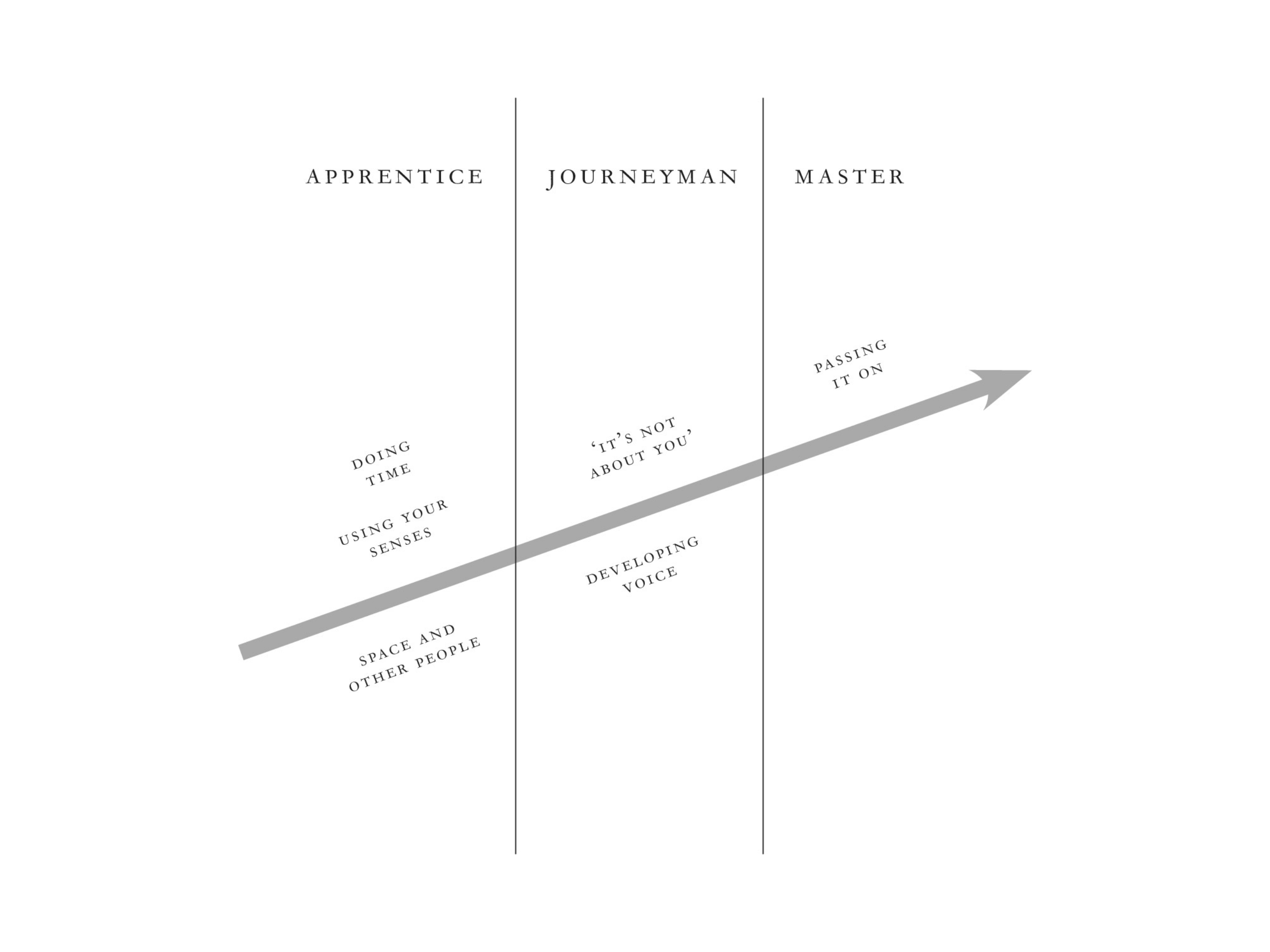
As apprentices, we serve time copying other people, following instructions and developing a sense of what we do. We are not responsible for our work; that lies with the master who teaches us and gives us our instructions.
Then, at some point, once we understand all the parts of what we do, we step into the Journeyman phase, taking responsibility for our own work and creating our own whole. We develop our own style, voice and relationship with the people who commission our work, and take responsibility for it. What we produce is down to us. We are no longer assemblers of other people’s parts or followers of other people’s instructions.
We travel away from the place where we learned our craft to practise in different environments, for different people, in different places. Our style and voice become tangible, and we can, if we choose, seek to become masters and take on apprentices of our own and leave a legacy by teaching them.
Unless, of course, we work for a corporation or a large organisation, where the rigours of productivity and efficiency mean that every job is broken into component parts and nobody owns the whole. We work on the parts allocated to us by process, while the people responsible for the whole govern the process but do none of the work of the parts.
In a corporation or large business we are all permanent apprentices. None of us creates the whole, and when it comes to what we make, the chief executive has more influence than a person on the shop floor, but cannot make what they are responsible for selling. They are equally disposable parts of a process; they just get bigger bonuses.
So perhaps it is not surprising that we are so animated by the idea of AI, when, or the sake of efficiency and productivity, we disaggregate a process into its component parts and allocate each to the lowest-cost resource. There is no journey. There is no experience of taking embodied skills and applying them in new areas, in different languages and cultures, for different people. There is little room for judgement, only calculation. There is no memory or embodiment of mistakes
So, perhaps the biggest risk with AI is that we allow it to kill apprenticeships, and that we end up with all of us a parts not understanding the whole that we help create.
Work without meaning other than money.
Digging a little deeper, other people explain the same thing in different words. Jean Lave and Etienne Wenger show that apprentices learn by taking part in real work from its edge and moving towards its centre. Two things determine how they move: access to the whole practice, and transparency, meaning they can see how the work and its tools fit together.
Richard Hackman and Greg Oldham point to “task identity”, the degree to which a job requires the completion of a whole and identifiable piece of work. Elliott Jaques writes about the time-span of discretion: how long a person is trusted to act on their own judgement before anyone reviews it.
In the end, I think it all centres on agency, and on the gap between what Harry Collins and Robert Evans call contributory expertise (being able to do the work) and interactional expertise (being able to talk about it fluently without doing it). Those who govern the whole can hold a conversation about all of the work, but cannot do the parts.
Corporations and large organisations are at their best in the middle of a cycle, when the work is clear enough to be organised but before it lags behind a changing world and begins to fall apart.
The trouble is, we are clearly at the end of one cycle and the beginning of another.
If you’re reading this, you’re probably interested in the world of work and how it is evolving. As the world changes, working for a corporation for a while, or better still for several corporations for a short while, is a good apprenticeship.
Staying, though, keeps us permanent apprentices, and we never understand the whole. When the organisation fails, our work identity goes with it.
At a personal level, it reminds me of Alan Moore’s beautiful book Do Build. I wrote about it a while ago, covering each of the 13 questions he asks. They are salutary questions to ask ourselves now, because if we cannot answer them, we are still apprentices in a world that needs journeymen and masters for a new time.
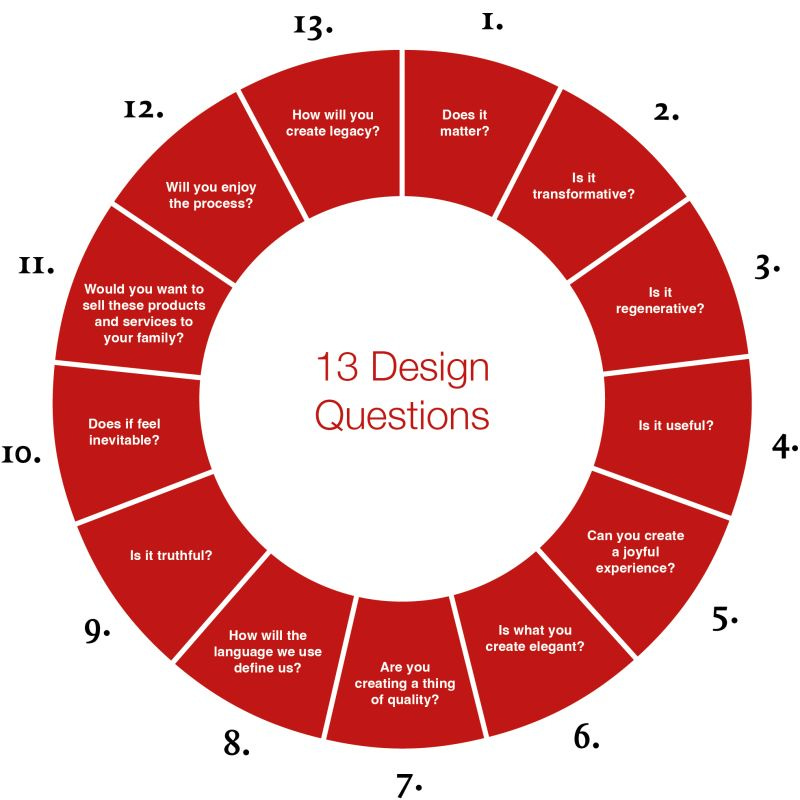
For a while, corporations and large organisations were places of relative safety. We traded agency for security and curiosity for compliance. That bargain no longer holds.
What we each do in future will be different, because our circumstances, aspirations and skills are as varied as our answers to Alan Moore’s questions.
What we share, though, whether we are newly employed or a chief executive, is the need to step from apprentice to journeyman: taking our experience and moving from being able to make a part, to being able to make the whole, whilst intimately understanding each part.
It is neither safe nor certain.
Then again, it is not as dangerous as remaining a permanent apprentice.
Something to read
Roger Kneebone, Expert: Understanding the Path to Mastery (Viking, 2020)
Ted Gioia, “The Most Dangerous Thing in Culture Right Now is Beauty”, The Honest Broker, 9 October 2023
Alan Moore, Do Build: How to make and lead a business the world needs (The Do Book Company)