

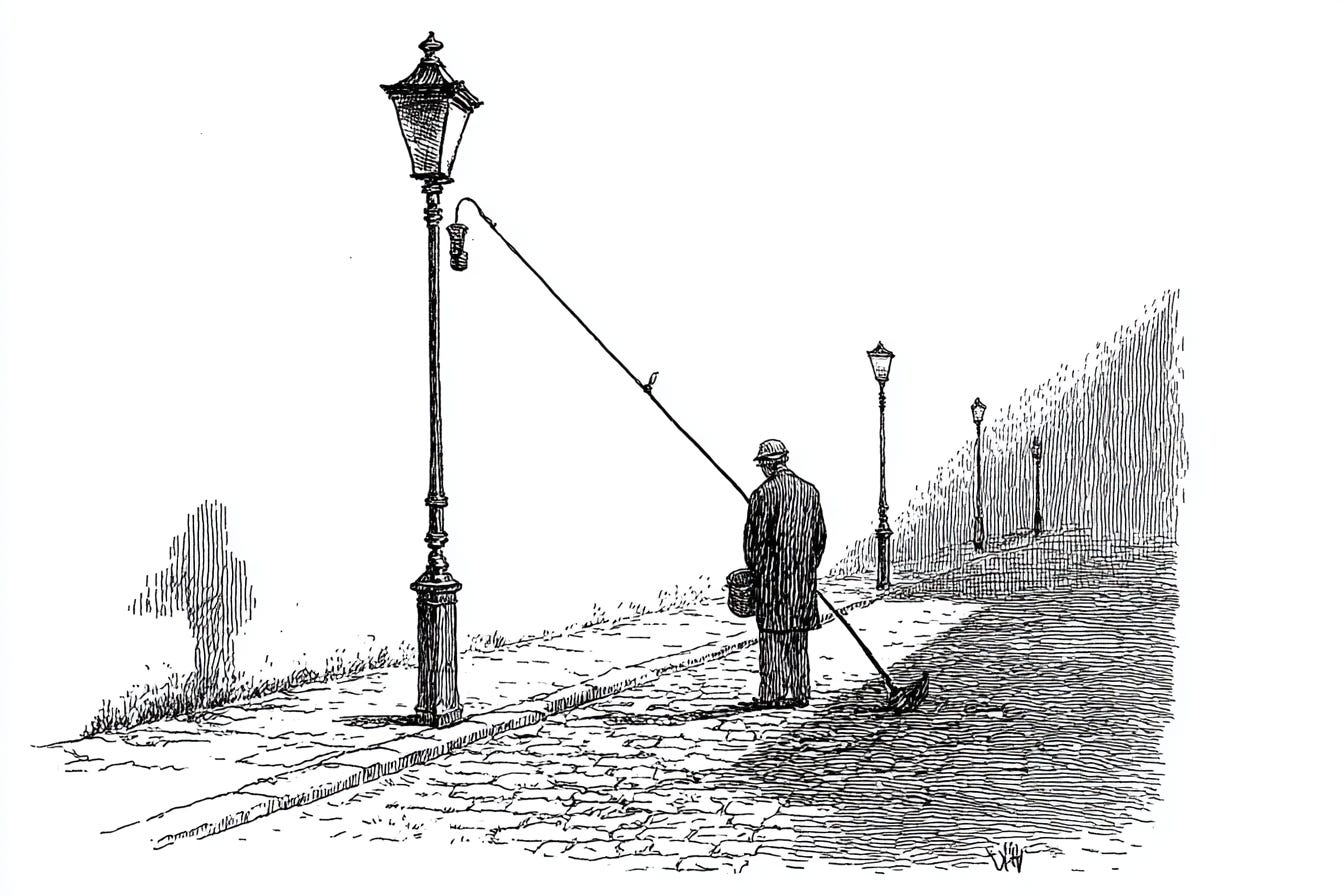
We tend to think of skill as a descriptive label, a thing a person has or lacks. The more I have turned it over, the less that holds. Skill is bound by time and context, and the binding is not the same in every case.
The mason laying stone in 2026 is doing roughly what a mason did in 1426. The tools differ at the margins; the geometry does not. The wood-joiner cutting a mortise-and-tenon is, in the parts of the work that matter, doing what his counterpart did six hundred years ago. The basics of bookkeeping follow the same pattern. These are skills that carry across civilisational change, and they will still be needed as source material in another century. With skills like this, we host them for a while; we do not own them.
Then there are skills that come into being to serve a particular transformation, do their constitutive work during it, and are consumed by it. The mule-spinner in the Lancashire cotton mills of 1820 was a new kind of worker, neither the craft-weaver he had displaced nor the unskilled labourer below him. By 1880 ring-spinning had eaten his machine-dependent skill whole. The train driver, the typesetter, the telephone operator, the punched-card operator, the COBOL programmer of the 1960s. Each was essential at the moment the skill emerged. Each was reabsorbed or removed by the technology the work itself had helped bring into being.
Coding, and many of the other jobs AI will touch, probably belong in this second category. I want to reserve judgement, because the case is not yet closed; they will be affected; quite how, the jury is still out. Whatever the speculation throws up, it will be wrong in ways that make it unsafe to build on.
There is a third category, harder to describe than either. Skills that are emerging now, not yet fully formed, whose practitioners cannot reliably tell whether what they are doing will last, or what it will be called once it is done. The factory engineer of 1820 did not know he was the constitutive figure of a new economic order; he knew he was operating an unfamiliar machine. The printer of 1470 did not see himself inaugurating a five-century craft; he may have seen himself as a metalworker who had taken on an unusual commission. The category is real, but its contents are visible only in retrospect. We can hold it as a structural placeholder. We cannot reliably name what belongs in it.
We do not know how long what we are making will last. We are all lamplighters.
I used Claude to test this three-part shape against the historical record. It did not confirm the scheme; it took it apart at the seams, which was more useful.
The permanent category is more porous than it first looks. Masonry has persisted, but concrete, steel, and prefabrication have pushed it to the edges of the building economy. The skill survives; the scale at which it is practised does not. Carpentry tells the same story. What is permanent may be the foundational problem, the working of wood and the joining of stone and the making of shelter, rather than the skill in any form we would recognise. So the category is better named for its foundation problem than for its craft, with the understanding that the share of the economy it occupies can contract to a fraction of what it once was, and the practitioner may end up doing conservation, heritage, or high-end domestic work that bears a complicated relation to the craft’s earlier mass form.
The transient category is more capacious than its name suggests. Some transients last a generation; some last five centuries. The printer of 1470 was inside a transient skill that did not collapse until desktop publishing arrived in the 1980s. He was hosting something that would shape five hundred years of practice, and he could not have foreseen Linotype, the photo-typesetter, or the laser printer. The COBOL programmer of 1960 was inside a far shorter arc. Both fit the pattern; neither could tell, from the inside, how long the arc would run. The typical generational transient and the rare long-arc transient look identical to the person living through them, and that is the difficulty.
Transient skills tend to eat themselves. The mule-spinner trained the next generation of mule-spinners, and that generation built the ring-spinner that put them all out of work. The typesetter trained the typesetters who built the Linotype, then phototypesetting, then digital typesetting, each step stripping skill out of the last. The pattern is consistent. A transient skill at its peak holds the conditions of its own obsolescence, because the people inside it understand most precisely what is laborious about the work, and have the strongest motive to mechanise the labour away. Coding sits in this pattern now. The strongest systems for automating the work are being built by the people most exposed to being replaced by them. That is not an irony; it is what a transient skill does in its mature phase.
Underneath this is a darker reading. The people hosting a transient skill at its peak are usually the ones who gain financially from the mechanisation. The ones who lose are the generation behind them, who entered expecting permanence and arrived in the terminal phase. The typesetter of 1980 who built the desktop-publishing system retired comfortably; the typesetter of 1995, freshly out of apprenticeship, did not. Coding may show the same shape across the coming decade. The senior engineer who built the AI systems will be fine. The graduate two years in may not be. Transient skills eat their young more readily than their elders.
This leaves a question without a clean answer. We frame a career as a sequence of jobs inside an economy where every skill is treated as the same kind of thing, differentiated only by what the market will pay for it. Things acquired, held, applied, replaced. It is an inadequate picture. Our relationship to a permanent craft, to a transient skill, and to an emergent practice are three different relationships, and treating them as one leaves people in the wrong posture for the thing they are actually holding. The mason who treats his craft as transient may be miserable in it. The coder who treats his craft as permanent will be unprepared. The practitioner of something genuinely emergent, looking for the established marks of recognition, will not find them, because the apparatus that confers them has not been built and may not be built in time.
So the honest position, for most of us, is that we cannot know which kind of skill we are holding while we hold it. We mostly do not, and the work is to stay clear-eyed about that rather than to resolve it prematurely in one direction or the other.
I will come back to what that asks of us in the next post.