

Strip away the proprietary acronyms and models, and change follows a familiar pattern. Something we have grown used to stops working. Contenders to replace it appear. Eventually one wins out and settles in as the new normal until, in turn, it stops working too. Only the timescales vary. A politician’s promise may last weeks or, in the current climate, hours. Civilisations are measured in centuries. In between sit commerce, the tools and rules we use, and our cultures. We seem to be living through a time when cultures are changing, and the tools and rules of commerce that sustained the fading ones are no longer adequate.
That is hard if we trained as specialists in the tools and rules that no longer serve us. It probably matters little to the top one or two per cent, whose scarcity and expertise will keep them in demand. For those of us a level below, who learned enough and became good enough to get by when things were stable, it is different.
When a general-purpose technology arrives, the specialists who thrived under the old order get culled. Writing reduced the power of the storytelling elders. Printing did the same to the scribes. The spreadsheet thinned the ranks of bookkeeping clerks even as it multiplied the accountants, and the internet made the librarian’s life harder while extending the reach of the data analyst. Now, in turn, AI is making life difficult for the accountants and the data analysts.
For the best part of two centuries, our education system has shuffled, sorted and force-ranked us into grades that set where we entered the workplace. Once there, what came next was fairly predictable. A labourer moved from job to job. In the professions, we spent perhaps ten years establishing our place and another thirty capitalising on it. After the first ten or twenty years, most of us recognised we were not going to be high-fliers, and hoped the structure of the profession we had entered would protect us.
It no longer does. If you trained as a vet or an optician fifteen years ago, you could reasonably have expected to be a partner in a practice by now, earning a comfortable living. Since you began training, many of those independent practices have been rolled up into a handful of groups. Veterinary practice is the clearest case. In 2013 around one UK practice in ten belonged to a large corporate group. By 2024 the Competition and Markets Authority put the figure at almost six in ten, held by six groups, three of them owned by private equity. The same logic runs through business, through charities, and anywhere else scale is offered as the solution.
The rules of scale have been applied by venture capital, private equity or government, and the autonomy you expected has gone. Fifteen years in, you have experience, but the protection fifteen years of practice once gave you has been analysed, captured, optimised and turned into algorithms. Unless you are in that top one or two per cent, you are, in effect, a commodity. It took you fifteen years to get here. With the technology now to hand, someone just arriving can draw level with your codified skills in under five.
What was captured, though, was only the part that could be written down. Michael Polanyi’s line was that we know more than we can tell, and the telling is all an algorithm can take. James C. Scott gave the remainder a name, mētis: the practical knowledge that comes only from long engagement with a particular place and its materials. It is what is left when the job description has been burned away.
Speed carries a price. The technologies we have, and are building, are extraordinary at making maps and guiding us across them with a professional satnav. We can research vertically and connect horizontally. We can build very good maps. But as Alfred Korzybski pointed out, the map is not the territory. A map can carry the forecast; it cannot tell you how the ground you are standing on will take the rain. It has no feel for what happens when fast-moving returns measured in money meet the culture expected to deliver them. And it struggles when our tools move faster than the rules we have developed for using them. A tool spreads at the speed of capital. The craft of using it well still matures at the speed of a working life.
This is where your fifteen, twenty-five or even fifty years come in. We can draw new maps to our heart’s content; the ground being mapped does not much care. The longer you have occupied it, the more you see what newcomers do not. A London cabbie spends years learning the Knowledge, riding the streets until the city lives in them. A satnav tells them nothing they did not already know, and it cannot tell them which road floods after a storm or which junction locks solid when the school run starts.
Models and algorithms are maps, not the truth. George Box told us that all models are wrong, but some are useful, and I think the same holds for algorithms. They are made in one set of circumstances and cannot keep pace with change as quickly as the people using them.
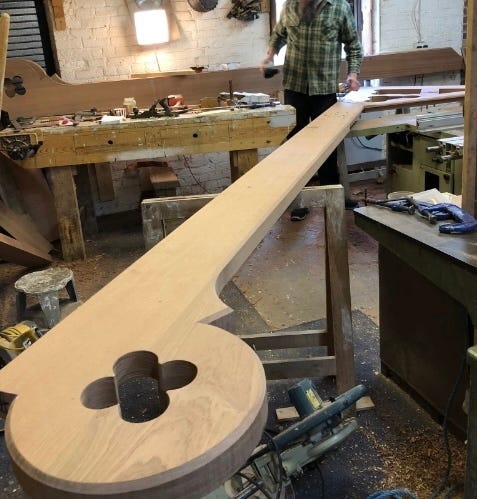
Artisans value craft, and craft is about noticing what is happening in the materials we work with. David Pye called it the workmanship of risk: work whose result is not settled in advance by the jig or the process, but is at stake with every stroke. We have made it much easier to assemble the parts of a solution and to take them apart again, but that does not tell us how to use them.
The heritage joiner who rebuilt the art deco fascias on our house once gave me a long lecture on sharpening. Every craft joiner sharpens their own tools, he said, because each holds them at a different angle, with a different pressure, from a different hand. He would neither borrow another man’s chisels nor lend his own; some of them had been with him since his apprenticeship half a century earlier. When we took down the old roof features, the previous joiner’s marks were still on them, beside hand-made nails that dated the work to around a hundred and fifty years before. I don’t think technology is much different.
So perhaps, instead of grieving the rate at which our replicable skills are being worn away, we should attend to what the tool cannot carry: our relationship with what we do, and with the people we do it for. The pleasure we take in it is the sign that the relationship is still alive.
The tool is open to all of us. The edge we put on it is uniquely ours.