

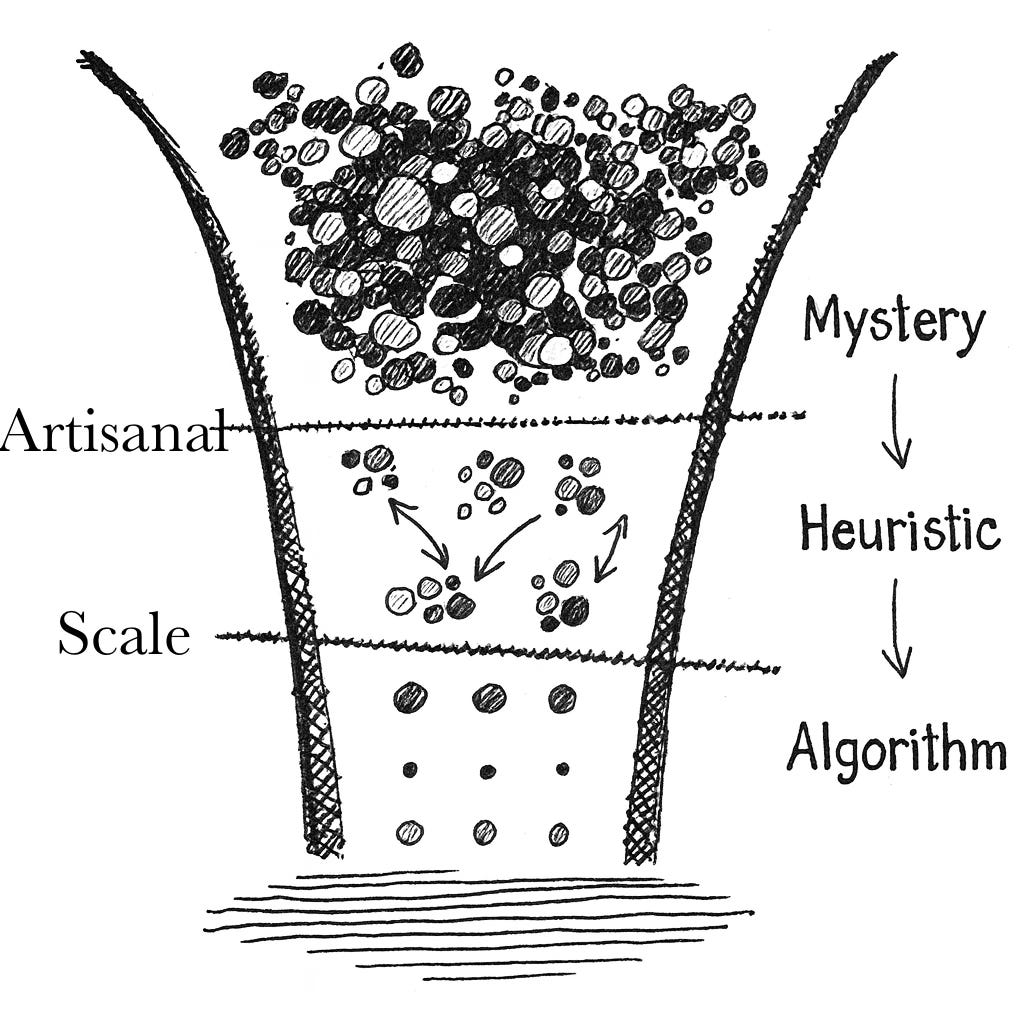
Roger Martin’s Knowledge Funnel is one of my favourites. It follows Colin Chapman’s idea of “first simplify, then add lightness”; it contains all the complexity he speaks about, wrapped in something that looks more like a koan. I have it printed on a card that I keep close to hand when I’m thinking around a problem.
Roger Martin’s knowledge funnel offers a seductive clarity. Mysteries become heuristics through pattern recognition. Heuristics become algorithms through codification, and value accumulates as we move from the ambiguous to the explicit, from the uncertain to the repeatable. The image suggests steady progress, a refinement process that converts the unknown into the manageable and ultimately into the scalable.
But this elegant simplicity conceals an important distinction. The funnel suggests boundaries as if they operated by the same logic, as if the passage from mystery to heuristic follows the same pattern as the passage from heuristic to algorithm. When we observe how knowledge actually moves in contexts where genuine expertise matters, we find these are two fundamentally different kinds of boundary, each with its own character, its own metabolic rate, its own relationship to us as humans.
The boundary between mystery and heuristic behaves like an organic cell’s semi-permeable membrane. Information, insight, and understanding flow in both directions. The heuristic gets tested against new mysteries and either proves adequate or requires revision. The mystery is illuminated by the heuristic but often reveals dimensions it cannot capture, forcing reconsideration. The boundary remains alive, active, responsive. It becomes a dance of evolution.
The boundary between heuristic and algorithm behaves quite differently, more like a production line with information flowing predominantly in one direction. The goal isn’t dialogue between states but conversion from one to the other in search of efficiency, consistency, and scalability. An algorithm that needs constant human judgment hasn’t actually achieved algorithmic status; it remains a heuristic pretending to be something more solid. Once the conversion succeeds, the dialogue ceases. Evolution becomes an intervention rather than an iterative process.
Understanding this distinction matters as AI enters both spaces with very different effects. AI accelerates the production line dramatically but has a far more ambiguous impact on the living membrane. We need to think carefully about the consequences for human work, and for what we choose to value.
Mystery and Heuristic as Dialogue
In my work across agriculture, diplomacy, and founder-led businesses, I see this pattern repeatedly. Someone confronts an unusual presentation. The problem shows symptoms that roughly match several conditions, but the pattern isn’t quite right. Experience provides heuristics, ‘when we see X and Y together, think Z’, but we hesitate, without quite knowing why. The heuristic gets us into the right territory, but the mystery hasn’t fully yielded. What follows isn’t a simple application of rules but a recursive movement between pattern and anomaly.
We apply the heuristic provisionally, watching how the problem responds. That response generates new information, which may confirm the heuristic or complicate it. Perhaps what we do produces an unexpected reaction, forcing reconsideration. The heuristic that brought us to this point now gets interrogated by the mystery it was meant to solve. Did we misread the initial situation? Does this case represent something we haven’t encountered? Has something about the circumstances surrounding the problem changed?
This movement back and forth across the boundary isn’t failure; it’s how expertise actually operates in complex adaptive domains. The mystery teaches the heuristic just as much as the heuristic illuminates the mystery. The boundary must remain permeable because context, variation, and emergence matter. Rigidity would be dangerous.
This is what separates artisans from managers. The artisan keeps the membrane permeable. They resist premature closure, maintain awareness of the mystery even as they work through heuristics, and treat every application as potentially teaching them something new. The boundary remains active because the artisan’s intelligence is devoted to maintaining it. Curiosity is more important than artificial deadlines.
Organisationally, this permeability requires particular conditions. The artisan needs permission to question established approaches that the manager may be denied. They need access to those who can help make sense of anomalies rather than dismissing them as noise. They need time for recursive movement, the capacity to slow down, reconsider, and test alternatives rather than constant pressure to maintain throughput.
Dialogue proves critical here. The membrane’s permeability depends on exchange with others encountering similar mysteries, testing similar heuristics, and experiencing similar tensions between pattern and exception.
Heuristic to Algorithm as Conversion
The boundary between heuristics and algorithms operates on entirely different logic. Here, the goal isn’t maintaining permeability but achieving successful one-way conversion. We want to take the judgment calls, the contextual assessments, the situational awareness embedded in heuristics and render them into processes that can execute reliably without requiring that same judgment.
We see this constantly now. LinkedIn feeds overflow with promises that agentic systems will help us make better decisions faster. This isn’t inherently problematic. It’s how we scale. The conversion of heuristics into algorithms, the creation of reliable, repeatable, efficient processes, enables coordination at scale.
But we pay a price. Context gets stripped away or systematised. Variation gets constrained or categorised. Judgment gets encoded and simplified into decision trees. The living quality of the heuristic, its responsiveness to situation and capacity for adaptation, must be sacrificed to achieve algorithmic consistency. These sacrifices enable scale, but they also make the resulting algorithms brittle when contexts shift unexpectedly. This isn’t a defect of the process, but its very purpose.
Once conversion succeeds, information flow becomes predominantly unidirectional. The algorithm executes. Deviations from the algorithm represent errors to be corrected or inefficiencies to be eliminated. The production line metaphor fits because, like physical manufacturing, the point is to take inputs and produce standardised outputs with minimal variation and maximal efficiency.
This creates particular talent requirements. The skill isn’t maintaining permeability but achieving closure, not preserving mystery but eliminating it. Large organisations orient themselves around this boundary. Their structures, incentives, and cultures typically reward successful conversion from heuristic to algorithm.
Yet organisations optimised for this conversion face a characteristic blindness. They struggle to recognise when the heuristic shouldn’t be converted, when the context matters in ways that algorithms cannot capture, when the mystery hasn’t actually been resolved but only apparently tamed. The production line keeps running, turning heuristics into algorithms, even in domains where permeability would serve better than efficiency.
Why the Distinction Matters Now
AI arrives in this landscape with asymmetric effects. It dramatically accelerates the production line. Organisations can now algorithmise work that resisted conversion for decades. Customer service scripts become conversational AI. Document review becomes automated extraction. Middle management coordination becomes workflow software. The production line speeds up dramatically, processing heuristics into algorithms at unprecedented pace.
But AI’s impact on the living membrane, the mystery-heuristic boundary, remains far more ambiguous. Current AI tools can generate hypotheses and identify patterns. They can process volumes of information that no human could manage. They can draw analogies across domains and suggest connections. Yet they cannot maintain the kind of recursive, contextually grounded, dialogically rich relationship between mystery and heuristic that characterises genuine artisanship.
They cannot know when a pattern matters and when it’s noise. They cannot sense when a heuristic that usually works might not apply here, and cannot hold the productive tension between confidence and uncertainty that marks expert judgment. They can accelerate certain kinds of exploration, but they cannot replicate the embodied, socially embedded, historically informed navigation of persistent mystery that human artisans perform.
This asymmetry creates interesting dynamics. The production line accelerates while the living membrane maintains roughly its previous pace. Organisations can convert and execute faster, but cannot necessarily sense, adapt, and learn faster. The metabolic mismatch intensifies.
An Uncertain Bet
A word that keeps surfacing in my recent conversations is discernment. We’ve been thinking about it as making decisions through the lens of wisdom rather than efficiency. It feels increasingly important as we watch organisations place their bets.
The favourite at the moment is clear: convert heuristics to algorithms as rapidly as possible. Invest in AI that accelerates the production line, and measure success by speed and scale. The logic appears compelling. The economic incentives align. The technology enables what was previously impossible.
The outsider bet looks quite different: protect and develop the relationship between mystery and heuristic. Maintain permeability even when it appears inefficient. Create conditions where artisans can keep questioning, exploring, and recursing. Invest in dialogue spaces rather than execution systems. Accept slower metabolic rates for certain kinds of work.
Right now, the production line sits several lengths ahead. The money, attention and organisational energy concentrates there. This may prove entirely correct. Perhaps AI really will handle the mystery-heuristic space adequately once the technology matures. Perhaps the permeability I’m describing will become automated, the recursive dance reduced to pattern matching sophisticated enough to mimic artisanship.
But I find myself thinking about Gil Scott-Heron’s 1970 spoken-word track where he said “The revolution will not be televised”. It became cultural shorthand for the idea that real change happens off-camera, in streets and communities, in the quieter work people do rather than in the spectacle of broadcast media. Scott-Heron was pointing to work that couldn’t be captured by broadcast media because its essential quality depended on direct engagement that cameras eliminate.
Perhaps artisanship points to knowledge work that can’t be captured by algorithmic systems, not because it’s hidden or mystical, but because its essential quality depends on permeability that algorithms must eliminate to function. The artisan will not be digitised, not through resistance but through the simple fact that digitisation requires converting the living membrane into a production line. That conversion destroys the very thing it is preserving.
I don’t know how this resolves. The technology continues evolving, and organisational pressures intensify. Economic realities constrain choices. What looks like necessary artisanship today might appear as romantic inefficiency tomorrow. What seems like obvious automation now might reveal unexpected brittleness later.
What I do observe is this: the two boundaries behave fundamentally differently. AI impacts them asymmetrically. We face a choice about which capacity to prioritise, even if that choice isn’t explicitly framed as such. The bets are being placed, mostly toward the production line’s acceleration.
Whether protecting the living membrane matters will become clearer as contexts become more uncertain, as established heuristics fail more frequently, as the need for genuine recursiveness intensifies. Or perhaps it won’t. Perhaps the production line’s speed will compensate for reduced permeability. Perhaps new forms of artisanship will emerge that I’m not imagining.
Whether we will become Centaurs, humans powered by AI, or reverse Centaurs, serving AI.
We will see what proves true.
We are bringing these ideas together in conversation groups in The Athanor, an online equivalent of the stove used by alchemists to turn base metals into gold. If you want to see what we’re up to, visit The Athanor.
Your model identifies a very important and overlooked truth. All too often we use the logic and tactic of production when we are dealing sense-making and problem-solving challenges. It reminded me or Steve Blank's 'Customer Development' model, which identifies two distinct phases in the development of a start up - Search (for product-market fit) and Execution (company building). These phases require different ways of thinking and evaluation and the reason a lot of of start-ups fail is because they move to execution too early, before the interactive experimentation has been completed.
I experienced this often in my career, corporate don't like the Search phase because it doesn't have clear outputs or time-scales and doesn't fit the financial and production metrics they worship (Blank says the true measurement of this phase is how much learning has occurred). So, in that regard, AI is simply amplifying an existing problem.
I think AI will cause some companies to collapse, either because they become too brittle to respond to crisis or because the automation will only be partial and of unproven heuristics. Some will do this an survive because of market dominance (often enabled by digitisation), which means we will all suffer from their sub-optimal products and performance. So much for the efficiency of capitalism.
Now that's serendipity. This @richardclaydon post that landed in my email a few minutes after I sent my post sits nicely alongside it as a provocation to thought. https://open.substack.com/pub/richardclaydon/p/where-does-the-work-really-live?utm_campaign=post&utm_medium=email