

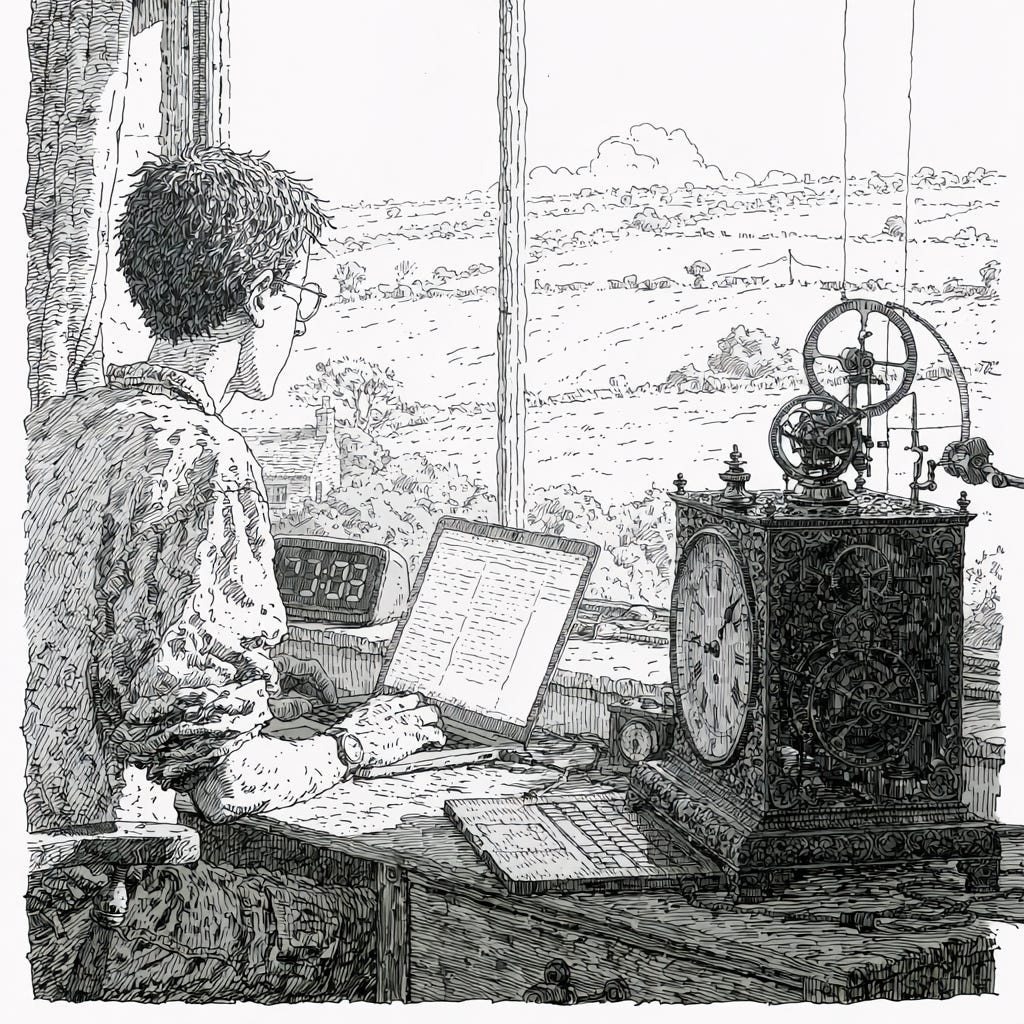
On Tuesday IBM lost a quarter of its value in a day, its steepest fall since 1987, over a revenue miss of some four per cent. The proximate cause was interesting: enterprise customers had raided their software and mainframe budgets in the final weeks of June to stockpile servers, memory and storage ahead of expected price rises, buying AI infrastructure at panic speed while nobody, including the buyers, could yet say with confidence what the infrastructure would be for. A hundred billion dollars of market value swung on the gap between how fast a tool can be acquired and how slowly anyone learns what to do with it.
That gap has a history. Use of a a new tool becomes a craft only after a period of years that has stayed roughly the same across the whole history of making, from the wheel to the technologies we are now wrestling with.
Two clocks run whenever a tool arrives. They keep different times. The first is diffusion: how quickly the tool reaches most of the people who will ever use it. The second is maturation: how long before the difference between the novelty of it and learning how to use it well. The first clock has been speeding up for two centuries. The second has hardly moved. Yet.
The potter’s wheel appeared as a slow turning platform, a tournette, around 3500 BCE. The fast wheel with a flywheel, that lets a potter throw a wall of clay upward rather than build it in coils, arrived some five hundred years later. Half a millennium separates the arrival tool from the version of the tool that now carries the craft, and that is before we count throwing itself, which a potter still measures against a working life.
Electricity offers a more contemporary example. Edison’s lamp arrived in 1879, followed quickly by the electric motor, yet the factory does not reorganise around distributed power until the 1920s, some forty years on. The delay was not speed of adoption; early plants swapped the steam engine for a dynamo and kept the old overhead line shaft, and the building still strung to a single central drive, as though electricity were steam that happened to arrive down a wire. The real dynamic waited needed those who could picture a floor where each machine held its own motor and the layout followed the work. That act of re-imagining was the craft, and it grew in people who had not grown up with the conventional wisdom of steam power.
Cinema followed a similar course. The Lumières project in 1895; Griffith works out narrative cutting through the 1910s; Eisenstein sets down a theory of montage in the 1920s. Twenty-five to thirty years from the medium existing to its grammar being written down, and the point at which the camera could be taught as a way of thinking.
Carlota Perez puts each technological surge at roughly fifty to seventy years, divided into an installation period and a deployment period across a turning point that is usually financial. Paul Saffo’s rule is blunter: thirty years from the laboratory to the commonplace; his reason that thirty years is a human generation, the time a person needs to grow up inside a tool and stop seeing it.
Set the cases alongside one another and the interval from a tool arriving to a craft settling around it clusters at a generation or two, something like twenty-five to seventy years, and has held more or less steady while diffusion has shortened by more than a factor of ten. The telephone took most of a century to reach saturation; the smartphone took under a decade.
I think the reason belongs to the older vocabulary of craft. What spreads quickly is the tool and sufficient competence to operate it, the kind of knowledge that can be written into a manual and shipped with the tool. What matures slowly is the feel for the relationship between material and tool, the mētis that gathers only through long repetition and experience in a world being changed by its reaction to the innovation. I think of it as Pye’s workmanship of risk, that fraction of the outcome that exists the far side of competence, and makes all the difference. Diffusion moves at the speed of capital and manufacture. Craft moves at the speed of someone learning to answer for what they make, and has no economy of scale.
The argument in illustrative rather than meaningful. Mastery has no finishing line, so the tidy thirty-to-fifty-year figure is an abstraction of data. We set the clock running retrospectively from the inventions that gave rise to craft; the ones that found no craft, or died in the first decade, leave no timeline to measure, though that does not mean they were irrelevant; sometimes they were a catalyst for what we do remember.
And it adopts a premise that tools are made at a point of need, and that is what first takes the imagination. Often, but not always true. The laser was called a solution in search of a problem for years; Edison built the phonograph believing it was for taking dictation. Some tools arrive before we work out what they are for.
I have a view that use of AI may well turn out to have the features of a craft, but we have only perhaps three years with our hands on it. On Saffo’s reading we are standing in the first of the three decades, the years when the audience is not yet formed and the early confident uses mostly disappoint. If the historical clock holds, the taste for what to ask, what to trust, when to overrule AI and how to judge work one did not labour to produce will settle around the middle of the next decade, in people who will never have known life without it.
History, of course, is not a rule; we are told that if we don’t learn from it, we are condemned to repeat it. It feels, though, in many ways what we’re going through is different. AI, in its broadest sense has taken half a century to appear, and yet its diffusion is the fastest on record, driven by novelty, capability and greed interacting.
And this technology is different. On my bookshelf is a copy of Norman Doidge’s book “The Brain That Changed Itself” on neuroplasticity. Who knows what happens when neuroplasticity meets technoplasticity?
Here the historic pattern meets what might break it. The craft clock stayed slow because tacit knowledge passed hand to hand, one apprenticeship at a time. A tool that explains itself, develops itself, answers in seconds, and lets a whole community pool what it has learned overnight is working directly on the bottleneck that kept craft to a human calendar. So the question is open in a way it has not been before. Either this tool compresses the maturation interval as none before it could, and the independence of the two clocks finally gives way; or the interval holds, because the scarce thing was never the passing on of technique but the formation of judgement in a person, incorporating senses that AI cannot reach.
So, some questions on this Wednesday:
- If AI does compress the craft clock, what would show it early, given that fluent output and formed judgement look much alike from the outside?
- Which phase are we actually in: the maturation of a craft, or the earlier phase of working out what the tool is for?
- What, in your own practice, is the workmanship of risk that should not pass to AI, and how would you know if it already had?
- If judgement still takes a generation to form, who is forming it now, and against what stakes?
A few sources
1. Paul A. David, *The Dynamo and the Computer* (1990). The forty-year lag between electric power and the factory rebuilt around it; the delay was re-imagining, not adoption.
2. Carlota Perez, *Technological Revolutions and Financial Capital* (2002). Installation and deployment across a fifty-to-seventy-year surge.
3. Paul Saffo, the thirty-year rule (Institute for the Future). Three decades from laboratory to commonplace, because thirty years is a generation.
4. David Pye, *The Nature and Art of Workmanship* (1968). The workmanship of risk, the fraction of an outcome settled at the moment of making.
5. James C. Scott, *Seeing Like a State* (1998). Mētis against episteme: the practical knowledge that accretes only through doing.
6. Norman Doidge: “The Brain that Changes Itself”
A great post, Sunil.
Nobody ever goes into an electricity showroom and asks to see some electricity.. I think, in many ways, what we face is having another member of the team with its own idiosyncrasies that react to our idiosyncrasies. In that way, it is different from what we have seen before. Not a static tool. It is contextual. We have spent five decades educating people to use processes rather than thinking. That there is a neat answer available if you ask, if you speak to the person smart enough. Preferably in a big consultancy for a lot of money
And that has changed. We are all enough for whatever it is we want to do next. But it does mean we need to really understand the new entity n the room.
"... thirty years from the laboratory to the commonplace; his reason that thirty years is a human generation, the time a person needs to grow up inside a tool and stop seeing it."
Like you said, AI seems to be changing this. Except, nobody knows what AI really is. LLM's, automation, autonomy, inorganic beings ...
One of the persistent problems in public discourse on AI is that "AI" has become a conflationary umbrella term. It compresses fundamentally different technologies, capabilities, and aspirations into a single label, making meaningful discussion difficult. We routinely move between them as though they were interchangeable.
I ruminate on this in my piece A Little Knowledge is a Dangerous Think https://sunilmalhotra.medium.com/a-little-knowledge-is-a-dangerous-think-1ce8f186ceb8?source=friends_link&sk=c93363ec4a176345fe789da9274556f2