

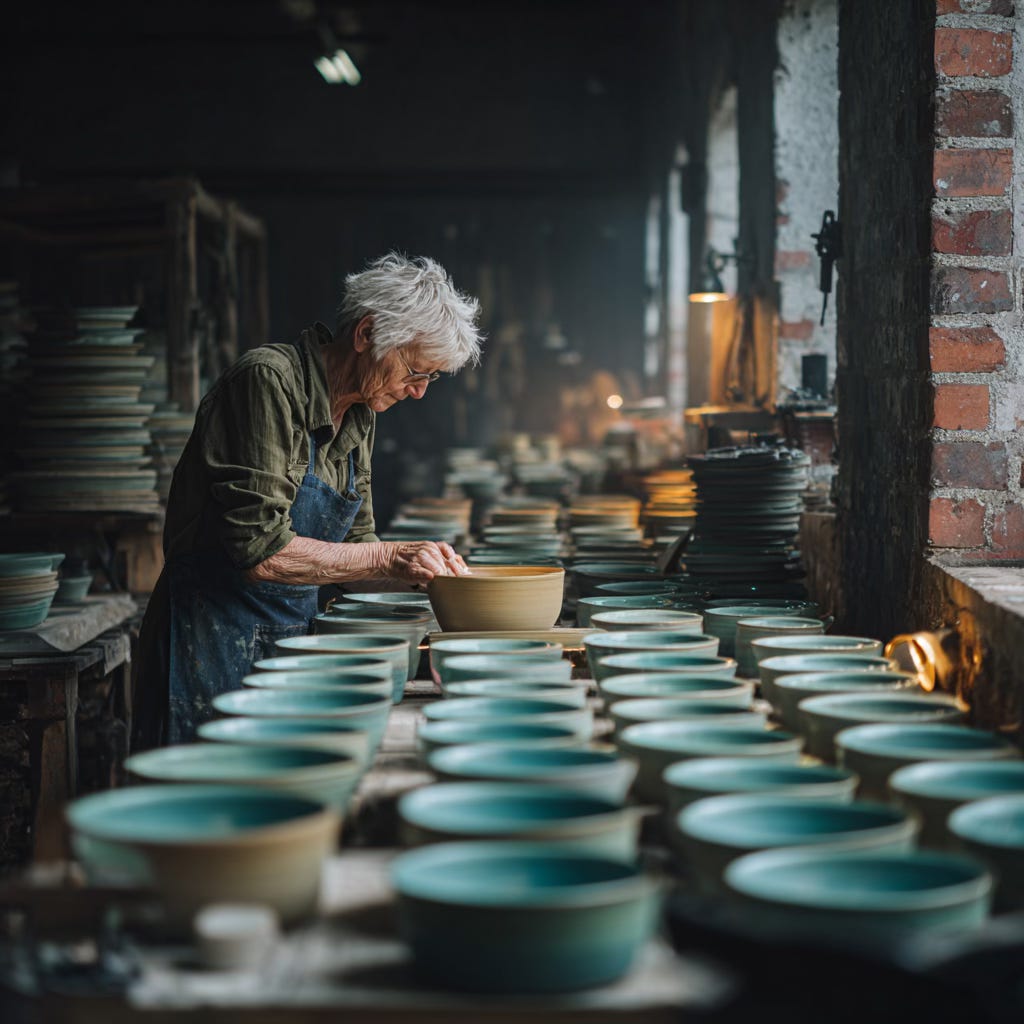
I have been thinking about Denby Pottery this week, as we await news of its fate. I have lived five miles from it for over three decades, know some of the people, and have used what they make all of my adult life.
Denby Pottery entered administration on 18 March 2026, after 217 years of continuous production in Derbyshire. Five hundred people are likely to lose their jobs. A business that had survived industrialisation, two world wars, and the collapse of its conglomerate parent could not survive the combination of energy costs doubling in four years, a weakened consumer market, and a capital structure that had been progressively hollowed out by successive owners who were interested in the business as a financial instrument rather than as a living practice.
I have been thinking about the fettler standing at the workbench, hands reading the clay; the kiln manager watching the colour change inside the chamber and knowing, from forty years of watching, what it means, and the generations from Denby Village who work there. About John Douglas Stone, the industrial chemist who joined the company in the 1940s and spent the next four decades developing the glaze formulations that made Denby’s stoneware what it was. He knew things about how those glazes moved at temperature that he could probably not have fully described. He knew them in the body, through attention, over years.
That last sentence encapsulates what angers me. Let me come at it from the direction that matters most to us here: not from the investors’ perspective, but from the craft’s perspective.
What 217 years build
William Bourne found a seam of exceptional stoneware clay during road construction near Denby in 1806. He built the pottery in 1809. His son Joseph ran it, and Joseph’s son Joseph Harvey after that. Then Sarah Elizabeth Bourne managed the business for thirty years: Five generations, 160 years, the same clay, the same valley, and a gradual accumulation of knowledge about what that particular clay could be made to do.
It is worth dwelling on, because what those 160 years built was not primarily a brand, a product range, or even a set of glaze formulations. What they built was a substrate of knowing that underpinned all those things that lived in people: the chemist, the designer, the kiln manager, the fettler, and the jollier whose hands had learned the material over decades of daily contact.
The clay could not tell you what it knew. Neither, entirely, could the people who worked with it. That is precisely the point.
Michael Polanyi, who gave us the concept of tacit knowledge, put it simply: we can know more than we can tell.
The glaze chemist John Douglas Stone knew more about those glazes than any written specification could contain. Glyn Colledge, who joined as a designer in the early 1930s and served as art director until 1983, knew more about what Denby stoneware wanted to be than any brief could specify. In their design peak of the 1950s and 1960s, we got the Chevron pattern, the Glyn Ware, the Glynbourne Ware, the collaboration with Tibor Reich on Tigo Ware: these things happened because of institutional continuity, because the same people were there, year after year, attending to the same materials, developing a relationship with them that only time can produce.
In the language of the Athanor framework I have been developing, this is what we call the tacit substrate: the invisible foundation on which everything codifiable rests. Every explicit product, registered glaze recipe, design file, and every fired piece rested on something that was never fully written down and could not be. It was the workmanship of risk, in David Pye’s precise sense: knowledge whose value resided in the skill and judgment of the person doing the work, in real time, in relationship with the material.
The moment the logic changed
Denby went public in 1970. That was the first structural break: not because public ownership is inherently destructive of craft capability, but because it introduced a logic that was not, at its core, oriented towards the thing itself. Institutional accountability means being answerable to people for whom the business is a position in a portfolio rather than a four-generation relationship with a seam of Derbyshire clay.
For a decade this did not matter much. But Crown House Group, which acquired full control in 1981, made no significant investment during its tenure. The Langley Pottery was closed in December 1982 after 117 years of operation. Glyn Colledge retired in 1983. Gill Pemberton, who had designed the Chevron pattern in 1962, had left in 1981. Crown House then sold the business at a profit.
Nobody set out to destroy Denby’s creative capacity. Crown House simply applied a logic: optimise the balance sheet, reduce costs, prepare for a disposal that was indifferent to the tacit substrate. The closure of Langley did not show up as “accumulated craft knowledge lost” on any balance sheet. It showed up as a cost reduction. The departures of Colledge and Pemberton showed up as reduced salary costs. The effect on the depth of the organisation’s creative capability was not measurable, and therefore, for the purposes of institutional accountability, it did not exist.
This is the catastrophe that James Scott documented across the twentieth century in entirely different domains: the things that cannot be measured are treated as though they do not exist, and their destruction is therefore invisible until the moment the system fails because of it.
What followed Crown House made things worse. Coloroll, the conglomerate that acquired Denby in 1987, collapsed in 1990 under the weight of its own leveraged expansion, dragging Denby into receivership through no fault of Denby’s operating performance. Then came the management buyout, the public flotation, and eventually, in the years before 2009, a leveraged buyout that left the business carrying £72 million of debt it had not itself incurred. This is the financial mechanism by which craft businesses are quietly bled dry: the acquirer uses debt to finance the acquisition price, places that debt onto the balance sheet of the acquired company, and the company must then service this obligation from its own operating cash flows. Every pound committed to debt service is a pound not available for the kiln chemist, the design programme, or the time and space that genuine craft development requires.
For a decade, this is what constrained Denby’s capacity to invest in its own capabilities. The business was being asked to fund, from its own earnings, the cost of its own purchase.
What Hilco got right, and what it could not fix
Hilco Capital’s seventeen-year ownership does not fit the simple extraction narrative, and the analysis would be dishonest if it pretended otherwise.
The turnaround in 2009 was real. The £72 million debt was written off at acquisition: a genuine structural repair that transferred losses to creditors rather than leaving them to crush the operating business for another decade. Leases were renegotiated, and the outlet store portfolio was expanded. Burleigh Pottery was acquired in 2010, adding a second heritage brand, and the design team was using SolidWorks CAD and 3D printing for prototypes by 2017. In 2021, Denby launched a porcelain collection from a newly established facility within the original factory, creating eighteen new jobs and entering a production category that required genuinely different kiln temperatures, clay chemistry, and glaze formulations. The design director described Denby as “the biggest studio pottery in the UK, designing as though for two or three pieces rather than tens of thousands.”
That description is worth sitting with. It is precisely the philosophy this Substack has been arguing for: depth over volume, craft values at working scale, making as though the work matters rather than making as though the process can be optimised. In 2021, Denby posted an operating profit of £2.7 million.
Then the energy market turned. Three gas-fired kilns running continuously, at the core of a production process that cannot be interrupted or substituted. Annual energy costs more than doubled from approximately £1.25 million before 2022 to between £2.5 million and £3 million by 2026. For a business with revenues of £45 million and an operating loss already building, a sustained £1.25 million annual increase in a single input cost, applied over four years with no prospect of relief, was not survivable without capital injection. The capital injection did not come.
The macroeconomic context is real. Wedgwood has had its difficulties, and Heritage manufacturing is under structural pressure across Britain. The energy cost shock of 2022 was applied broadly, but a better-capitalised business, one that had not spent a decade servicing the debt from its own acquisition, one with genuine financial headroom built up over years of stable stewardship, might have survived the same conditions. The immediate cause of the administration is macroeconomic, but its root is structural, accumulated over 50 years of ownership transitions.
What is actually at risk
When Denby’s administrators at Alvarez and Marsal conduct their process, they will be valuing assets. The brand name: 217 years of provenance, strong recognition in the UK market, cult status in South Korea after an appearance in Squid Games. The design archive: decades of documented patterns, colourways, and product ranges. Registered glaze formulations. The Burgess and Leigh subsidiary, which appears to be trading well. The Korean subsidiary. The pottery village visitor operation in Derbyshire.
All of these are real assets with real value. An acquirer will likely emerge for some or all of them. The brand may well survive.
What will not appear on the administrator’s asset schedule is the knowledge that the fettler carries in her hands. The kiln manager’s forty years of reading the chamber. The glaze chemist’s understanding of why a recipe that works perfectly in one atmospheric condition fails in another.
This knowledge is not fully codified, and cannot be purchased from a catalogue. It was never on any balance sheet because balance sheets do not have a column for things that cannot be measured. And if the workforce is dispersed, as 500 people scatter to whatever comes next, this knowledge does not go to a competitor. It simply goes. Retired, scattered, lost. The brand can be revived by an acquirer with ambition and marketing budget. The design archive can be reissued, but the knowledge of how to make Denby stoneware the way Denby stoneware has always been made cannot be reconstituted from the archive. It would take a generation to rebuild, and there is no guarantee that anyone will think it worth the effort.
This is what David Pye meant by the workmanship of risk, and it is the most precise description of what is at stake. The chip resistance, the oven and dishwasher safety, the colour depth, the material honesty that two centuries of glaze development produced: none of this survives a move to contract manufacturing in any meaningful sense. What survives is the name and the cultural memory. The workmanship of certainty can replicate the shape. It cannot replicate the risk.
What this means for us
Denby is not an isolated case. It is a pattern. British craft manufacturing follows the same arc again and again: family foundation, craft peak, institutional acquisition, extraction or neglect, administration, brand survival without craft survival. Wedgwood, Royal Doulton, Wade, now Denby. The tacit knowledge that made these businesses what they were was never on any balance sheet and therefore did not receive protection from successive ownership transitions. It was invisible to the logic that destroyed it.
I am not arguing for the preservation of craft as heritage or nostalgia. I am arguing that craft capability, the workmanship of risk, the mētis that cannot be codified, the knowledge that lives in people rather than procedures, is not a luxury or a remnant of a pre-industrial past. It is the irreducible substrate of competitive advantage in a world where algorithmic certainty is becoming ubiquitous. As AI absorbs the workmanship of certainty, the workmanship of risk becomes more valuable, not less. The fettler’s hands, the kiln manager’s eye, the chemist’s four decades of attention: these are exactly what the machine cannot replicate. I have friends in the professions who sense the same emerging in their own field.
But the conditions under which this kind of knowledge develops and survives are specific, and they are not the conditions that the dominant logic of institutional ownership tends to create. Generational timescales. Owner-operator alignment. Reinvestment over distribution. The space to develop work slowly, to let the material teach you, to accumulate the kind of knowing that cannot be hurried. These are not romantic conditions. They are structural requirements.
The question that Denby’s administration poses for every artisan, every craft business owner, every professional whose competitive advantage lives in tacit knowledge rather than codifiable process, is not primarily about what went wrong at a pottery in Derbyshire. It is about what conditions we are creating, or allowing to be created, around our own work. What logic are we answerable to? Whose timescale are we operating on? What are we trading away, in small increments, when we optimise for things that can be measured?
When the furnace at Denby has gone cold, it will be a loss, and not only for the 500 people who worked there. A form of knowing has left the world, and the world is the smaller for it.
Whether the brand acquirer understands that is the question that will determine whether anything worth preserving actually gets preserved.
I suspect they will not. I hope to be wrong.
I will be picking up this theme further at The Athanor over the coming weeks…..
I am one of eight grandchildren of John Douglas Stone, and for all of our lives we have been surrounded by Denby Pottery – from little test glaze bottles with Doug's handwritten notes on them to our own sets of pottery. It was his life and his love – his desire to make the glazes ever safer by removing toxins such as lead, while also maintaining and enhancing the distinctive look and pushing the boundaries of what was possible.
Your article was beautifully written, but heartbreaking at the same time. I feel so connected to the pottery, but obviously not directly at all any more, so it's gut-wrenching to see it battered by global and corporate forces that pay no heed to the artisans and the workers who have dedicated their lives to their passion. Thank you for writing this.
Thanks Amit. Good to hear from you; hope all well. Denby is more than a case study, it’s a model of an extractive culture. Not bad people, just compliant and with little connection to cause. I’m not sure how much we can change it where it’s embedded, but we can learn not to repeat it in the businesses we support.
In later posts I write about “starfish”. It’s something that tech can enable. I’m working on how. Happy to chat…..